Lisa Jarvis: Is lettuce safe? Probably. Will cyclospora spur change? Hopefully
Published in Op Eds
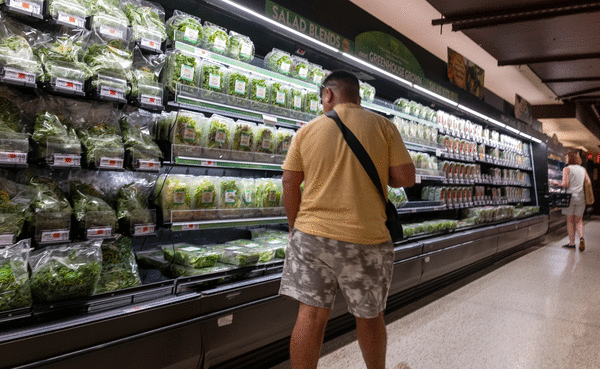
For the last month, Americans have viewed their lunchtime salads or even a single, crisp leaf of iceberg on their burger as a possible threat. Could it harbor cyclospora, the explosive-diarrhea-causing parasite that by early August had sickened thousands, hospitalized hundreds, and led to two deaths?
In Michigan, the epicenter of the cyclospora outbreak, cases are on the downturn, yet our national fear persists. It didn’t help that the Centers for Disease Control and Prevention recently widened the scope of the outbreak to 15 states (a move that is more about retrospective detective work than some new surge in infections). Nor is it comforting that the root cause of the outbreak — that is, how the suspected tainted lettuce was contaminated — is still a mystery. Adding to the chaos is a separate recall of products containing potentially salmonella-tainted jalapeños distributed by Taylor Farms, the same company implicated in the cyclospora outbreak.
Americans are rightly overwhelmed and confused. When can they feel safe throwing a bag of lettuce in their grocery carts again?
Probably about now. Michigan health officials recently said people could go back to their normal produce handling habits, and food safety experts told me the tainted products should be well out of circulation. Kyle Diamantas, acting commissioner of the Food and Drug Administration, reiterated that message to CNBC: “Americans should feel confident in eating fresh produce including leafy greens at this point.”
Still, getting consumers to understand the state of their salads, not to mention trust health officials’ messaging, reflects a larger truth of foodborne outbreaks: Finding definitive answers is still a clumsy, challenging process that desperately needs investment to improve.
It also underscores the need to squeeze as much information as possible out of this latest situation so that public health officials and regulatory authorities can do better next time around — not only to contain the damage before infections get so widespread, but to ensure consumers have a clearer sense, in real time, of how to minimize their risks.
Perhaps the biggest lesson for US consumers is that a large, complicated food chain, which allows Americans to enjoy inexpensive produce year-round, has consequences. The prime suspect in the cyclospora outbreak is iceberg lettuce from a grower in Mexico that supplies Taylor Farms, one of the largest distributors of fresh-cut produce in North America. When a problem filters through such a giant supplier, it can affect many people across many states and create a traceability nightmare.
That’s not a new lesson, but it’s one Americans have a habit of forgetting once the latest bout of foodborne illness has subsided. This time around, consumers discovered that the same lettuce that had tainted their Taco Bell orders also was sold to many other restaurants, and from a distributor whose packaged salad mixes were on the shelves of many grocery store chains. Information trickled out slowly, and parsing which products posed an actual risk and which might be safe to eat felt downright impossible, leaving many people to chose to avoid leafy greens altogether.
Speed is of the essence in an outbreak. The first goal is to prevent illnesses by quickly getting tainted product off shelves and out of kitchens. But any delay in tracing a contamination back to the source also make it harder to pinpoint its cause, lowering the chances that food safety experts can suggest changes that might prevent the next outbreak.
Researchers want to know where the problem began so they can teach farmers better growing processes for the future. That requires knowing whether the pathogen was introduced in the water used to irrigate crops, accidentally sprayed on plants, circulated through the water used to wash the lettuce, or if it might have surfaced through a contamination on adjacent property, explains Kalmia Kniel, an expert in microbial food safety at the University of Delaware.
In the case of cyclospora, so much time has passed between when infections began and the farm in Mexico was identified as the likely culprit that it’s possible we’ll never know the root cause.
Tracing back cyclospora to the source was always going to be a challenge. The long lag between when someone eats some bad lettuce and when they show symptoms is a huge headache for public health investigators trying to identify what’s making people sick.
And this parasite is trickier to trace than more common foodborne pathogens. When an outbreak is caused by bacteria like E. coli, scientists can match the genetic signature of the bug causing a human’s infection to that of the bacteria found on a food sample or on a farm. Importantly, they also can use whole genome sequencing to link human infections together to show an outbreak is coming from one source rather than several, explains Craig Hedberg, co-director of the Minnesota Integrated Food Safety Center of Excellence.
It's currently hard to do that kind of quick genetic analysis with cyclospora. Amid an outbreak, “we can’t really know if there’s one thing or 10 things going on,” Hedberg says. That longer process to make connections likely contributed to the public’s confusion in the current outbreak, as states were tied to the broader problem only after infections were dying down in Michigan and the contaminated product was reportedly already out of the food chain.
Improving the detection technologies will require investment — something health agencies must prioritize if we have any hope of acting faster the next time around.
Meanwhile, some of this confusion could have been alleviated by a new FDA policy that requires companies to keep closer track of how food moves through the supply chain and speeds up the deadline for reporting that data. Infuriatingly, that food traceability rule was meant to take effect this past January, but was delayed under industry pressure until 2028.
The FDA’s Diamantas has repeatedly assured Americans that the US has “the safest food supply in the world.” Even if that’s true, it certainly doesn’t feel that way to Americans contemplating their choices at the grocery store or their local fast-casual chain. This outbreak is laying out a blueprint for health agencies to do better. Now let’s hope they act on it.
____
This column reflects the personal views of the author and does not necessarily reflect the opinion of the editorial board or Bloomberg LP and its owners.
Lisa Jarvis is a Bloomberg Opinion columnist covering biotech, health care and the pharmaceutical industry. Previously, she was executive editor of Chemical & Engineering News.
©2026 Bloomberg L.P. Visit bloomberg.com/opinion. Distributed by Tribune Content Agency, LLC.



















































Comments