Commentary: Trump has the power to save 13 men who face prison again
Published in Op Eds
I know what it’s like to walk out of prison believing your debt has finally been paid.
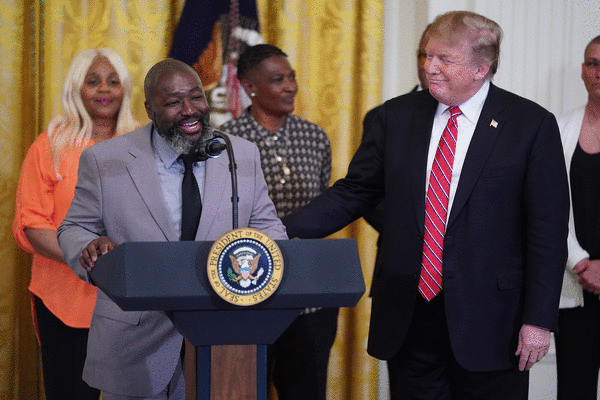
I served time, as I should have. And in a twist of remarkable fate nearly a decade ago, I went back to prison after earning my release. At the time, my unique situation didn’t fall through the cracks of our legal system, like many do. It became a national cause, and I became the first man freed by the passage of the landmark First Step Act.
Today, 13 people face the terrible fate of walking in my shoes. They have become ensnared in a legal quagmire because of a new U.S. Supreme Court ruling. For them, as it was for me, their only path to freedom is in the hands of President Donald Trump.
I served 22 years in prison for drug crimes that required mandatory minimum sentences that were so extreme, they no longer exist under today’s laws. When Trump signed First Step Act legislation, it finally ended my return to prison. The landmark bill was so significant that I joined Trump at his State of the Union address not long after my release.
After lengthy legal processes and clear demonstration of their rehabilitation, federal judges determined 13 others also had extraordinary and compelling reasons for reduced sentences. But because of the Supreme Court’s recent decision in Rutherford v. United States, the legal foundation for their release is now gone, and they could go back to prison to complete much longer original sentences, like I almost did.
They deserve to stay where they are, at home with their families. They are sons, fathers and grandfathers. They cook dinners, they work, they pray. Clifford Darden was just elected deacon of Abundant Life Ministries. Damian Smith volunteers for his congregation, Free Will Deliverance Praise Outreach Ministries. These souls are living in the steady, grounding rhythms of a life reclaimed.
There are few experiences more devastating than having your freedom restored only to be told to pack your belongings, say goodbye to your loved ones and return to a prison cell. I wouldn’t wish it on anyone.
Fortunately, our system has always recognized that the law alone cannot account for every circumstance. That’s why the Constitution gives the president clemency power.
Trump has the constitutional authority to grant clemency to these 13 men, and due to the Supreme Court ruling, clemency is their last and only hope. As someone who has had the incredible honor to attend the State of the Union as a guest of Trump’s, I know how his words can change a life.
Thoughtful leadership in the criminal justice system — including the landmark First Step Act — helped change so many lives like mine. It showed the country that conservatives can lead on criminal justice reform without compromising public safety.
While the Supreme Court has clarified the law, clemency would recognize that mercy has a meaningful place in our justice system as well. Mercy is not a rejection of justice. Mercy is a part of justice.
None of these people or their families are asking for a free pass. They have already served time, in some cases decades, in federal prison. They have done the hard work of rebuilding their lives. They are proud to contribute to our communities.
Their unique circumstances force us all to ask: Are these free souls still a threat to public safety? Does our nation believe that a person can be redeemed? Does our nation believe in mercy?
I know what it’s like to feel the grace of a second chance at a time my case felt impossibly lost in our legal system. I hope that I’m not the only one. Keeping these 13 people home would affirm that when people earn a second chance, our country will keep its promise.
____
Matthew Charles was the first person to be released from prison under the First Step Act and currently serves as an advocate with Families Against Mandatory Minimums, known as FAMM.
____
©2026 Chicago Tribune. Visit at chicagotribune.com. Distributed by Tribune Content Agency, LLC.


















































Comments