Commentary: Will cynicism keep us from recognizing our next statesman?
Published in Op Eds
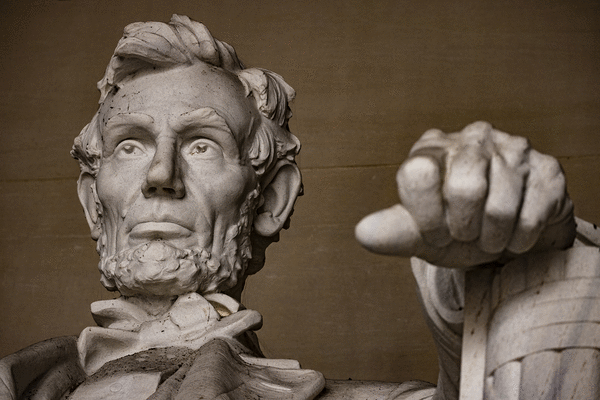
As a people, have we become too cynical for our own good? We live in an age where we routinely assume that all politicians have the worst motives, that they are driven by self-interest and that they are dishonest and/or corrupt.
It’s our default attitude. And we are not always wrong. There are certainly politicians like this, but not everyone in politics has such low motives. We shouldn’t be naïve, of course, but our extreme cynicism hurts us in the end. Most importantly, it can keep us from recognizing statesmanship when it appears.
Why are we so cynical? Clearly, part of the reason is that President Donald Trump has for years been telling us that the political system is rigged, judges are partisans, the media are fatally biased, and everyone who disagrees with him is an enemy of the people. We can’t blame all of our cynicism on Trump; it was already here when he arrived on the political scene. Social media also plays a major role in promoting cynicism. The turning point in America, the moment when cynicism became respectable and even admired, was in 1913, when Charles Beard’s “An Economic Interpretation of the Constitution” was published.
Beard argued that our Founders were not men of principle doing their best in an imperfect world to fashion a great Constitution. Rather, they were narrow, self-interested politicians, hoping to consolidate their wealth. His book has had an enormous effect on how politics is viewed in America, despite historians showing that his methods were shoddy and his conclusions incorrect. The damage to the public psyche was done. In spite of scholarly rejection of Beard’s analysis, his cynical view survived. Beard invited us to think poorly about our Founders, and we accepted his invitation.
The problem is that cynicism closes our minds. As Alain Van Hiel and his colleagues point out in Advances in Political Psychology, “politically cynical people show low trust, and they generally have active, overt negative feelings towards and negative expectations about the intentions and actions of politicians.”
If we continue to embrace cynicism, political polarization will increase, and it will become increasingly more difficult to find a way through our current political challenges. If we really believe that everyone is out for himself, then social trust and respect for the law disappear. We are left with political nihilism. And we will turn our backs on true statesmen when they emerge, and they will.
What are statesmen? This traditional term (which applies to men and women) is those rare public officials who transcend the ordinary in politics. They are exceptional individuals. Most people get involved in politics because of their love of power, status and the benefits they can accrue from their positions. From time to time, a truly great person emerges and casts political life in a new light, in the pursuit of the common good.
Abraham Lincoln and Winston Churchill come to mind. These were not perfect people; they had their own flaws and even their demons. However, they were remarkable human beings. In a sense, they were teachers first. They each sought to reframe their nation’s common understanding of the challenges they faced — Lincoln by turning to the Declaration of Independence to confront the evil of slavery, and Churchill by turning to his deep understanding of history to rally his country to stand up to Nazism. Much of their contribution was in promoting and explaining fundamental ideas to the average person, ideas about which there was little clarity until they came forward.
Statesmen also have a special gift: prudence or practical wisdom. They have the ability to understand not only what is best for the nation but, at the same time, to know that the best can never be achieved. They seek only the best possible, given current conditions, attitudes and political constraints. This means that statesmen do not shun compromise with opponents. This is not a sign of weakness or lack of principle; it is an indication that they understand that the perfect is the enemy of the good. They have both moral clarity and political flexibility.
As a people, we need to transcend thoughtless cynicism and embrace what I would call a mature optimism, which means that our eyes are open to the low motives of most politicians but that we also know that some men and women can offer more.
We need to think critically, not cynically. If we don’t believe that statesmanship is possible, we won’t welcome it when it appears. We can’t allow extreme cynicism to determine our future. We deserve better than that.
____
ABOUT THE WRITER
Solomon D. Stevens is the author of “Religion, Politics, and the Law” (co-authored with Peter Schotten) and “Challenges to Peace in the Middle East.” He wrote this for InsideSources.com.
_____
©2026 Tribune Content Agency, LLC.
















































Comments