Commentary: Just like in the film 'The Dink,' pickleball was the best medicine for my husband
Published in Op Eds
If you aren’t among the millions of pickleball players, the fastest growing sport in America, watch “The Dink” on Apple TV to get a glimpse of what you’re missing.
Jake Johnson plays Dusty, a former tennis prodigy whose career was thwarted early when he broke his wrist during a match with the for-real tennis star Andy Roddick. Now he teaches children at his father’s elite tennis club. In what his dad (Ed Harris) calls the decline of humanity, the club is being encroached on by pickleballers clamoring for more courts.
The film captures the friction between tennis snobs and the more democratic pickleballers while examining father-son relationships and intergenerational friendships. More importantly, it reveals the heart of what creates an intimate pickleball community.
The underhand serve, smaller court, fast-learning curve and slow-moving plastic ball make it a more egalitarian game. Women compete with men without having to be Billie Jean King or Aryna Sabalenka. Younger players partner with older ones. Grandparents can play with their grandchildren.
Many join after personal trauma, such as divorce, widowhood, injury and illness.
In the film, Dusty reinjures his wrist, and his doctor (Ben Stiller) prescribes pickleball to promote healing. He joins a group in which a recently divorced woman played by Mary Steenburgen and two other 70-year-olds teach him the rules and the culture.
Four years ago, my husband, Dean Skylar, a lifelong tennis player, was diagnosed with cancer. He joined a pickleball club, allowing him to continue to play a sport though he was weakened physically.
The joy found in the game fosters enduring relationships outside of it. Members of Dean’s group cruise together, hit happy hours, dine for lunch and dinner. They play mahjong twice a week. We even celebrated Christmas dinner with them.
His pickleball family walked closer with him than some biological family members, longtime friends and even his religious leader.
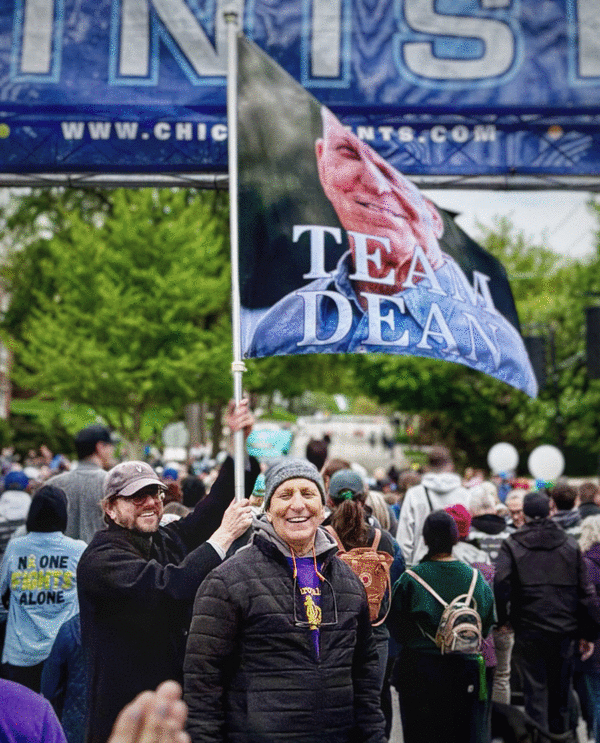
Over 40 of them joined him in a 7 a.m. 3K fundraising walk in May to raise money for Wellness House, a nonprofit cancer caregiving facility that Dean supported fervently. When he was hospitalized for 25 days that same month, they visited, called, texted, sent photos, brought flowers and food. They took him for walks in the hospital corridors. They shared updates via group texts and checked in with our daughter — many of them integral to her own pickleball learning.
Just before a surgical procedure, one in the group directed a video in which pickleball family members described their feelings for Dean, how they were praying for his well-being and waiting for him to join them again on the pickleball court.
He watched it moments before the surgery and said it uplifted his soul.
They organized and hosted a tournament in his honor to raise additional funds for Wellness House while he watched from the bench — talking smack and offering well-intentioned but snarky critiques like always. For Team Dean, they erected signs and balloons, brought home-cooked meals to share and displayed a cake with his likeness.
He entered home hospice early in July. The flowers, food and prayers continued.
They made potstickers in our kitchen. One brought him a beer and Triscuits. Another dropped mac and cheese and stuffed peppers at our door. There were lots of hugs and tears.
When he lost his ability to make it upstairs and even shuffle around with his walker, a friend insisted he go for a drive in a 2000 Jaguar convertible, where they stopped by a nearby preschool to see our 5-year-old grandson who grabbed Dean’s hand for the last time for a photo-op.
It was Dean’s final time upright.
Through pickleball, Dean discovered a new family — one that offered love, support and joy during the last and most challenging chapter of his life. While he began as a tennis player facing a cancer diagnosis, it was the camaraderie, compassion and laughter on the pickleball courts that carried him through his illness.
In his final days, Dean tried to get rid of as many loose ends as possible. He sold his beloved car and canceled credit cards and vacations. He insisted I get my own Costco card. He made plans for the future of all his pickleball paddles.
He watched Wimbledon and called childhood friends to say goodbye. He made room in his hospital bed for me to slip in next to him.
Dean was also actively planning his last act — his memorial. He wanted his service to be held in September, at his favorite pickleball court, of course.
There will be food, a slide show and just a few speeches. Between the pop-pop sound of the balls, a DJ will play classic rock songs, including Iron Butterfly’s 17-minute “In-a-Gadda-Da-Vida,” which he repeatedly cited as one of his favorite tunes.
There will be no mourning attire, only athletic wear. Pickleball was his church, its community, his congregation. We will be celebrating. And maybe swearing a little, in his honor.
____
Christine Ledbetter is a former senior arts editor at The Washington Post who lives in Illinois, where she writes about culture and politics.
___
©2026 Chicago Tribune. Visit at chicagotribune.com. Distributed by Tribune Content Agency, LLC.



















































Comments