Commentary: Ukraine has always been here -- and always will be
Published in Op Eds
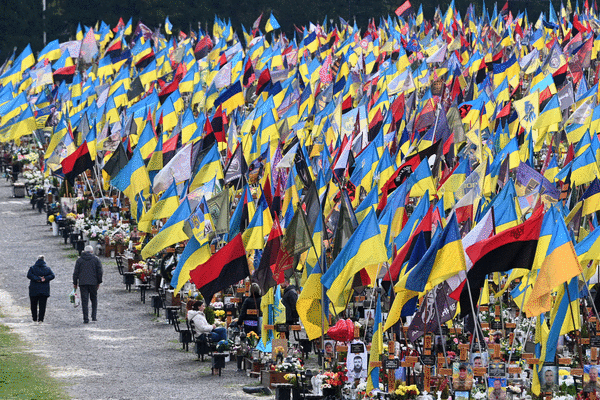
Many historians and security experts agree that Russia’s full-scale invasion of Ukraine, which continues to reshape the world, did not begin on Feb. 24, 2022. It began much earlier, on July 12, 2021, when Russian leader Vladimir Putin published his essay “On the Historical Unity of Russians and Ukrainians,” arguing that Russians and Ukrainians are “one people” and portraying Ukraine as an artificial state. Many analysts have since viewed that essay as an ideological blueprint for the invasion that followed.
Ukraine’s history tells the facts. We were here. We are here. And we will remain here.
The reality is that Kyivan Rus was not Russia. Kyiv flourished as a powerful center of political, cultural and religious life and accepted Christianity in 988. Moscow first appears in historical records as a medieval frontier town in 1147. Ukrainian is a separate language, not a Russian dialect; in fact, Ukrainian and Russian are more different than Spanish and Portuguese. Ukraine has its own culture and political tradition. Ukraine strived for independence during the Cossack Hetmanate and again in 1918 after World War I.
For centuries, Russian rulers repeatedly tried to ban the Ukrainian language and suppress the very identity Putin claims never existed. Millions of Ukrainians died during Josef Stalin’s forced collectivization and the Holodomor famine of 1932-33. In Ukraine’s all-national referendum on Dec. 1, 1991, 90.3% voted for independence, with a majority in every region of Ukraine, including Crimea. Ukraine is a recognized member of the United Nations. In March 2022, 141 countries supported a resolution deploring Russian aggression and demanding that Russia withdraw its forces.
The human consequences of Putin’s latest imperialistic campaign are staggering. The Russian military suffered nearly 1.4 million casualties and 450,000 deaths since its full-scale invasion began. Ukraine has seen over 525,000 casualties and 125,000 fatalities. Impacts to civilians across Ukraine are daunting: There have been over 65,000 civilian casualties and displacement of people, and massive damage to infrastructure impedes humanitarian and emergency response efforts. Plus, utility disruptions cut off access to electricity, running water and heat.
For the global economy, Russia’s war compromised the global supply chain for fuel and food, exacerbating post-pandemic inflation pressures.
Imperialists do not conquer through force alone. They rewrite history, erase historical memory and reshape how a nation views its past and future. Today, Ukrainians defend the universal principle that no nation should be destroyed because a more powerful neighbor claims it has no right to exist. Today, Ukrainians are not simply defending territory on the battlefield. Ukraine’s fight is also taking place in classrooms where children learn the truth instead of propaganda. It is taking place in museums that preserve evidence instead of ideology. It is taking place in truth-sourced and responsible journalism.
Putin’s lies threaten more than Ukraine — if we allow him to erase history, we undermine democracy everywhere.
Russia has bombed churches, museums, libraries, schools and archives. It understands that if memories disappear, identity becomes easier to erase. Destroy a people’s culture, and eventually you can convince the world they never had one. That is why museums have become unexpected front lines. The Ukrainian National Museum in Chicago, together with our partners and peer institutions across the globe, stands against that assault.
Ukrainian immigrants first arrived in the U.S. 150 years ago and have strengthened our communities through service, entrepreneurship, innovation, education and civic leadership. Today, we and our neighbors are raising humanitarian aid, welcoming refugees, supporting and healing soldiers, preserving history and reminding the world that freedom is never inherited — it is defended.
That is why the recent proclamation of August as Ukrainian Independence Month in Illinois matters. It is not simply a celebration of heritage. It is a declaration that Ukraine’s identity cannot be erased, its history cannot be rewritten and its people will not stand alone. Ukraine is fighting for its future — but it is also fighting for a world where truth is stronger than propaganda, democracy is stronger than tyranny and no nation can be erased by force.
Stand with Ukraine. Learn its history and its truth. Support and speak for those defending their homeland.
____
Lidia Pilecky is president of the Ukrainian National Museum in Chicago’s Ukrainian Village neighborhood.
_____
©2026 Chicago Tribune. Visit at chicagotribune.com. Distributed by Tribune Content Agency, LLC.



















































Comments