Andreas Kluth: The US ammo crunch is a global disaster
Published in Op Eds
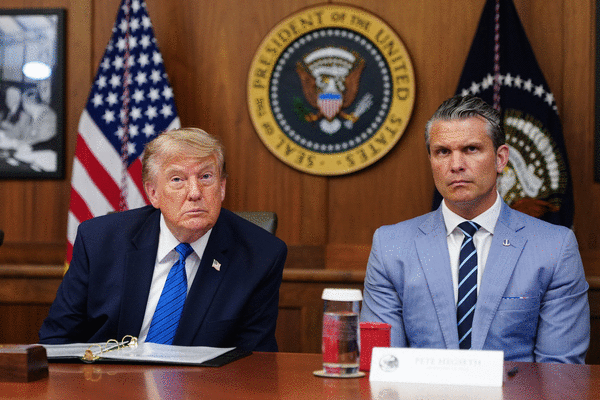
It appears that President Donald Trump is livid at Pete Hegseth. Not long ago the president still cooed that his macho secretary of defense “loves war,” including the one Trump launched in Iran. Now that war is turning out to be unwinnable and seemingly unendable. So Trump, venting his frustration at Camp David, wanted to know why Hegseth misled him by not explaining earlier that America was — who could have guessed? — running out of ammunition.
We should all be mad at Hegseth for overselling “lethality” in general and the war against Iran in particular. But we should be even angrier at Trump, who as commander-in-chief gave the order to start this misguided conflict. Both men could have listened to any number of advisers who would have “red-teamed” scenarios of things going wrong, from Iran closing the Strait of Hormuz to the U.S. depleting its munitions.
The most important adviser, as it happens, did warn specifically about that latter risk. In the days leading up to the U.S.-Israeli attack on Iran in February, Dan Caine, the chairman of the Joint Chiefs and highest-ranking military officer, worried about the scarcity of certain types of ordnance in a prolonged conflict. Trump ignored him.
Now the numbers are coming in, and they’re ugly. As Reuters has reported, the U.S. military has used up “virtually all” of its global stockpile of high-precision offensive missiles. Those include the ATACMS (short for Army Tactical Missile Systems, pronounced “attack ’ems”) and the newer, even more accurate and even longer-range Precision Strike Missiles (PrSM). Tomahawks, which are cruise missiles fired from ships or submarines, are also running low.
It’s the same story for defensive missiles, also called interceptors. The Center for Strategic and International Studies, a think tank in Washington, estimates that the U.S. has used up about two in three of its Patriot missiles and almost half its Terminal High Altitude Area Defense systems. THAAD, as they’re abbreviated, shoot down incoming ballistic missiles in or even outside the atmosphere.
Of course the Pentagon is now leaning on manufacturers, such as Lockheed Martin and Raytheon, to make lots more of these missiles — in a hurry. It will nonetheless take years to replenish the American arsenals.
What, then, are the consequences of this new and unnecessary scarcity? Here’s a partial list, ranging from the tactical to the strategic.
The most immediate effect is to constrain Trump’s options for military escalation if negotiations with Iran, which he claims are happening in the background, don’t go anywhere. (The shortages apparently already contributed to his decision to call off a huge strike he had threatened this month.)
If Trump wants to resume massive bombardment but the military is low on offensive missiles fired from land or sea far away, aircraft would have to deliver the hellfire. But to do that they would have to fly near or over their targets, where the Iranians have better odds of shooting them down. And Trump can’t afford a surge in American casualties, which already number 18 dead and hundreds injured.
The same logic applies to defensive missiles. If Trump escalates, the enemy will retaliate by hitting U.S. bases throughout the Middle East or American allies such as the Gulf emirates or Jordan. With the supply of interceptors limited, the U.S. would have to decide what to protect and, by necessity, what to leave unprotected.
I recently observed a war game organized by the Center for a New American Security in Washington in which participants had to make exactly these decisions. Every trade-off, and every outcome, was grim.
At the strategic level, the Middle East is obviously not the only potential theater of war. The U.S. is expected to have a global military presence. It’s supposed to deter China from attacking Taiwan, say, or the Philippines, which is a U.S. treaty ally. On the Korean peninsula, the U.S. must dissuade the North from even thinking about having another go at the South and reigniting the Korean War (which never formally ended).
And Washington is still, despite occasional appearances to the contrary, the most important member of NATO, so it should be ready to deter Russia — which is already waging hybrid war against European NATO countries — from entering the Baltics, say. Even short of that kind of escalation, the American missile crunch is hurting Ukraine, which was hoping to buy more American weapons with European money to defend itself against Moscow’s constant bombardment. Now there simply won’t be many, or any, left over.
I’m not suggesting that Beijing, Pyongyang or Moscow will look at America’s missile shortages in isolation and give the order to open new fronts in what would then threaten to become a world war. But it cannot have escaped their attention that the U.S., which a French foreign minister once called a “hyperpower,” now looks much diminished militarily: almost out of breath and out of ammo.
Trump, as is his wont, is trying to dismiss reports of his frustration at Hegseth and the munitions crisis as fake news, claiming that “everything has been extraordinary.” The reality, as Kori Schake, a veteran of the National Security Council in an earlier Republican administration, puts it, is that “far from discovering a new way of war, Trump has merely discovered new ways to lose.”
Ammunition stocks are one metric of a catastrophe whose scale is only gradually becoming clear. Trump can have at it against Hegseth and his other minions all he wants. What he should, but won’t, admit is that he has wrought a global disaster.
_____
This column reflects the personal views of the author and does not necessarily reflect the opinion of the editorial board or Bloomberg LP and its owners.
Andreas Kluth is a Bloomberg Opinion columnist covering US diplomacy, national security and geopolitics. Previously, he was editor-in-chief of Handelsblatt Global and a writer for the Economist.
_____
©2026 Bloomberg L.P. Visit bloomberg.com/opinion. Distributed by Tribune Content Agency, LLC.





















































Comments