Commentary: The only communist threat is coming from inside the White House
Published in Op Eds
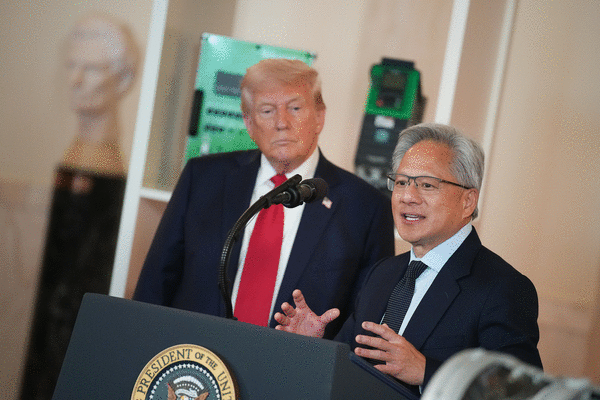
To listen to representatives of the U.S. government lately, you’d think the United States is at imminent risk of a communist takeover. “Communism is the single greatest threat to our country and its history,” President Donald Trump said in a recent speech outside Atlanta.
House Speaker Mike Johnson has likened the midterms to a battle between maintaining the republic, if his party wins, or losing it to communism if it doesn’t. Last month, Secretary of State Marco Rubio claimed it was a “transnational threat,” with the Cuban government conspiring with America’s far left.
It is a well-worn trope in American politics, harking back to the Joseph McCarthy era of the 1950s and the associated “Red Scare.” But why has it returned now? Because, when a party in power is deeply unpopular, it must find another boogeyman to blame for its people’s woes.
Anyone with a vague understanding of communism knows that these claims are disingenuous. But some Americans are susceptible to believing it, particularly those who came of age during the Cold War, when communism was shorthand for our gravest national threat.
The first step to combating disinformation is real information, so here are some facts.
Communism is a political and economic system in which property, means of production and natural resources are collectively owned by the community or state, rather than private individuals, and divided either equally or according to need. The concept was introduced in the 19th century by Karl Marx, who wanted to abolish private property and dissolve class distinctions in order to more fairly distribute resources.
But this concept of communism doesn’t exist in the real world. No countries today are run under communist principles. The five countries that still officially claim to be communist states are China, North Korea, Laos, Cuba and Vietnam. What do they have in common?
All are one-party systems designed to obstruct political competition, and all have varying degrees of state interference in the marketplace. Only North Korea’s government has total control over the economy. The rest have mixed systems with different levels of centralized planning and state control. None are the classless societies envisioned by Marx. Instead, most have privileged political classes tied to the ruling party that benefit disproportionately from the state’s economic control. Communist states today are more corrupt than communal.
Democratic socialism is a different political philosophy entirely. The broad movement has many interpretations, but all versions promote a robust democracy to make government accountable to the people, a mixed economy where the government ensures that utilities and services that are essential for human well-being are managed for society rather than for profit, and a strong social safety net. The democratic socialism growing popular in the United States today basically seeks the social support most European countries offer. Affordable healthcare, energy and public transportation are hardly a threat to our democracy.
If there is a communist threat clawing its way into the halls of American power, that threat is coming from inside the White House, which has interfered with the free market not for social benefit but to strengthen its own centralized power.
The Trump administration has engaged in an unprecedented campaign of government meddling in business affairs. It has leveraged the threat of regulatory consequences to press dozens of private companies into giving the government equity stakes in their businesses, from semiconductors and nuclear energy to minerals and steel, as The New York Times has reported. A shareholder of Intel has already brought a lawsuit claiming that the Trump administration secured its 10% stake in that tech company through extortion.
In each of these cases, the federal government is now both the regulator and a shareholder, raising questions about whether commercial competitors in important U.S. industries still have a level playing field and whether regulatory action will continue in the interest of the public or of profitability. As one example, the price for regulatory approval of Nvidia’s advanced chip sale to China was to give a cut of the revenue to the government. Trump may gloat about the earnings, but that did nothing to address the very real national security concerns with handing our greatest adversary a leg up in the artificial intelligence race.
But state economic control isn’t the only lesson Trump has taken from states such as China. He aspires to a noncompetitive political system with centralized authority too. Trump has pushed aggressively for gerrymandering to dilute the electoral power of his political opponents, even punishing members of his own party who declined to pursue it, and he is bullying a reluctant Congress to pass the SAVE Act to raise barriers to voting. According to Trump, that law would ensure that Republicans would “never lose” an election again. In an interview this year, he said midterm elections shouldn’t happen either.
Like China’s Xi Jinping, Trump believes his power should be absolute. That may not reflect communist philosophy, but it does reflect the flavor of governance that most so-called communist states offer today. In that case, we may face a communist threat, but it isn’t coming from the foes of this administration.
_____
Elizabeth Shackelford is a senior adviser with the Institute for Global Affairs at Eurasia Group and a foreign affairs columnist for the Chicago Tribune. She is also a distinguished lecturer with the Dickey Center at Dartmouth College. She was previously a U.S. diplomat and is the author of “The Dissent Channel: American Diplomacy in a Dishonest Age.”
_____
©2026 Chicago Tribune. Visit at chicagotribune.com. Distributed by Tribune Content Agency, LLC.

















































Comments