Lisa Jarvis: Trump's vaccine order puts parents in a bind
Published in Op Eds
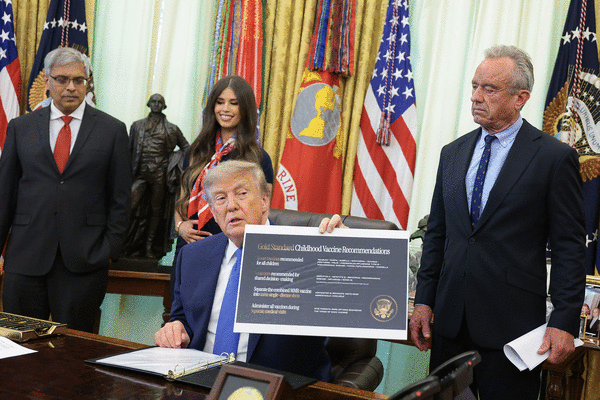
President Donald Trump’s proposed sweeping changes to the childhood vaccine schedule, whether ever actually implemented or not, are yet another affront to public health in the U.S.
No new evidence is being offered to justify the proposed overhaul, which arrived via executive order on Monday and calls for cutting back the number of vaccines children receive and instructing states to review their immunization laws — probably because there is no new data to support it. Instead, the change is being pushed forward in the name of protecting parental authority, while likely making it harder for parents to protect their kids from preventable diseases.
Trump’s biggest preoccupation seems to be with the U.S.’s approach to vaccination against measles, mumps and rubella. The long-used MMR shot, which combines three vaccines, should be replaced with separate shots given at separate times, Trump said in a press conference.
Trump first floated the idea of breaking up the MMR vaccine into shots for each virus back in September, during a press conference ostensibly held to unveil new insights into autism. “This is based on what I feel,” he said at the time. “It seems to be that when you mix them, there could be a problem. So there's no downside in taking them separately.”
It's unclear what the president’s feelings were predicated on, but it’s certainly not the advice of infectious disease researchers, epidemiologists or pediatricians. In fact, experts see plenty of downside — and no upside — to separating the shots. That’s because studies in the U.S. have shown that combining vaccines into a single shot can significantly improve the rate of uptake.
Childhood vaccines are backed by decades of science. Researchers by now have reams of data to support their safety, and more reams of data proving they prevent the spread of disease and save millions of lives.
Similarly, the schedule by which they are administered is the product of careful research and input from a wide range of stakeholders, from pediatricians to U.S. public health experts.
Trump’s executive order seeks to align the U.S. with the practices of peer nations, yet most of the countries being held up enjoy some form of universal health care. As I’ve written before, the financial equation for vaccination versus treating a disease changes slightly when everyone has access to free care. People don’t tend to put off a doctor’s visit when they’re sick (and contagious) or forgo preventive care, and so some countries might decide not every child needs certain shots.
In the U.S., the recommendations of vaccine advisors are meant to ensure shots are accessible and affordable to every corner of our complicated healthcare system. The goal is to maximize uptake and quash outbreaks before they begin.
Trump threw those careful considerations out the window when he offhandedly noted that his proposed changes mean children now will get vaccines across five separate visits in a year instead of just one.
That groan you hear? That’s the sound of working parents everywhere imagining the scramble to get their frequently needle-fearing kids to all of those unnecessary appointments. Already stretched pediatricians, meanwhile, are surely gathering somewhere for a collective primal scream. Worst off are the moms and dads who don’t get paid time off, don’t have easy transportation to the doctor’s office and will no doubt worry about paying for each of those separate visits.
That’s what makes this cavalier attempt to overhaul to the vaccine schedule so dangerous: children would easily fall through the cracks.
Anyone tempted to take comfort in the fact that these changes likely aren’t legal — Trump can’t simply change the schedule, and earlier efforts by Health Secretary Robert F. Kennedy Jr. to upend it have been repeatedly shot down in court — should still worry about the chaos and confusion the order will sow.
Trump’s press conference was filled with gross misinformation and false promises. When describing the MMR vaccine currently in use, he wrongly claimed the combined shot could be “quite lethal,” but that separate vaccines “are not at all lethal, but just very effective.
And he and Kennedy might not have directly reiterated the thoroughly debunked claim that vaccines cause autism, but the implication was clear. Both suggested that rates of autism had risen with the number of childhood vaccines given each year and that this overhauled schedule thus would bring down autism rates.
The U.S. is already witnessing the consequences of nearly two years of their anti-vaccine falsehoods. With five months left in the year, measles cases have already hit a 35-year high, and the U.S. is expected to soon lose its elimination status. The question is how much worse Trump’s executive order will make this trend—and whether measles will just be the start of the preventable diseases we allow to let rip.
____
This column reflects the personal views of the author and does not necessarily reflect the opinion of the editorial board or Bloomberg LP and its owners.
Lisa Jarvis is a Bloomberg Opinion columnist covering biotech, health care and the pharmaceutical industry. Previously, she was executive editor of Chemical & Engineering News.
©2026 Bloomberg L.P. Visit bloomberg.com/opinion. Distributed by Tribune Content Agency, LLC.

















































Comments