Editorial: Democratic socialist -- 'Anti-Zionist' isn't antisemitic. Jewish voters know better
Published in Op Eds
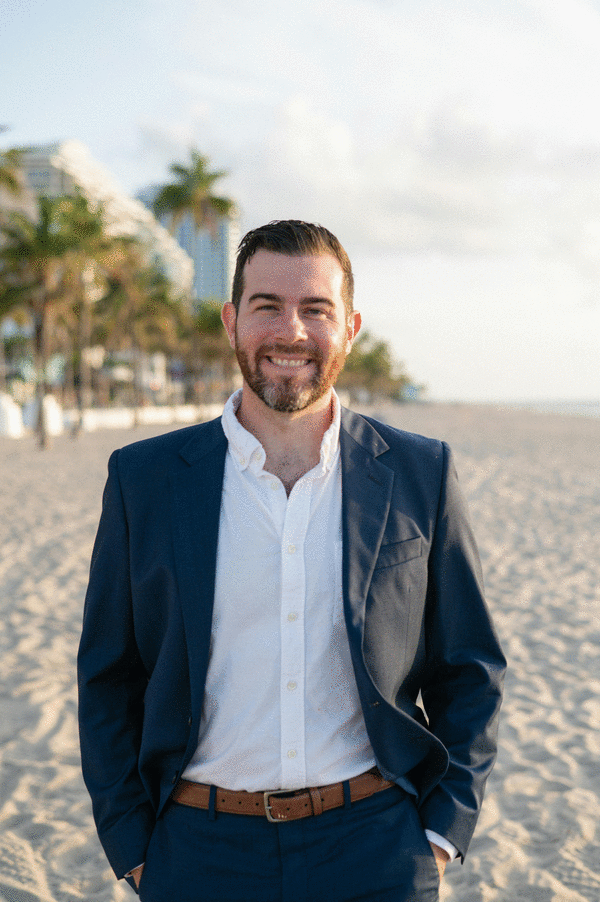
To hear candidate Oliver Larkin define himself as “anti-Zionist” is jarring — and that’s an understatement — as he runs in a Democratic primary to represent a South Florida congressional district that’s roughly 25% Jewish, one of the largest concentrations of Jewish voters in the country.
Larkin is part of a growing faction of the Democratic Party that’s fairly novel in South Florida: He is a democratic socialist who, if elected to Congress, would advocate for cutting off U.S. aid to Israel and imposing an arms embargo on the country, he told the Herald Editorial Board during an endorsement interview.
We endorsed his opponent, U.S. Rep. Jared Moskowitz, in the Aug. 18 Democratic primary to represent District 25, an area stretching from Miami Beach to Delray Beach.
Political candidates should be able to criticize the Israeli government’s actions in the war in Gaza and debate U.S. support for the nation’s military without being labeled antisemitic. But anti-Zionism is a dangerous extreme. Its growing popularity cannot be untangled from the rise of antisemitism in the U.S. and calls for the destruction of Israel.
Anti-Zionism opposes the movement for the self-determination and statehood of the Jewish people in their ancestral homeland. The Zionist movement began in the 1800s in Europe as Jews sought an alternative to thousands of years of persecution against them and culminated with the creation of Israel in 1948 after the Holocaust.
Larkin said he does not consider anti-Zionism to be antisemitic. But that’s disingenuous. He must know full well that many, or even most, Jews see anti-Zionism as a less-obvious but still potent form of antisemitism. He may try to add his own spin to the term, but it remains offensive and is a dog whistle that, no doubt, appeals to antisemites.
Uninformed voters, in particular young ones, may assume that labeling themselves anti-Zionist is a way to support Palestinian rights. But people running for office should know better: The label means that “Jewish people don’t have the right to live in their homeland,” Josh Sayles, vice president of external affairs at the Greater Miami Jewish Federation, told the Editorial Board.
“There’s very little distinction” between antisemitism and anti-Zionism, Sayles added.
Larkin, 34, told the Board he’s not opposed to Jews but to a “Zionist project that is repressing people” and pointed to accusations by international groups that Israel committed human rights violations in Gaza. He said he’s against any religious state, whether it’s Israel or Saudi Arabia.
Larkin also said he rejected support from the Anti-Zionist America PAC because he believes the political committee engages in antisemitism — that’s “something that I’m not willing to tolerate in any manner of speaking whatsoever.” But Larkin sees no problem with letting controversial far-left influencer Hasan Piker — who has been criticized for using antisemitic language — host an online fundraiser for him.
In recent years, there’s been debate over whether Israel critics can be anti-Zionist without being antisemitic — and some argue that “it’s increasingly absurd to treat the Israeli state as a stand-in for Jews writ large,” as New York Times columnist Michelle Goldberg wrote in 2018. But after the Oct. 7, 2023, Hamas terrorist attacks and American Jews’ concerns about their safety in this country, we must wonder why any candidate running for Congress would insist on using a label that antisemites also like.
Anti-Zionism is especially hurtful to Jewish voters “because it evokes a whole world of persecution that goes back thousands of years,” said Haim Shaked, director of the University of Miami’s Sue and Leonard Miller Center for Contemporary Judaic Studies. He said if anti-Zionists are going to question Israel’s existence in the name of human rights, they should also question the existence of other countries, like Iran or China, based on human rights violations.
American support for Israel has divided the Democratic Party in primaries across the country. In Michigan, Democratic U.S. Senate nominee Abdul El-Sayed has also been characterized as an anti-Zionist. Among Republicans, Israel is also losing support, particularly with young voters.
We don’t believe people who oppose actions by the Israeli government should be immediately discredited as anti-Jewish. Even the Anti-Defamation League says such criticism isn’t necessarily antisemitic, but the organization also says anti-Zionism is different because “it attacks the foundational legitimacy of Jewish statehood.”
There is an insidious danger here. Some voters may not fully understand the creep toward antisemitism that can occur when we allow offensive terms to become normalized. But Larkin and other candidates certainly should.
_____
©2026 Miami Herald. Visit at miamiherald.com. Distributed by Tribune Content Agency, LLC.




















































Comments