Commentary: Not all change is good -- Medicaid, Medicare shifts are everyone's problem
Published in Op Eds
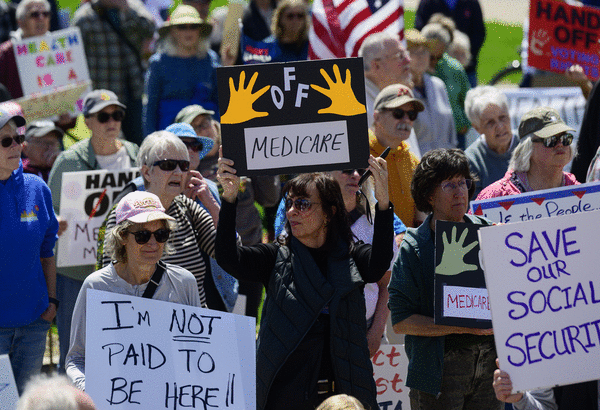
Like 155 million other Americans, I get my health insurance coverage through my employer. The millions like me who are not on Medicaid or Medicare may not be closely tracking the massive changes coming to public insurance programs because of H.R.1 (also known as President Donald Trump’s “One Big Beautiful Bill Act”).
But over the next decade, it’s estimated that up to 10 million people may lose health insurance because of changes to Medicare and Medicaid.
And everyone is going to pay for it.
As Associate Chief Medical Officer of Covered California, I witness that health insurance coverage gains since the Affordable Care Act have resulted in more affordable healthcare, better health outcomes across a variety of conditions such as cancer and substance use disorder and saved tens of thousands of American lives.
In California, the uninsured rate dropped from 18% before the ACA to below 6% in 2024. Longstanding evidence shows that higher rates of health insurance coverage mean that more people have a front door to the healthcare system, access preventive and primary care, are protected against catastrophic costs from accidents or major diagnoses and are more likely to get the care they need for chronic conditions.
Unsurprisingly, the opposite is true when people lose health insurance coverage. Access to primary care and preventive services are standard and free across health insurance plans thanks to the ACA. Without health insurance, people seek care later, when they’re sicker, and where it’s more costly — in the emergency room.
Before the Affordable Care Act took effect and expanded health insurance access, I was a first year Internal Medicine resident working in the ICU. A woman in her 40s was admitted with a tumor visibly bursting out of her chest.
She had a cancerous breast mass that had grown so large and so destructive it had started to bleed, and the bleeding was finally what prompted her to go to the emergency room. She required extensive hospital care, and had very advanced cancer that, by the time she came to the hospital, could no longer be cured.
When I asked her why she hadn’t come in sooner she said she had nowhere to go and no way to pay for it. Since she had no health insurance coverage, she had ignored the tumor on her body until it had started to weep.
When people without insurance seek care in emergency rooms, emergency rooms are required to care for them, even though no insurance company will pay the hospital for this care.
When doctors and hospitals can’t get reimbursed enough to cover costs for patients without insurance, they rely on public funding sources to fill in the gap. With H.R. 1, these federal funding sources are being stripped away.
If they’re not already doing so, doctors and hospitals may shift their gaze toward commercial health insurance companies to make up these costs. They may be forced to cut services, making it more difficult for those of us with insurance to access care.
On the one-year anniversary of its passage through Congress, over 1 million Californians are projected to lose insurance coverage in 2027 as H.R.1 changes take effect. As a doctor, I fear a regression back to that time in the ICU when patients came in seeking treatment later, when they were sicker.
And as someone with health insurance, I recognize that companies will need to find money to cover the costs for those people. Although H.R. 1 was designed to impact insurance for people with low incomes or certain immigration statuses, the cost will be all of ours to pay.
This issue may seem less pressing for Americans whose employers cover the cost of their health insurance or for those with very high incomes. But even the current healthcare workforce is stretched thin and there are only so many doctor’s offices and hospital beds to go around.
If they cannot keep their doors open, there won’t be anywhere left to go.
And even though they’re paying more each year, a shocking number of people don’t take advantage of the health insurance coverage they have. One in five people with commercial health insurance coverage don’t use it at all-- not one doctor’s visit, flu shot, medication fill, or screening test. And for young men age 18-34, that increases to one in three.
Blood pressure screenings, cancer screening tests, and annual preventive visits are $0 with health insurance, thanks to the Affordable Care Act, but Americans aren’t getting their money’s worth. To hold health insurance companies to account, and to make sure that Americans are getting the value they deserve and the care they need, the easiest, cheapest thing to do is take advantage of the coverage they have.
With changes due to H.R. 1 looming, it’s especially important to vote in November and to understand the consequences today. Though the changes may not have been aimed at all Americans, the cuts to healthcare access and coverage will have a ripple effect on us all.
____
Barbara Rubino is the Associate Chief Medical Officer at Covered California and a Public Voices Fellow on Public Health with The OpEd Project and Blue Shield California Foundation.
_____
©2026 The Fulcrum. Visit at thefulcrum.us. Distributed by Tribune Content Agency, LLC.





















































Comments