Editorial: What happened to our collective reverence for death?
Published in Op Eds
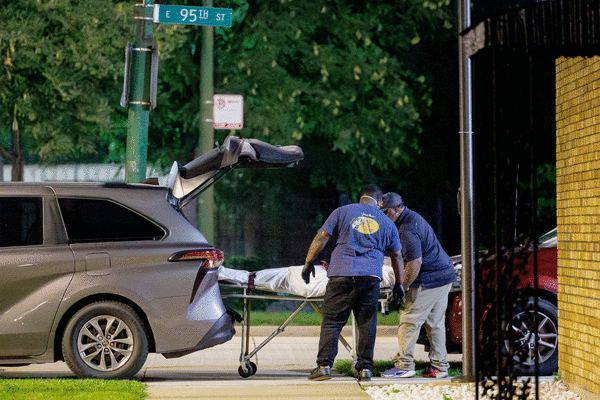
Few things are as shocking to living people as corpses decomposing in the summer heat.
But that is what apparently occurred inside a funeral home on the city’s Southeast Side when more than 50 human bodies were discovered inside the South Chicago Chapel funeral home in the 2900 block of East 95th Street, following complaints from neighbors about a strong odor. That particular funeral home had sold itself as being “here to guide families through one of life’s most difficult moments with compassion, dignity, and care.”
The investigation has only just begun, but it would appear that the home’s promises were hollow. To say the very least.
We offer our condolences to the bereaved Chicago families for whom this must have been unspeakably upsetting news.
Funeral homes are subject to state regulation for numerous good reasons, one of which is that the customers thereof, the families of Chicagoans who die, are not in a position to know what subsequently happens to their loved ones’ bodies. People pay their money to funeral directors — often with considerable hardship, especially in low-income neighborhoods — and then trust that respect for their wishes will guide whatever happens next. Families want their beloved to rest in peace.
This hardly is the first instance of the betrayal of that trust.
In 2025, investigators discovered 125 bodies inside a Colorado funeral home called Return to Nature, which allegedly had not sent the bodies to a crematorium as families had been promised but had pocketed the money and seemingly sent those families fake ashes derived from concrete. There are numerous other examples from both near and far.
In the case of what happened in Chicago Thursday, it appears that the president of the funeral home, Clark X. Morgan, had a previous run-in with the Illinois Department of Financial and Professional Regulation, which had fined him $10,000 in 2024 for practicing elsewhere in the state with an expired funeral-director license and unspecified “unprofessional conduct.”
State Comptroller and mayoral candidate Susana Mendoza said that Clark Morgan and Johanna Morgan also had run a crematory in south suburban Chicago Heights. That facility, she said, lost its license last year after the discovery of improperly stored bodies and hundreds of cremated remains that weren’t given to families. If true, the Morgans appear to be repeat offenders. And it raises questions about why they were allowed to continue operating on the Southeast Side.
Mendoza called what was discovered Thursday at the South Chicago funeral home “heartbreaking and an abomination.” She is right on both counts.
This incident will, of course, need to be thoroughly investigated and one of the focuses of that investigation should be on how Morgan was allowed to get back in business seemingly with sufficiently little state oversight that investigators only made this discovery after being alerted by neighbors. What they found there would suggest much more frequent checks should have been made. At a minimum.
The issue at the home follows hard upon the joint investigation of conditions at the Joliet Treatment Center conducted by the Marshall Project, WBEZ and the Chicago Sun-Times. That reporting into what claimed to be a better kind of prison, more focused on treating inmates with mental-health issues, concluded that the conditions at the center were appalling, resulting in fires being set by inmates on their own persons. The report also alleged that the foundational promise of the Joliet Treatment Center — available treatment for the mentally troubled — had gone largely unfulfilled.
Read that report and you wonder where were the inspectors from the Illinois Department of Corrections, just as you wonder about the presence, or the lack thereof, of the Illinois Department of Financial and Professional Regulation as the bodies piled up in the funeral home.
These regulatory state entities are crucial safety nets. The first plank of the mission statement of the IDFPR is to “protect Illinoisans,” and even if the incident at South Chicago Chapel has yet to be fully investigated, it hardly seems premature to say that it appears the families of those deceased folks were not protected. Indeed, the incident traumatizes families far beyond those attached to the bodies in the home. Many others at this and other funeral homes in the state inevitably start to wonder whether or not their wishes were carried out as they instructed. It is, as we noted above, very difficult to know.
It is axiomatic of funeral homes that they they really take care of the living even if it appears they take care of the dead. But the second begets the first.
We know, from personal experience, of this state’s many honorable funeral directors who see this as a sacred mission and will deeply lament this stain upon their profession, just as we know that will be true among many who work for the IDFPR.
But there is no glossing over the epic failure that happened here and its impact on Chicagoans at one of the most vulnerable times of their lives. Steps should be taken by the governor to ensure that this does not happen again anywhere in Illinois.
We have one last point to make here. We’ve noted, in political and other circles, a diminishment of respect for the deceased, an inability to let go of ideological difference to give grace to a decedent’s family, those who loved a person as a person, not as a public figure with a point of view.
Throughout human history, our rituals surrounding the end of human life have abided as societies that have little else in common have understood that a dignified death is not only what we all deserve but a crucial part of what helps the living recover.
That did not happen at the South Chicago Chapel funeral home, and the horror there should galvanize us all.
___
©2026 Chicago Tribune. Visit at chicagotribune.com. Distributed by Tribune Content Agency, LLC.




















































Comments