Commentary: Empty pews, regulatory zoos and populist views
Published in Op Eds
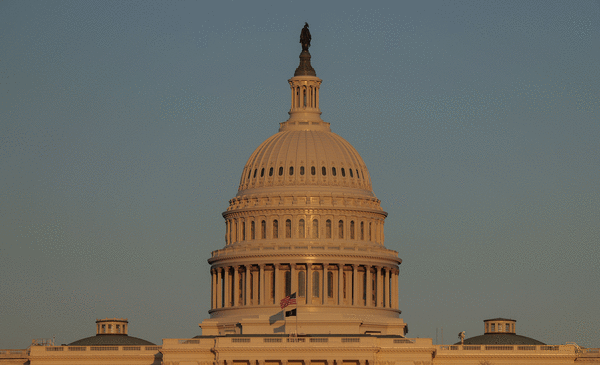
A quarter-millennium into the American experiment, some of our skepticism of big government has given way to populism and astounding numbers of regulations. Here’s one explanation.
Following British overreach and the weak Articles of Confederation, we found the happy medium of the Constitution — a system made possible not just by separation of powers or rugged individualism, but by the strength of America’s churches, charities, neighborhoods, clubs, local governments and other voluntary associations.
A free people once learned to govern itself because in some ways, life was governed close to home. Why, then, has the same country now built an administrative state with tentacles reaching into nearly every corner of economic life?
Some say that as a country gets richer, increasingly diverse and more complex, society demands more rules. That’s true, but it misses a deeper change. Churches and other local institutions provide a wide range of services, ranging from childcare to food for the poor. For decades, these and other sources of moral formation, security and local solidarity have been hollowing out. As they wither, Americans ask Washington to fill the void.
Gallup finds that 70% of us deemed religion “very important” in 1965, compared to only 45% in 2023. Church attendance numbers have fallen, and Pew reports that Christians made up 90% of Americans in 1972; today they are about 62%. The religiously unaffiliated grew nearly sixfold. This tends to happen as societies modernize.
Empty pews don’t fully account for the backslide in American community institutions, but they have an important ramification for government. Research by Anthony Gill and Erik Lundsgaarde shows the relationship between large welfare states and secularism. Pew’s latest Religious Landscape Study finds that Americans with low levels of religious engagement are much more likely to prefer a bigger government.
This does not mean secularization created the regulatory state, whose machinery was built earlier. Congress created the Federal Register in 1935 to house agency rules and standardized the modern rulemaking process in 1946. But it helps explain why that federal machinery kept expanding, and why the state came to be seen as America’s default social problem-solver.
Church and state are distinct institutions, but they can substitute for one another. Jonathan Gruber and Daniel Hungerman found that New Deal relief crowded out church charitable spending. Angela Dills and Rey Hernández-Julián later found that when the Catholic abuse scandals reduced religiosity and private giving, more affected areas saw higher welfare spending. This pattern runs both ways: Weaker religious institutions invite more public provision, and more public provision can crowd out local social assistance.
When Washington becomes the first or only resort, it governs how it knows best: by layering rule on top of rule. The recent growth in federal regulations is stunning. As measured by the RegData project, the number of “restrictive terms” in the Code of Federal Regulations (such as “shall” or “shall not”) has grown from about 400,000 in 1970 to more than 1 million today.
And while bureaucracy can redistribute money and write commands, it cannot generate belonging, trust or moral formation. What bureaucracy begets is more bureaucracy, coupled with costs.
Studies in the Journal of Economic Growth and Review of Economic Dynamics have shown how too many rules — added one at a time, rarely revisited and almost never subtracted — create a quiet economic drag on all of us. Other work finds that more-regulated industries see fewer new firms, that larger firms weather heavy regulation better than smaller ones, and that greater regulatory exposure is linked to income inequality. Ironically, these pay differences stoke demand for more regulations. It’s a vicious cycle.
A healthy republic needs strong institutions to occupy the space between the isolated individual and the clumsy, centralized state. Otherwise, Washington will keep trying to fill a God-sized vacuum in its mother tongue of mandates, prohibitions, guidance, enforcement and compliance.
The answer is not merely deregulation, though we need lots of that. The federal code must be managed and culled thoughtfully as it ages.
The civic institutions that provide non-governmental solutions and keep the heavy hand of Washington at bay also need revitalization. This means making room again for families, congregations, charities, markets and local governments to solve problems before they become federal cases. It means strengthening civic education and teaching Americans to embrace true intellectual pluralism. Government spending cannot be seen as the default solution to every issue.
A free society cannot live indefinitely on a choice between loneliness and bureaucracy. When the pews empty, the rulebooks thicken. Next, the economy suffers. Then, the masses worship at the altar of populism.
____
Patrick A. McLaughlin is a research fellow at the Hoover Institution and a visiting research fellow at the Pacific Legal Foundation. He created the RegData and QuantGov projects, which quantify regulations using data-science tools.
_____
©2026 Tribune Content Agency, LLC.


















































Comments