Mark Gongloff: Florida chooses insurers and their profits over homeowners
Published in Op Eds
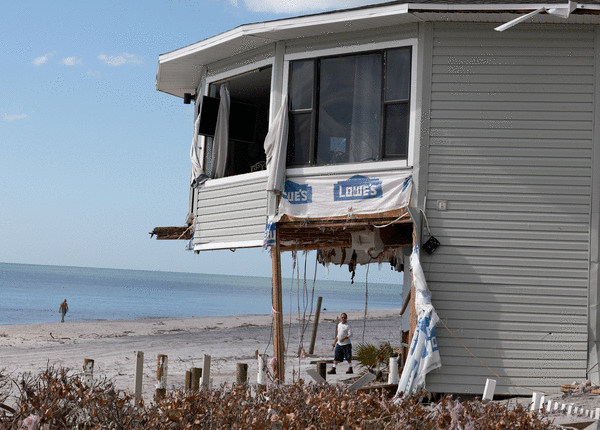
U.S. states are supposedly the laboratories of democracy, cooking up and testing local solutions to national problems. But some of those labs are more like Walter White’s RV methmobile: They’re not always doing stuff you want to emulate.
Consider the concoctions Florida has brewed up in response to the national home-insurance crisis that is hitting the state especially hard. It keeps making it harder for homeowners to challenge insurers in court, arguing that frivolous lawsuits are the cause of soaring premiums and insurers abandoning the state. Unshockingly, insurance companies agreed with this argument, and they’re trying to persuade other states to adopt it.
Also unshockingly, the results have been nothing like supporters promised. The root causes of soaring home-insurance premiums around the country are a climate that has grown hotter and more dangerous and a flood of people into some of the places most at risk, including Florida. Lawsuits are a sideshow at best.
Nevertheless, Florida passed the latest in a string of tort-reform laws in 2023 and quickly declared victory. State officials claimed the law lowered premiums, attracted new insurers and transitioned people out of Florida’s insurer of last resort, Citizens Property Insurance Corp.
There is an argument that Florida did have too many lawsuits before that reform, accounting for more than 70% of the national total. And it is true that in 2024, the first full year after reform, premiums dipped 3%, according to the comparison site Insurify. But there’s no evidence the reform had anything to do with that.
In fact, home-insurance premiums then soared 18% in 2025, and Insurify expects they’ll rise 2% this year. Florida still has far and away the highest premiums in the country, at $8,292 per year on average, more than triple the national average and far ahead of second-place Louisiana’s $5,050.
“Tort reform has effects, but those are always to enhance the bottom line of insurers,” Jordan Haedtler, a former House Financial Services Committee staff member and climate finance strategist, told me. “That relief never makes its way to consumer pockets.”
Meanwhile, the percentage of insurance claims that were denied in Florida rose from 30% in 2023 to 40% in 2024 before dipping to 34% in 2025, Bloomberg News reported. Eleven insurers in the state have raised their percentages of closed claims without payment since 2023.
The net result is that tort reform has produced more lawsuits than ever, according to Weiss Ratings, a Florida-based ratings company. Florida homeowners filed 143 suits for every 1,000 denied claims last year. That’s nearly 11 times the national average and up from 124 suits per 1,000 in 2022. Tort reform brought down neither prices nor torts.
As for the new insurers that entered Florida’s market, several aren’t capitalized well enough to handle a significant disaster, Weiss and others have argued. Seven of the state’s insurers failed regulatory stress tests in 2024, the Palm Beach Post reported, double the rate of 2023. The state won’t identify them.
A 2025 study by the nonprofit Insurance Fairness Project found four of Florida’s 16 new insurers were previously insolvent companies that had been restructured or had ties to financially troubled insurers. Four new companies were fined by Florida’s insurance regulator for mishandling hurricane claims. And nine have far lower ratings from Weiss than from Demotech Ratings, a private firm critics often accuse of inflating insurers’ ratings.
Meanwhile, many of the Florida homeowners that left the state’s insurer of last resort have moved into the “non-admitted” or “surplus” insurance market, which is lightly regulated and expensive. These policies were once limited to comically hard-to-insure properties such as fireworks factories, Bloomberg News has noted. Now they’re taking up an increasing share of home-insurance markets in places like Florida and California.
All of this was predictable. Florida has repeatedly applied tort-reform medicine to its insurance problem since the 1980s. None of it has helped, according to Joanne Doroshow, executive director of the Center for Justice & Democracy at New York Law School and co-founder of the advocacy group Americans for Insurance Reform. She and a former Texas insurance commissioner, Robert Hunter, produced a series of national studies going back to 1999 and discovered time and again that tort reform never helps customers.
“The insurance industry comes to a state and says rates are going up and the only way to bring them down is to pass tort reform,” Doroshow told me. “In every single case, rates continue to go up, because the reasons rates go up have nothing to do with these kinds of tort limits.”
Texas is another example. In 2017, it not only cut off avenues for homeowners to sue insurers but also slashed penalties for wrongful claim denials. Lieutenant Governor Dan Patrick blamed a surge in lawsuits for higher premiums and lower coverage. In fact, the real cause was an increase in hailstorms, along with a rise in the denial of hail-damage claims, trial lawyers argued at the time. Protecting insurers from lawsuits would help nobody but the insurers.
History has proved the trial lawyers right. Texas’ average home-insurance premium jumped 57% between 2017 and 2024, according to data from the state comptroller and PolicyGenius. Texas has the fourth-highest premiums in the country, according to Insurify, following a 14% jump in 2025. At the same time, home insurers have found it far easier to deny claims. Texas’ denial rate surged to 47% in 2024 from 35% in 2004, according to Weiss Ratings.
Despite this long record of failure, states keep trying to use tort reform to fix home insurance. Inspired by Florida’s supposed success and egged on by the insurance industry and friendly politicians, Georgia passed a similar law last year. Minnesota, which has the country’s ninth-highest premiums, created a task force to study the idea, though it has gone no further yet.
Insurance companies make money by collecting premiums and investing them. They didn’t go into business for the thrill of paying claims. The industry takes in $8.8 million for every day it delays a claim, according to a new study by the Consumer Federation of America. That’s why insurers have made $405 billion in profits in the past three years despite the rise in climate-driven disasters.
All that said, insurance can still play a productive role in both keeping housing affordable and helping society adjust to climate chaos. High premiums in some cases are no evil if they send legitimate signals about climate risk and encourage homeowners to either move or harden their properties against catastrophes. Playing games to dodge accountability signals only greed.
_____
This column reflects the personal views of the author and does not necessarily reflect the opinion of the editorial board or Bloomberg LP and its owners.
Mark Gongloff is a Bloomberg Opinion editor and columnist covering climate change. He previously worked for Fortune.com, the Huffington Post and the Wall Street Journal.
_____
©2026 Bloomberg L.P. Visit bloomberg.com/opinion. Distributed by Tribune Content Agency, LLC.




















































Comments