Jill Burcum: A 'zombie' that could slash abortion access may be lumbering to life
Published in Op Eds
Sen. Tina Smith warned Minnesotans two years ago that a zombie could rise from the dead. She was right.
The zombie in question isn’t a movie monster. It’s the Comstock Act, a 1873 law criminalizing the mailing of “obscene” materials that has remained on the books, though largely unenforced, for more than a century. In an April 2024 Star Tribune commentary, Smith described the law as an undead monster, warning that it could come back to life under a second Trump administration to gut access to the medications commonly used in abortions.
Smith didn’t think it would take a Supreme Court ruling to bring the zombie back. “Even if the Supreme Court doesn’t take the bait, a newly re-elected President Donald Trump could order his Department of Justice to start interpreting that line to mean that it is illegal to mail mifepristone,” she wrote.
Recent events suggest the scenario she described is now unfolding.
Acting Attorney General Todd Blanche, who is seeking confirmation to lead the Justice Department, gave the zombie its first flicker of life last Thursday, on a private call with religious leaders hosted by the White House Faith Office. But a group called Intercessors for America posted audio of the session online, and Politico reported his remarks in a recent story.
On the call, Blanche said the Justice Department is “putting practices and policies in place” to stop the mailing of abortion medication to states that ban it, an approach that leans directly on Comstock’s dormant mailing provisions. He said the administration is working “so that the Dobbs decision becomes permanent in every single state,” a reference to the 2022 Supreme Court ruling that eliminated the federal right to abortion and left the issue to the states.
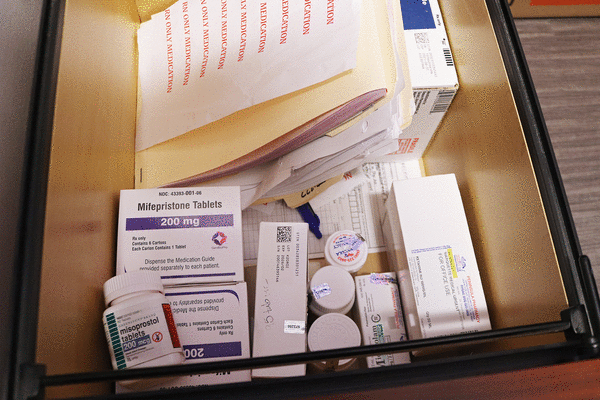
Data from the Guttmacher Institute provides important context for why this fight matters so much. Abortions induced by medications such as mifepristone account for an increasing number of U.S. abortions, 63% in 2023. The drugs can often be prescribed by telehealth and delivered by mail, easing access especially for women who don’t live near an abortion provider.
Minnesotans might assume the state’s own strong reproductive health protections would shield them if there were federal restrictions on mifepristone access. In 2023, the DFL-controlled Legislature passed the PRO Act, codifying abortion access in state law.
But the Constitution’s Supremacy Clause could mean that the federal enforcement of Comstock trumps state safeguards. Not a single vote in Congress would be needed for the U.S. Department of Justice to adopt a new, stricter interpretation of the law. Still, newly enforcing mailing restrictions to mifepristone would likely be contested legally.
The stakes are sobering. KFF, a respected health policy nonprofit, has noted that “anti-abortion activists have argued in federal court that the Comstock Act prohibits the mailing of the medication abortion pill, mifepristone, directly to patients, as well as the general distribution of the medication to physicians, hospitals, and pharmacies.”
It’s easy to see how difficult access to this health care could become. What’s less clear is exactly how far Blanche intends to go.
On the call with faith leaders, he wouldn’t say whether the administration plans to act through the U.S. Food and Drug Administration’s dubious and ongoing safety review of mifepristone, through the revived Comstock Act, or through another legal avenue.
An FDA move against mifepristone alone would still leave misoprostol, another abortion drug, available by mail. A Comstock-based approach could shut down both drugs at once. Blanche’s remarks give reason to worry about the most restrictive outcome.
But heavy-handed moves on abortion tend to backfire politically. Predictions and historical norms suggested that Democrats should have been routed in the 2022 midterm elections. President Joe Biden’s approval ratings were dismal. Inflation was hitting consumers hard. But no Republican red wave materialized that year.
A 2024 study by University of Pennsylvania researchers, published in the prestigious Proceedings of the National Academy of Sciences, found the difference wasn’t the economy. Voters who supported legal abortion were measurably more likely to swing from Republican to Democratic between 2020 and 2022.
Blanche’s private remarks hand Democrats a version of that same gift. Smith is already leveraging the moment, releasing a statement on Tuesday demanding Republicans account for what she called a plan to make the Dobbs ruling “permanent in every single state” and reviving her push to repeal Comstock outright.
Smith has reintroduced the Stop Comstock Act this Congress but Republicans control both congressional chambers, meaning the bill doesn’t have a path forward at the moment. And with Smith not seeking re-election, there’s no clear plan yet for who takes up the bill once she’s no longer in office.
The initial furor over the Supreme Court’s 2022 decision to overturn Roe may have simmered down in the years since. But Blanche’s remarks just put the issue back on the ballot for 2026.
In 2022, voters punished a party for what an unelected court did. This November, they’ll get to judge a party for what its own attorney general nominee said he intends to prioritize.
_____
©2026 The Minnesota Star Tribune. Visit at startribune.com. Distributed by Tribune Content Agency, LLC.

















































Comments