Commentary: From Nazi Party membership records to family lineages, databases reveal hidden histories
Published in Op Eds
What keeps secrets secret? Historically, social respectability has relied, remarkably often, on the discretion of others and the last resort of deniability. Now, these safeguards are being demolished by databases: collections of facts that, when revealed, can become bombshells.
Today, with unprecedented ease, people may explore their family background — and be stunned to learn they were adopted. Generations may be rocked by discovering unknown biological siblings or hidden ethnic or religious identities — even their forebears’ political affiliations.
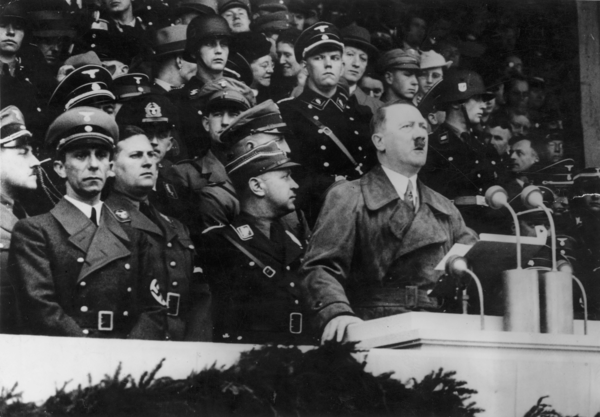
A perfect example lies in recent news reports about the opening of a database containing millions of Nazi Party membership cards. The database, accessible through the U.S. National Archives as well as German sources, reveals not only party membership but also the date of joining, Rowan University historian Mikkel Dack revealed in a July 20 interview with me. It’s safe to assume that the earlier the date, the more enthusiastic the new Nazi.
This information shreds the secrecy over that shameful era. Through three postwar generations, families discussing “Nazi times” tended to present loved ones in a flattering light. Dack explained this practice during a June interview with CNN.
Dack said that many Germans relied on a protective barrier called “communicative memory” — stories passed down by descendants who, in this situation, believed their forebears had nothing to do with the Nazi regime. “These stories,” he said, “often run counter to the empirical data now available.”
Locating a family member’s name in the database can upend identity. In that moment, nothing will ever be the same. As a German friend said to me, shocked after learning that his father had been a prominent Nazi: “I am the son of a perpetrator, and I must ask myself: If my father could commit these crimes, who am I?”
The same question might confront an American finding that a beloved relative had belonged to the Ku Klux Klan. How would it feel to know that your great-grandfather — for whom you were named — participated in a lynching?
In postwar Germany, countless family histories rested on the fact that relatives’ names were cleared through a process instituted shortly after their country’s surrender. All German adults were required to answer a lengthy list of questions about their wartime activities, Dack said. Based upon their replies, occupying Allied officials ranked their culpability, then tried the worst offenders — most famously in the Nuremberg trials, but also in numerous local tribunals.
Millions of cases piled up in the American zone alone. Soon the Allies, eager to move on, handed over this enormous task to the Germans themselves — who also were eager to move on.
As detailed by Clemson University historian Donald M. McKale in the book “Nazis After Hitler: How Perpetrators of the Holocaust Cheated Justice and Truth,” the cases meriting further investigation were whittled down to about 100,000. These were typically examined by members of the nation’s educated elite — many of whom were former Nazis. Worse, friends and neighbors who were called to provide evidence routinely covered for one another.
In the end, on charges related to often heinous crimes — committed over more than a decade at a massive, multinational scale — only 6,487 Germans were convicted, according to McKale. Many served a pro forma sentence, or none at all.
Those who were acquitted, or never charged, believed the past was just that. But some remembered the truth — and would have found in the database proof of what they saw with their own eyes.
One of them was Mina Lautenschläger, a young Christian whose rural village fell early and hard for Nazism. As a live-in housemaid for one of the town’s two Jewish families, Lautenschläger saw the lies behind Nazi propaganda. Deeply devoted to her employers, she fiercely repudiated the people she called “wolves” and their howls of racism and brutality.
In 1932, shocked as the villagers’ hostility escalated, Lautenschläger began collecting evidence. Newspaper clippings, documents, photos, letters — all went into her small brown suitcase. This jumbled, makeshift archive reassured her about her own perceptions. Eventually, she hoped, it would prove the local Nazis’ criminality.
Fourteen years later, she thought her moment had arrived in the local tribunals. Far from being vindicated, however, she was crushed as a brazen, thorough cover-up emerged.
Lautenschläger’s beloved Jewish family had been ruined: stripped of their home, property and business, the children sent to America and the parents murdered in camps. Lautenschläger meticulously constructed two cases seeking justice for the orphaned children. Both evaporated as the guilty parties supported each other against sworn statements.
For Lautenschläger and many others, the tribunals’ failure was, as McKale writes, “in itself a form of antisemitism.”
“Everything was forgotten after the war,” Lautenschläger said in 1990. “The new owners of Jewish homes forgot they were illegal owners. The town forgot what they had done. They only wanted to keep what they had stolen from the Jews — the houses, the household goods, the books and art — everything. But I haven’t forgotten. I know who you are.”
When the Allies were approaching, Lautenschläger watched in despair as her neighbors raced to destroy every trace of their Nazi activities. Everything — starting with party membership cards — went down the local “cat hole,” where unwanted kittens were drowned in the Rhine River.
The evidence, she believed, was gone forever. Her “archive” was no match for her neighbors’ lies. Like the guilty parties themselves, Lautenschläger believed their secrets were safe.
But they were wrong. Now, from membership in the Nazi Party to the facts behind family lineage or legends, communicative memory no longer has the final word.
Today, the truth lies in the databases.
____
Fern Schumer Chapman is a former Chicago Tribune reporter. She details the lifelong friendship uniting her mother and Mina Lautenschläger in the memoir “Motherland” and tells Lautenschläger’s story in her latest work “I Will Not Howl with Those Wolves.”
____
©2026 Chicago Tribune. Visit at chicagotribune.com. Distributed by Tribune Content Agency, LLC.

















































Comments