Commentary: No one who works full time should be on Medicaid
Published in Op Eds
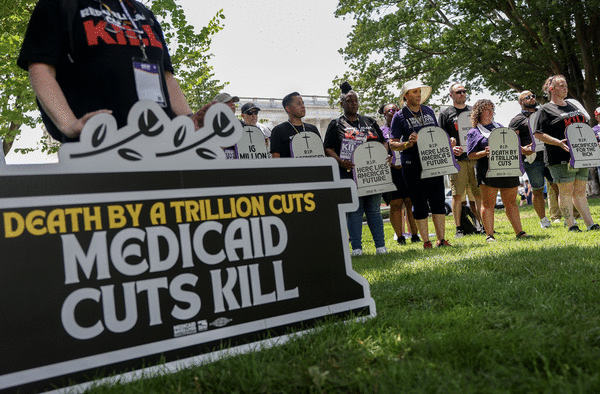
There are a lot of jobs in the U.S. economy that pay miserably low wages. And there are a lot that offer a reasonable hourly rate but still result in miserably low earnings because of unstable, fluctuating schedules.
How many is hard to know, but it’s not a small number: According to the Government Accountability Office, there are about 9 million Medicaid recipients who are working full-time, and 7.5 million who receive SNAP benefits.
But the most interesting aspect of the report may be where exactly these people work. The GAO collected data from 11 state agencies to identify the employers. Most of these full-time workers on need-based assistance worked for the private sector in transportation, restaurants and retail. While one in five employees work for small businesses with fewer than 10 employees, more than half work for employers that had at least 100 employees.
The GAO named names, and the number of Fortune 500 companies with thousands of need-based beneficiaries in their employ speaks less about the labor market than it does about the collapsing sense of fairness in the U.S. tax system.
When it comes to the labor market, there’s not much to say. The laws that protect workers have either been abandoned (as is the case for the Fair Labor Standards Act, which dictates things like the minimum wage) or gutted (as is the case for the National Labor Relations Act, which gives workers the right to organize).
Nor is there much to say about the galling reality of Fortune 500 employees who need food stamps and Medicaid. A leaked internal presentation from Kroger in 2018, for example, put its internal estimates of employees on food stamps at 25%. That echoes a leaked memo from Amazon in 2022 that warned its astounding turnover rate meant that it was burning through the total potential hiring pool. In the U.S., not paying or treating workers well is industry standard.
What’s changing is responsibility — specifically, who is shirking it. Corporate profits are at the highest level the U.S. economy has ever seen, equivalent to 11% of the economy. As a strategist at JP Morgan recently noted, this is due in no small part to a diminished corporate income tax rate. According to the Institute on Taxation and Economic Policy, there were 88 profitable U.S. companies that paid nothing in taxes last year, and even more have effective rates in the single digits.
The losers here are typical, middle-class W2 salaried earners. To start, they’re actually paying their taxes. The tax gap — the difference between what the IRS is owed in taxes and what it is paid — is a sprawling sum, nearing $700 billion a year. Just 1% of the gap comes from wage and salary workers, while a quarter of it comes from business income.
But what really makes these workers tax chumps is just how many other jobs they are subsidizing. The GAO shows clearly that they fund the Medicaid and SNAP benefits of workers at profitable companies.
In addition, the One Big Beautiful Bill Act created new deductions for some income from overtime and tips for some workers. Consider that Congress could have raised the tipped minimum wage, increased overtime pay or expanded who is eligible for it — any of which would have resulted in employers paying more to all such workers. Instead, it chose to subsidize the pay of some of those workers via the tax system.
Of course, that was happening already. The Earned Income Tax Credit provides a refundable credit to workers with low earnings. Because it had a significant expansion in the same year that the cash welfare entitlement was ended, the EITC is often thought of as the replacement program for welfare and, as a result, assumed to be a benefit for single parents with children. That is not the case, as low-earning couples and childless adults can qualify. Indeed, nearly 30% of EITC recipients, more than 7.5 million workers, do not have children.
So, to review: The reliable, salaried W2 earner picks up the tab and absorbs the responsibility. Meanwhile, companies benefit twice over — a lower tax bill and a subsidy to payroll in the form of tax credits, deductions, and direct spending on their very low-paid employees. And don’t forget that 60% of private-sector workers in lowest-earning occupations do not have any paid sick leave.
Every economic era is its own natural experiment. In the U.S. right now, the question is what would happen if the federal government were to abandon its efforts to protect workers and instead redistribute money to corporations to improve working conditions on their own.
We now know: pay so low those workers can’t even afford food or health insurance without government assistance. It’s not a great state of affairs, but it’s good to have an answer.
_____
This column reflects the personal views of the author and does not necessarily reflect the opinion of the editorial board or Bloomberg LP and its owners.
Kathryn Anne Edwards is a labor economist, independent policy consultant and co-host of the Optimist Economy podcast.
_____
©2026 Bloomberg L.P. Visit bloomberg.com/opinion. Distributed by Tribune Content Agency, LLC.





















































Comments