David M. Drucker: Trump's army of election deniers is a problem on many levels
Published in Op Eds
Let’s set aside, for a moment, how ridiculous it is that officials serving in President Donald Trump’s administration, including executive and judicial officials, won’t acknowledge in front of Congress that Joe Biden won the 2020 election.
These deliberate dodges — a consistent pattern more than 18 months into Trump’s second presidency — aren’t just political theater; they’re informative. Trump is famously heterodox and transactional on cultural, fiscal and foreign policy matters. During his first term, the president sought wide counsel and invited debate from congressional Republicans and his Cabinet. But in stubbornly clinging to the falsehood that he defeated Biden while allowing zero deviation from others, Trump has revealed himself to be a diminished leader compared to his initial White House sojourn.
The culprits haven’t been limited to obvious (and occasionally churlish) partisans like FBI Director Kash Patel, former Attorney General Pam Bondi and White House budget director Russell Vought, among others. But otherwise serious people, like freshly confirmed Attorney General Todd Blanche (granted, he’s functioned as a Trump loyalist) and Director of National Intelligence Jay Clayton are the latest high-profile examples.
That’s why political “gotcha” questions about the outcome of the 2020 election from Democrats during congressional hearings, and the absurd obfuscation from Trump administration officials and nominees, shouldn’t be dismissed as just another Capitol Hill clown show.
“The answer to the question seems particularly relevant for positions where a job should require the ability to say things the president does not want to hear,” said Drew Kurlowski, an associate professor of political science at Coastal Carolina University, in Conway, South Carolina, who has studied the history of congressional hearings.
Congressional oversight and confirmation hearings, which theoretically intend to elicit or impart relevant, if not damning, facts, devolved long ago into soap-box sessions, used by lawmakers of both parties and those testifying to produce viral, made-for-social media moments. For representatives and senators, these clips are useful for raising money and bolstering their position with the leftwing or rightwing base. In the case of Trump administration officials and nominees, their performances have been about satisfying an audience of one. (And yes, he’s watching.)
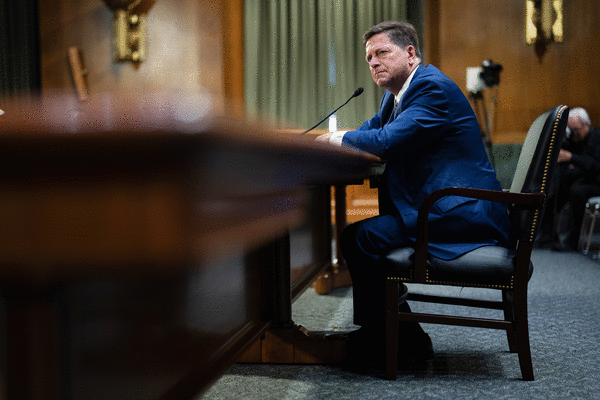
“Who won the 2020 election?” Senator Jon Ossoff, a Democrat from Georgia, asked Clayton during his confirmation hearing. Answered Clayton, a qualified nominee who some Democrats initially expressed interest in supporting but ultimately rejected: “I’m not going to do this with you.”
Ossoff, who is up for reelection this year, tried a few more times but came up empty, including with this query: “It’s a simple question, Mr. Clayton: Who won the 2020 presidential election?” Clayton still sidestepped a straightforward response. “I’ve answered it.” (Expect to hear quite a lot about this in the upcoming 2028 Democratic presidential primary — and the ensuing general election. What’s unclear is whether voters will care how Vice President JD Vance, or whoever the Republican nominee is, treats the topic.)
Clayton’s dogged evasion undercuts his professional reputation for being capable, competent and committed to public service, said Doug Heye, a Republican strategist periodically critical of Trump. The new DNI was serving as a federal prosecutor when the president tapped him for the post. Unfortunately, Heye said, humoring Trump is the price of serving in this administration, or even being nominated for the federal bench, during his second term. “What serious person makes that deal with themselves?” he asked, rhetorically.
It’s standard practice, and politically effective, for administration officials and nominees to offer disciplined, albeit canned answers to probing questions. Supreme Court confirmation hearings, in particular, have historically featured aggressive confrontations between lawmakers and nominees. In her 2022 confirmation hearing, now-Supreme Court Justice Ketanji Brown Jackson prominently would not agree that physical differences exist between men and women when asked to do so by Republican Senator Marsha Blackburn of Tennessee.
“What seems somewhat distinctive in recent years is the degree to which questions surrounding the 2020 election have become a recurring test of alignment with President Trump, creating a dynamic that extends beyond traditional policy disagreements,” political science professor Gibbs Knotts, Kurlowski’s research partner at Coastal Carolina University, told me. It’s almost as if Trump administration officials and nominees would be better off crossing the commander-in-chief on one of his key policy priorities than they would the red line about his loss to Biden nearly six years ago.
With voters prioritizing the economy, Trump’s obsession with rewriting the 2020 elections is doing his party’s prospects of defending slim House and Senate majorities in this fall’s midterm elections no favors. But Trump is undeterred, and that’s telling.
During the president’s first term, his brittle ego was certainly visible, but he regularly listened to critics, many of whom inhabited his White House, often changing course while exhibiting strategic acuity. As the president’s former acting chief of staff during term No. 1, Mick Mulvaney, explained to me in a December 2024 piece for The Dispatch: “There are a few things that Trump is just dead-set on.… There are other things, however, where he would absolutely be open to reasoned discussion.”
Is our aging, 80-year-old president still capable of that? Some days, it appears so. But with an economy saddled by tariffs Trump refuses to recognize as burdensome and a tactically incoherent, on-again, off-again war against Iran — not to mention other myriad national challenges — it might be good to know for sure.
____
This column reflects the personal views of the author and does not necessarily reflect the opinion of the editorial board or Bloomberg LP and its owners.
David M. Drucker is a columnist covering politics and policy. He is also a senior writer for The Dispatch and the author of "In Trump's Shadow: The Battle for 2024 and the Future of the GOP."
©2026 Bloomberg L.P. Visit bloomberg.com/opinion. Distributed by Tribune Content Agency, LLC.




















































Comments