Ronald Brownstein: Democrats are about to test the left's big theory
Published in Op Eds
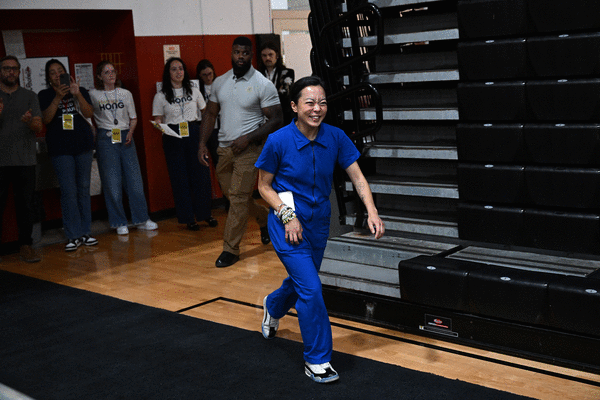
Democratic voters are setting up a high-stakes, real-world messaging test in the states most important to their hopes of recapturing the presidency.
The most direct path back to the White House for Democrats in 2028 is to retake Michigan, Pennsylvania and Wisconsin, the three states that President Donald Trump in 2016 and 2024 dislodged from what I once called “the blue wall.”
Last week’s Michigan primary advanced candidates who embody the party’s competing theories of how best to do so: centrist Jocelyn Benson, the gubernatorial nominee, and Abdul El-Sayed, a Bernie Sanders-style progressive running for Senate. Which one performs better in November will offer the party important clues about which approach can build a broader coalition in this indispensable battleground.
A similar comparison will become available if socialist Francesca Hong wins Wisconsin’s Democratic gubernatorial nomination on Tuesday. While Wisconsin doesn’t have a Senate election that could provide a direct benchmark for Hong, she offers a distinct contrast to Josh Shapiro, a centrist (and possible 2028 candidate) who is seeking reelection as governor in Pennsylvania.
To be clear, this isn’t only about who can beat their Republican challenger in November. Yes, progressives have much at stake in whether their candidates can win general elections outside deep blue terrain. It’s an “all-our-chips on the table moment,” says Adam Green, co-founder of the Progressive Change Campaign Committee, the political organization affiliated with Senator Elizabeth Warren. If El-Sayed (and Hong if she wins the nomination) loses, it will hugely deflate the left. But at a time when Trump’s approval has fallen so sharply, each could win without proving that a candidate in their mold can carry their state in a more neutral environment, or with the larger electorate of a presidential election.
That’s why the more revealing yardstick in these crucial battlegrounds will be whether the progressive candidates exceed, match, or trail centrists Benson and Shapiro on the November ballot.
Dan Kanninen, the swing state director for the 2024 campaigns of Joe Biden and Kamala Harris, worries that the progressives are likely to underperform. If that happens, “I just truly hope that those with a particular point of view on policy can confront the realities of the electorate and try to build a coalition that can win” in 2028, he says.
Early general election polling in Michigan has already shown El-Sayed struggling against Republican nominee Mike Rogers among the same key constituencies that largely preferred Representative Haley Stevens in the primary: voters over 50, women without a college degree, and Black voters. In the same poll, Benson was performing at least 15 points better among each of those groups against her Republican opponent, John James.
In Wisconsin, Hong is likely to post huge numbers Tuesday in Dane County — the prosperous, young and well-educated county around Madison. But she could face similar challenges to El-Sayed in both the Black neighborhoods of Milwaukee and the state’s midsize cities dominated by working-class White voters.
Because Democrats have already maxed out in Dane (typically attracting at least 75% of the vote there), Kanninen says the key to winning a Wisconsin general election is improving in those smaller, blue-collar places. “That’s the difference between winning by 20,000 votes and losing by 20,000 votes,” he says. “And those are not the people clamoring for socialist candidates.”
By comparison, Shapiro has demonstrated a much broader appeal in Pennsylvania. During his first election in 2022, he ran slightly better than Democrats typically do among working-class White voters while amassing crushing margins among Black voters and college-educated White voters. Public polling shows Shapiro in position to replicate his performance with all three groups this year.
Finding the right model in Michigan, Pennsylvania and Wisconsin is vital for Democrats. Those three states have become the pivot in modern presidential politics. Though not carbon copies, the three are strikingly similar demographically, with more White residents and seniors than the national average, slightly fewer college graduates, and many fewer minorities and immigrants. The trio has voted for the same candidate in all but one presidential election since 1980 — and that candidate tends to win. (The exceptions were the 2000 and 2004 elections, when Democrats Al Gore and John Kerry carried all three but lost to George W. Bush, in Gore’s case with an asterisk.) Since 1994, they’ve even elected governors from the same party in every election but one.
The states converge so deeply that veteran Democratic strategist Tad Devine argues they should be thought of as a single massive swing state — what he calls “Mi-Pa-Wi.” Adding Mi-Pa-Wi to the 19 states that have voted against Trump in each of his campaigns, plus Washington DC and Omaha’s “blue dot” district, would net the next Democratic nominee exactly the 270 Electoral College votes needed to win.
For that reason, the outcome of the 2026 elections in these states will reverberate loudly. Smart Democrats will study whether the progressive nominees outrun not only their Republican rivals but their centrist counterparts.
_____
This column reflects the personal views of the author and does not necessarily reflect the opinion of the editorial board or Bloomberg LP and its owners.
Ronald Brownstein is a Bloomberg Opinion columnist covering politics and policy. He is a CNN analyst and the author or editor of seven books.
_____
©2026 Bloomberg L.P. Visit bloomberg.com/opinion. Distributed by Tribune Content Agency, LLC.



















































Comments