Michael Hiltzik: Republicans want to turn the clock back -- to the red-baiting Fifties
Published in Op Eds
The Republican desire to turn the clock back to some (largely mythical) halcyon period of yore is well-known. President Donald Trump often has expressed his admiration for the 1890s in America, an era of high tariffs. The conservative assault on women's reproductive rights harks back to the time before the ratification of the 19th Amendment in 1920 brought about universal suffrage.
Lately, however, Trump and his followers have been evoking another period and another political trope. They're crying about the threat of "communism," which is so old that maybe they think it's new again.
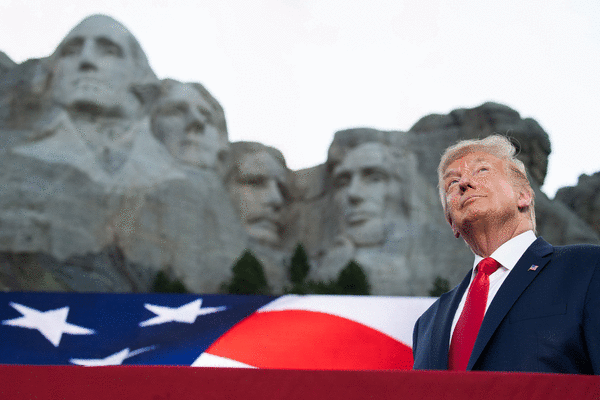
Speaking on July 3 at Mount Rushmore, Trump said, "A generation after we fought and won the Cold War against the menace of communism, there is now a resurgence of the communist menace in our land, including from newcomers to our country who embrace ideas totally opposed to our way of life and our great success." He called communism "a mortal threat to American liberty ... the greatest threat to our country, including World War I, World War II, Pearl Harbor or even 9/11."
On July 21, the State Department released a report titled "Cuba: the Capital of 21st Century Communism," which employed verbiage redolent of the anti-communist past to smear progressive figures today — listing New York Mayor Zohran Mamdani, progressive webcaster Amy Goodman and even Ben Cohen, the co-founder of Ben & Jerry's ice cream among dozens of "fellow travelers" of communist Cuba.
This is an attempt to weaponize what Derick Dirmaier of Talking Points Memo labels "the politics of nostalgia." Yet communism, as it was once associated with Soviet Russia and Red China, is such a dead letter as a political ideology that the very use of the term has an antique ring.
The conservative and Republican target isn't really "communism" but "democratic socialism," an affiliation espoused by progressive Democrats including Mamdani and Rep. Alexandria Ocasio-Cortez, D-N.Y.
Trump and his associates may believe that calling them "communists" will inspire the same sort of red-baiting that has erupted periodically in the U.S., starting with the Bolshevik revolution in 1917 and surging again after the end of World War II. The latter period inspired historian Richard Hofstadter to write his famous 1964 article in Harper's, "The Paranoid Style in American Politics."
Hofstadter identified the febrile anti-communism of the 1950s as one of "the basic elements of contemporary right-wing thought." The idea, he wrote, was that "the country is infused with a network of Communist agents..., so that the whole apparatus of education, religion, the press, and the mass media is engaged in a common effort to paralyze the resistance of loyal Americans."
The figurative enemy, Hofstadter wrote, "is a perfect model of malice, a kind of amoral superman — sinister, ubiquitous, powerful, cruel, sensual, luxury-loving."
That description is what makes the contemporary hand-wringing about communists seem so absurd to today's Americans, who might be more likely to think that it applies more accurately to plutocrats such as Elon Musk and Peter Thiel.
In today's usage, "communism" isn't so much a description of a political and economic doctrine as it is a shibboleth, a code word directed at the conservatives' political base. As I wrote in 2021, the effectiveness of a shibboleth doesn't depend on an understanding of its meaning — in fact, any such understanding would work against its effectiveness as a partisan dog whistle. Its very ambiguity allows listeners to apply their own definition; how many people really understand what "DEI" is, or "critical race theory," or, indeed, communism? The partisan core needs only to feel that these things must be bad.
The birth of the red scare often is dated to Feb. 9, 1950. That's when Sen. Joe McCarthy (R-Wisc.) delivered a speech to a conservative audience in Wheeling, W. Va., in which he flashed a piece of paper and described it as a "list of 205 ... members of the Communist Party" working in the State Department. The figure was certainly made up: Over the following weeks it fluctuated up and down, ultimately settling at 57 — also made up.
McCarthy rode the furor created by his speech to the heights of political celebrity, and ultimately to his own downfall. "McCarthyism" collapsed because of the same factors that have brought down conspiracy theories of all stripes — public weariness at its repetition, but more because McCarthy's efforts to dredge up factual support for his allegation devolved into slapstick.
McCarthy peppered journalists, congressional staff and even FBI Director J. Edgar Hoover with desperate appeals for evidence, but no one had any.
In truth, Republican exploitation of the postwar red scare predated McCarthy's speech. In 1938, a congressional committee launched an investigation of communist infiltration in Hollywood, even considering calling Shirley Temple as a witness; the idea inspired so much ridicule it was hastily dropped. Shirley Temple was 10 years old at the time.
The young Navy veteran the California GOP ran for Congress in 1946 won his race by insinuating untruthfully that his opponent, the respected Democrat Jerry Voorhis, was associated with communists via the Conference of Industrial Organizations, or the CIO.
He was Richard Nixon, who later rode anti-communism to victory in the 1952 Senate race against Helen Gahagan Douglas, a progressive whom Nixon slandered with flyers about her record issued on pink paper.
Anti-communist panic remained live in the U.S. through the postwar Forties and into the Fifties. In 1949, the government confirmed that the Soviet Union had tested a nuclear bomb. That same year, Mao Zedong established the People's Republic of China. Not long before McCarthy's speech, the purported Russian spy Alger Hiss was convicted of perjury and atomic physicist Klaus Fuchs was unmasked as a Russian spy embedded in the Los Alamos atomic bomb laboratory.
A decade earlier, opponents of the New Deal used "communism," "socialism" and "Moscow" as interchangeable epithets signifying a foreign ideology posing a mortal threat to the American way. It wasn't only Republicans using the trope against Democrats —it also was a weapon for anti-New Deal Democrats to wield against Franklin Roosevelt and his supporters.
The high-water mark of the "socialist" battle cry came in January 1936, during a gala dinner sponsored by the American Liberty League, a splinter group of wealthy business leaders and old-guard Democrats formed in 1934 in opposition to the New Deal. The glittering star of the gala was former New York Gov. Al Smith, who had thrown in his lot with the plutocrats after a distinguished career as an icon of progressive Democratic politics.
As I recounted in my book "The New Deal: A Modern History," Smith's keynote speech at the league gala was broadcast on a national radio hookup. "Make a test for yourself," he told his audience. "Just get the platform of the Democratic Party and get the platform of the Socialist Party and lay them down on your dining room table, side by side... After you have done that, make your mind up to pick up the platform that more nearly squares with the record, and you will have your hand on the Socialist platform."
Smith continued, "There can be only one capital. Washington or Moscow. There can be only one atmosphere of government, the clear, pure, fresh air of free America, or the foul breath of communistic Russia. There can be only one flag, the Stars and Stripes or the flag of the godless Union of the Soviets."
Roosevelt countered this slur by unearthing a speech Smith had delivered during the 1928 campaign that ridiculed the same charge of "socialism" from Republicans that he now was leveling against the president.
On that occasion, Smith said: "The cry of socialism has been patented by the powerful interests that desire to put a damper on progressive legislation. Is that cry of socialism anything new? Not to a man of my experience. I have heard it raised by reactionary elements and the Republican party … for over a quarter-century."
It may turn out that communism today seems such a remote threat that the conservative campaign will fall flat. As for the accusation of socialism, it may be that voters will associate the supposed purveyors of this purportedly dangerous doctrine more with their efforts to steer government resources to preserving Social Security, Medicare and Medicaid, ending the Iran war and restoring "affordability" to food and gasoline.
That their policies stand in direct opposition to Trump's may be what really has him carrying on about "communism." He just doesn't get it right.
©2026 Los Angeles Times. Visit at latimes.com. Distributed by Tribune Content Agency, LLC.


















































Comments