Commentary: College degrees no longer last a lifetime. UC schools can help graduates keep up
Published in Op Eds
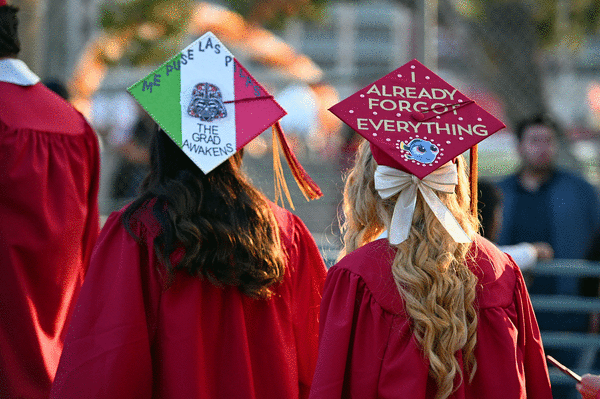
Nearly half of all American workers today are college-educated adults, with many holding jobs for which their degrees are no longer enough to help them to remain effective or sometimes even employable. Now, artificial intelligence is accelerating the issues, technological shifts and investor pressures that white-collar work has faced for decades.
Today’s educated workers need the ability to switch directions, acquire skills and make radical changes as old career paths disappear and new ones emerge. The problem is that our education and training systems haven’t kept pace with the abrupt and often unanticipated shifts in job requirements. Layoffs forcing career pivots are common across numerous industries, and a study of a million career trajectories by New York University and the Burning Glass Institute, a labor market analytics firm, found that nearly 25% of mid-career professionals were now in a “stall,” defined as five or more years without wage growth or promotion.
What is a college grad aged 25, 40 or 55 to do in the face of these radical job market shifts? Where can people and companies go to get the “just-in-time” knowledge and skills needed to adapt and stay competitive? These are central questions facing millions of students, parents, workers and employers today.
Here’s what almost nobody knows: A solution is already hiding in plain sight. The University of California system educates more than 320,000 college graduates each year in new and emerging technologies, including healthcare, teaching, manufacturing, drug development, material science and media, largely through its extension and professional development programs.
Through studies conducted across eight metropolitan regions, including New York, Atlanta, Chicago and San Diego, we discovered that research universities throughout the U.S. are helping college-educated workers retool and pivot their careers thanks to what we describe as America’s “shadow training system.” These programs quietly meet employers’ needs for up-to-date skills and graduates’ needs to stay current, even those who hold advanced degrees from prestigious institutions.
California helped invent this model. UC San Diego, for example, has spent more than 50 years meeting the real-time talent needs of once incubating local companies such as Qualcomm, the telecom giant, and Illumina, a leader in DNA sequencing technologies. Meanwhile, Georgia Tech has trained tens of thousands of working adults in digital technologies, originally with AT&T‘s backing. And the University of Washington has enjoyed years of career training partnerships, first with Boeing and more recently with Microsoft.
The universities doing this training understand that “career launching” of undergraduates with bachelor’s degrees is not enough, and that “career sustaining” education of college graduates is not a luxury or a private good but a necessity for regional economic competitiveness. They remain strong in foundational degree education — focusing on the liberal arts and sciences that form and launch lifelong thinkers, communicators and problem servers. And they operate at dual speeds: Alongside the deliberate rhythms of degree programs and research institutions, they run nimble units that read labor market signals in real time, design short-term programs with employer input, schedule these programs for working adults and retire them when demand fades.
Community colleges and technical programs rightly get credit for workforce development, but the college-educated workers facing disruption are largely absent from that conversation, even as employers search for people who can quickly adapt to new technologies in the office, the laboratory, the clinic and the sales floor. Hiring managers, notably, already trust universities here. A National Assn. of Colleges and Employers survey suggests that employers place unusual trust in university certificates: More than 75% ranked them above certificates from community colleges and for-profit institutions.
If we want to address this issue head on, the UC system’s leadership — its president, its chancellors, its regents — should declare career-sustaining education a formal and co-equal mission of the universities alongside launching careers and conducting research — and it should invest in this mission and measure it accordingly. That means every UC graduate would come with a guarantee that no diploma currently promises: that the university that launched their career will have their back if and whenever reeducation becomes necessary. It also means that California will be able to maintain a workforce nimble enough to keep the state’s regions competitive in a global economy now being rewritten by AI.
The mechanisms exist. The track record is more than 50 years long. What is missing is the declaration that this work is central to what a public research university is built for. Many of the technologies disrupting careers today are pouring out of university laboratories. The obligation to help Californians adapt to them should live there as well.
____
John D. Skrentny is a p rofessor of s ociology at UC San Diego. Mary L. Walshok is recently retired a ssociate ice c hancellor for p ublic p rograms and d ean of u niversity e xtension at UC San Diego.
©2026 Los Angeles Times. Visit at latimes.com. Distributed by Tribune Content Agency, LLC.





















































Comments