Commentary: Censoring is out. Bullying is in
Published in Op Eds
When we imagine a threat to free speech, we picture a ban — a law forbidding certain words, a prosecutor charging a dissenter, an official with a censor’s stamp. That picture is increasingly obsolete. The gravest threats to expression today rarely announce themselves as censorship. They take the form of ordinary administration turned to punishment — a grant frozen in reprisal, a clearance revoked over a dissenting view and, most insidiously, a damaging official label affixed to a company for the positions it has taken. The designation does quietly what the censor’s order once did openly.
I call this expressive governance — the use of routine administrative tools to punish disfavored views while preserving the appearance of business as usual. The government issues no prohibition and prosecutes no speaker. It deploys an administrative instrument against the speaker instead, pointing to a managerial or security rationale that, on its face, appears to lie within the government’s discretion.
A case now in federal court in California shows how it works. After the artificial-intelligence company Anthropic publicly maintained that it would not allow its models to be used for autonomous weapons or mass surveillance — and declined contract terms that would have required otherwise — the government labeled it a “supply-chain risk to national security,” a designation historically reserved for foreign adversaries, and moved to sever Anthropic’s commercial relationships across the federal defense ecosystem. The label was framed as a security judgment. But the timing, the naming of a single company and the sheer disproportion of the response point to something else: retaliation for protected speech, accomplished through an administrative tag. A federal court has already preliminarily blocked the government from enforcing the core designation while the case proceeds. The court is set to hear the parties’ summary-judgment arguments on July 30 — a ruling that could decide whether the label survives at all. (I filed a friend-of-the-court brief in the case, supporting the company.)
What makes this tactic so effective is precisely what makes it hard to stop. The instruments are facially neutral — nothing in a supply-chain designation announces a viewpoint. The decisions are discretionary, the very terrain on which courts have long declined to second-guess the executive. And the justification typically arrives afterward, pitched at a comfortably vague altitude: “national security,” “supply-chain risk,” “mission alignment.” The result is a mode of governance that produces the silencing effect of censorship while presenting to a judge as routine paperwork. The “chilling effect” courts once treated as censorship’s unintended byproduct has become the instrument itself.
The danger does not stop with the target. Nearly every institution through which Americans speak and learn — TV networks, universities, digital platforms, the firms that build the tools we use to find and share information — depends, directly or through its owners, on federal contracts, grants, licenses or approvals. Most news outlets themselves hold no federal licenses or contracts, but their owners often do — the Washington Post’s Jeff Bezos built Amazon, whose cloud division is a major defense contractor, and owns the aerospace firm Blue Origin, so the dependency runs one level up. Each dependency is a lever. When one company is punished for a public position, every similarly situated speaker takes the lesson: a disfavored view may invite quiet reprisal. The chill is structural. It shrinks the space for debate across an entire class of speakers, not just the one in the headlines.
Here is the frustrating part: The legal principles needed to address this are not in doubt. The government may not use coercion to suppress disfavored speech, and it may not do indirectly what the Constitution forbids it to do directly. Courts applied exactly these principles when they struck down executive orders targeting law firms by name for their advocacy. The principle is clear and solid; the problem is applying it to this new administrative strategy. The legal doctrine was built to reject bans, not labels, and it lacks a reliable way to surface an illicit motive when the government has dressed its action in the language of discretion.
So I have proposed a method — not a new constitutional test, and not a rollback of the executive’s legitimate authority, but a disciplined way for judges to ask three questions in sequence.
The first is the simplest: Where did this power come from? When an administrative tool is turned against speech or the infrastructure that carries it, a court should require the government to point to clear congressional authorization — a clear-statement requirement familiar from other corners of the law. What statute authorizes the executive to brand a domestic American company a foreign-adversary security risk at all? If none does, the case is over before motive ever comes up.
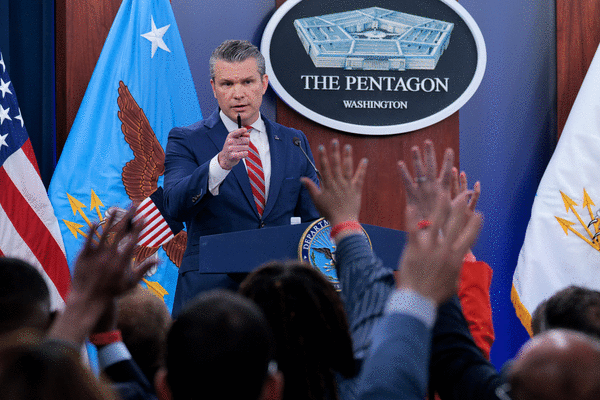
From there, the burden of proof should shift. Can a claimant show both a pattern that points to viewpoint bias on the government’s part — suspicious timing, a company singled out by name, officials’ own statements — and a dependency the government can exploit? Officials are rarely as discreet as one might assume: The executive orders against the law firms named their advocacy on their face, and in the Anthropic case the Defense secretary denounced the company’s “arrogance,” “rhetoric” and “ideology” in the very post announcing the label. If yes to both showings, the government should have to prove, on the record, that it would have acted identically for legitimate reasons. That a decision is discretionary and hard to see is a reason to look harder, not to wave it through.
And the third: Does the target belong to the class I call expressive intermediaries — a newspaper, a platform, an AI system, the kind of entity that shapes how the rest of us find and understand information? If so, a presumption should attach. A vague invocation of “national security” cannot carry the day; the government must come forward with neutral criteria stated in advance, individualized evidence and real procedural safeguards. A government acting on legitimate reasons rarely needs to hide them.
This framework cuts both ways, which is the point. A different court recently declined to block an executive order precisely because the government carried this burden: statutory authority on point, an articulated security rationale, and a record free of retaliatory statements.
The government remains free to disagree with a speaker and, with valid justification, to decline its terms and to take its business elsewhere. What officials may not do is convert the instruments of administration into instruments of punishment. The task now is to give courts the tools to tell the difference — before the label becomes the censor’s new stamp.
____
Simona Grossi is a professor of law at LMU Loyola Law School in Los Angeles.
©2026 Los Angeles Times. Visit at latimes.com. Distributed by Tribune Content Agency, LLC.

















































Comments