Jill Burcum: Smoke-filled summers cannot become the norm
Published in Op Eds
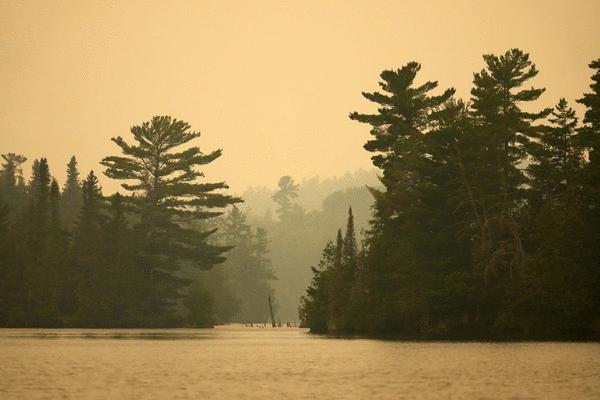
My late father-in-law smoked unfiltered Camel cigarettes. Regrettably, I now feel like I do too when summer makes its annual debut.
The culprit is the wildfire smoke blanketing Minnesota again and again, turning blue skies to apocalyptic yellow, with ash coating cars and windowsills in some of the hardest-hit areas of our state. The gloomy haze has made it challenging to enjoy our world-class natural resources during the season when they’re easiest to appreciate. Paddling, hiking or even sitting on the porch has become hazardous to your health instead of a reward for surviving a long, brutal winter.
So I understand the frustration that’s led President Donald Trump and other holders of high office to lash out at Canada, even though a collaborative approach to wildfire prevention and management would be far more productive.
I would like my summers back, please. I’m not willing to accept a new normal where I have to schedule around air quality alerts the same way I do thunderstorm watches and warnings.
Something must be done, because this is unacceptable. But we need more than the angry rhetoric coming from Washington.
Trump last week accused Canada of “Willful Negligence” in a Truth Social post, threatening to tack the cost of wildfire smoke onto existing tariffs. Ohio Sen. Bernie Moreno went further, introducing a bill that would have the president determine whether Canadian wildfire smoke harmed U.S. air quality, then sanction the Canadian officials found responsible, freezing assets, revoking visas, and declaring Canada’s ambassador unwelcome until the smoke clears.
It’s not the first shot fired in this direction: U.S. Rep. Tom Tiffany, R-Wis., spearheaded a similar effort last summer, authoring a letter co-signed by Minnesota’s Tom Emmer, Michelle Fischbach, Pete Stauber and Brad Finstad, blaming Canadian forestry mismanagement.
Ontario Premier Doug Ford had a blunt response recently to the criticism. “Why don’t you send up some water bombers?” he said publicly on July 20, pointing to the water bombers, firefighters and utility crews Canada has sent south for California blazes and hurricane recovery. “Why don’t you start helping us, like we would help you in a heartbeat?”
Canada has already stepped up to help in a big way. Earlier this month, the Royal Canadian Air Force evacuated 11 Minnesota teenagers and four staff members trapped by wildfires in Ontario’s Wabakimi Provincial Park, flying them out after 48 harrowing hours. Minnesota Gov. Tim Walz has credited Ford and the Canadian military for the quick response. It’s a small, timely reminder of how well cross-border cooperation can work.
Lost in the political point-scoring by Trump and Moreno is this reality: Smoke doesn’t respect borders. Wildfires burning in Minnesota, California and other U.S. states have sent their own smoke north into Canada this year. Treating this as a one-way offense is ridiculous.
It’s also unhelpful. The angry rhetoric exacerbates already simmering tensions between the two nations over trade and Trump’s proposal to make Canada the 51st state. We are North American neighbors and allies. We need to act like it more broadly, but especially when it comes to fighting wildfires.
Prevention and containment are complex. Combining U.S. and Canadian resources, technology and expertise is our best shot at preventing and getting ahead of fires before they become a crisis on the ground and in the air.
Last summer, I was frustrated by a smoke-filled visit to Grand Marais, the beautiful small city on Minnesota’s North Shore. This 2025 visit there was so hazy I could barely see a block down the street, much less the serrated vista of the nearby Sawtooth Mountains.
I followed up when I returned home by interviewing the University of Minnesota’s Lee Frelich. He’s the director of the Center for Forest Ecology. Forest fires are one of his areas of interest.
I asked him then if Canada’s wildfires are evidence of its own forest mismanagement, which the rhetoric from Trump and Moreno implies.
His answer was that both countries rely on similar strategies. Canada’s real challenge, he said at the time, is that it holds one of the “world’s most flammable types of forest” across millions of acres, much of it in remote locations that are difficult to reach.
This boreal forest is dominated by conifers that dry out fast. Going without rain for even a couple of weeks is enough to create hazardous conditions, especially given the long hours of summer sunlight at northern latitudes. Add in pine needles and naturally flammable pine pitch, and the fuel is already there. Then, Frelich said, layer in climate change. An earlier spring and later fall mean more time for water to evaporate, extending the fire season, while extreme warm spells add still more risk.
I checked in with Frelich again on Tuesday, and he said this remains an accurate summary.
Long-term data from the Canadian national fire database tells a surprising story: The annual number of fires has generally trended down since a peak in the early 1990s. But what has changed is the size of the area burned. This has spiked in recent years, topping out at around 15 million hectares (or around 37 million acres) in 2023, far above anything in the historical record. Fewer fires burning more land appears to be a signature of drought and heat.
Chelene Hanes, a Canadian Forest Service research scientist, told CBC News earlier this year that today’s largest fires often overwhelm conventional firefighting tactics, pushing crews toward containment rather than suppression. The reason, she said, is that everything is so dry that these fires are accounting for a growing share of the total land burned.
None of this, however, is an excuse for throwing up our collective hands. If conditions are driving bigger wildfires, what can be done to prevent them and improve the response to control them?
A Canadian Senate report released in June drilled down into this and called for more coordination among the federal, provincial, local and Indigenous governments. There were also calls to more closely look at prescribed burning, wildfire-resilient infrastructure, modernized building codes, enhanced predictive modeling, early-warning systems and investments in new technology such as satellite monitoring, aerial firefighting capacity and advanced drone systems.
That prescription also holds value for the United States. Coordination between the nations on investments and strategies would be a logical step. A shared threat calls for a shared response.
The president and others should focus on collaboration with our northern neighbor. Instead of retaliatory rhetoric or legislation, let’s build the joint infrastructure and funding streams that actually reduce fire risk. And, enable innovation to better predict and control fires.
That’s the kind of leadership needed to meet this moment. None of it will be easy or inexpensive. But it’s a necessary investment in summers yet to come.
_____
©2026 The Minnesota Star Tribune. Visit at startribune.com. Distributed by Tribune Content Agency, LLC.



















































Comments