Jill Burcum: Who should decide what research gets funded, political operatives or scientists?
Published in Op Eds
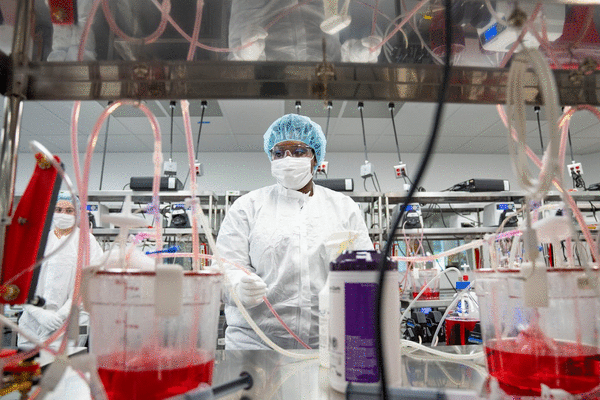
Minnesota’s medical centers and research laboratories do more than heal patients and push forward science’s frontiers. They also power the state’s economy.
In 2025 alone, the National Institutes of Health (NIH) awarded $725 million in grants and contracts to Minnesota institutions, dollars that supported 7,735 jobs and generated $1.79 billion in economic activity, according to data compiled by United for Medical Research, a research advocacy coalition.
That’s critical context in which to weigh a proposed federal shake-up of the research funding system. If this ill-advised reform is finalized, it threatens to funnel research dollars to whoever curries favor with the White House’s political agenda instead of wherever the best science is happening.
This isn’t just a concern for doctors and researchers. A strong economy and access to the latest treatments when illness strikes is foundational for our physical and economic well-being in Minnesota and across the nation.
The U.S. government invests massive sums in research and development — an estimated $193 billion in 2025, according to an American Association for the Advancement of Science analysis. The funding touches nearly every field of American science, fueling the innovation that makes the United States a global leader in medical and scientific discovery.
But under this proposed change, this invaluable investment could instead become a tool for political retribution or fighting supposedly “woke” ideas or other cultural issues any administration deems unworthy. This would be a grave mistake when the United States’ current system is the model other nations have spent decades trying to replicate.
The proposal is formally titled “Regulation for Federal Financial Assistance.” It was unveiled by the White House Office of Management and Budget (OMB) on May 29. OMB is led by Russell Vought, one of the architects of Project 2025, the conservative blueprint for reshaping the federal government.
The plan calls for rewriting the governmentwide framework that decides where federal research dollars should flow. Political appointees would have new power to approve, reject or cut off funding for research projects that have traditionally been vetted by independent scientists.
It’s not hard to imagine what could go wrong. A political appointee lacking expertise could mistake legitimate research on transgenic crops or organ transplants for something about transgender issues. Legitimate science could be defunded over nothing more than a misunderstanding.
It’s unsurprising that critics are taking aim at this reckless proposal.
One of the world’s most prestigious medical publications, the New England Journal of Medicine (NEJM), sharply criticized the change in a June editorial.
They noted that selecting the most promising research is “an enormously complex and challenging undertaking.” Jettisoning a merit-based award process for one driven by politics will put patients at risk and waste resources, they warned.
The editors took particular aim at changes allowing agencies to terminate active grants, potentially years into a study, without cause. Consider a hypothetical they raise: a clinical trial testing a new cancer therapy, which is often a yearslong endeavor.
“If a decision to stop funding the trial occurred at year 4 for political rather than scientific reasons, what would happen to patients who were enrolled in the study at that time?” the editors wrote. ”How would longer-term safety and efficacy observations be made? This type of arbitrary midcycle termination of a clinical trial could place participating patients at significant risk of harm."
Families who have relied on Minnesota’s medical centers voiced their concerns in the public comments filed on the OMB docket, part of a public-comment period that closed Monday. One commenter described a brother-in-law’s diagnosis with an aggressive form of cancer. Care at the University of Minnesota and Mayo Clinic extended his life long enough to see his youngest son graduate high school. The treatment was made possible by federally funded research.
“Please do not allow the proposed rule by OMB to be instituted,” the commenter wrote. “Don’t throw sand into the gears of lifesaving federal medical research.”
The University of Minnesota, one of Minnesota’s two world-class medical research institutions, is understandably worried by the proposed change.
“The University of Minnesota, similar to other higher education institutions across the country, is concerned about the Office of Management and Budget’s proposed rule and its potential impact on federally funded research,” a University spokesperson said. She added that a work group has been reviewing the rule and gathering input from researchers.
Mayo Clinic’s communications office did not respond to questions about the rule. But individual Mayo researchers have made their personal opposition known directly to the federal government through public comments filed on the rule’s official docket.
Minnesota’s own Sen. Tina Smith has also been sounding the alarm. In a June 26 letter, one that just became public last week, Smith and 11 other senators warned that the rule “turns federal assistance into a political slush fund” and would let political appointees “circumvent Congress’ constitutional power of the purse.”
Then, on July 1, every member of the Senate Democratic caucus — including Smith’s fellow Minnesota Democrat Sen. Amy Klobuchar — signed a broader letter demanding OMB rescind the rule entirely, calling it an attempt to turn federal grants into “a new cudgel for the President to unilaterally advance his partisan agenda and punish political rivals.”
Concern has crossed party lines. Senate Appropriations Committee Chair Susan Collins, a Maine Republican, has sent her own letter asking OMB to extend the public comment period and strip out the most damaging provisions.
Smith didn’t hold back in a statement shared with me last week. She pointed to a recent achievement: U scientists developing the first synthetic cell with a complete life cycle.
She said this is exactly the kind of high-level research the rule puts at risk. “If this rule goes through, it’s a lose-lose situation,” Smith said. “Rather than scientists reviewing other scientists’ ideas, the president’s loyalists will inject partisanship into a previously nonpartisan process.”
OMB has defended the changes as necessary oversight, and that the rule change would improve the ability of agencies to identify and respond to waste, fraud and abuse.
Waste and fraud are real problems, but the solution is stronger audits and oversight, not handing presidential appointees the power to override scientists and pull the plug on lifesaving research for ideological reasons.
___
©2026 The Minnesota Star Tribune. Visit at startribune.com. Distributed by Tribune Content Agency, LLC.



















































Comments