Michael Hiltzik: Puncturing the myth of Alan Greenspan, whose policies gave us the Great Recession
Published in Op Eds
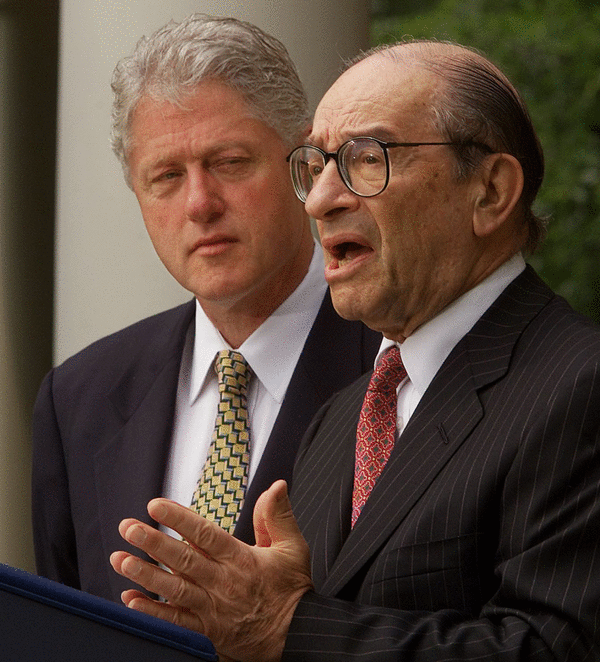
Noah Cross, the archvillain of the movie "Chinatown," had the definitive line on how old age brings respectability. "'Course I'm respectable," he tells Jake Gittes. "I'm old. Politicians, ugly buildings and whores all get respectable if they last long enough."
I wouldn't necessarily slot former Federal Reserve Chairman Alan Greenspan into any of those categories, but the general reaction to his death Monday at age 100 puts the lie to Cross' observation.
As much as he was revered during his nearly two decades as Fed chairman for protecting the stock market from a series of crashes and near-crashes, his obituaries take a more measured view. The headline on the Wall Street Journal's main take on his legacy is: "The Myth of Alan Greenspan as 'The Maestro.'"
The Journal blames Greenspan for fostering "the great credit mania of the mid-2000s" and observes that "the music stopped in 2008, producing the panic that did so much harm to the free-market economy that Greenspan promoted." That was the Great Recession, which started with the 2008 crash in the housing market and persisted into 2012.
That is from a publication that was more or less in accord with Greenspan's goals of less regulation and lower taxes. His contemporary adversaries were harsher. "R.I.P. Alan Greenspan: You were charming, thoughtful, powerful, and wrong," writes Robert Reich, who served as Bill Clinton's Labor secretary while Greenspan led the Fed.
The Great Recession, "in which in which millions of Americans lost their jobs, their savings, and even their homes — resulted from the deregulation of Wall Street that Greenspan advocated," Reich wrote. But he had to admit that Greenspan's "iron grip" over Fed policy forced Clinton "to do exactly what Greenspan wanted — which was to reduce the federal budget deficit and thereby destroy much of the agenda Clinton ran on."
It would be unfair to depict Greenspan's influence as invariably pernicious. Social Security advocates still think highly of his work chairing the so-called Greenspan Commission of 1982-1983, which developed a series of changes in benefits and revenues for that program to address a looming, immediate fiscal crisis.
Greenspan led the bipartisan panel "masterfully," recalls William J. Arnone, the former chief executive of the National Academy of Social Insurance, who witnessed its deliberations as a consultant to the New York Citizens Committee on Aging.
Before the commission's formation, "Republicans and Democrats fiercely disagreed over underlying data," Arnone told me. "Greenspan used his expertise as an economic empiricist to convince both sides to agree on a singular, shared set of actuarial facts. Quite an accomplishment."
To the public, Greenspan was known for his impenetrably cryptic speaking style and for the relative tranquility in the American economy during his tenure, which has been termed "the great moderation" despite recurrent short-term crises.
Greenspan was the second-longest serving Fed chair. But he may have had the weirdest background. Having grown up in an affluent New York household, he was talented enough on clarinet and saxophone to have sat in with Stan Getz's band and attended Juilliard for a time.
He began his economics education in 1945 at New York University and got as far as a master's degree, but by then he was already working on Wall Street, where his skill at financial analysis propelled him toward the top echelons of high finance.
Somewhere along the line he fell in with the arch-libertarian Ayn Rand, becoming part of her inner circle of economic cultists. Referring to his dour mien and predilection for charcoal gray garb, Rand called him her "undertaker."
Greenspan provided a veneer of rigorous economic analysis for Rand's ideology, which lionized the rich and described them as fighting a ferocious battle with the lazy and grasping hoi polloi. He contributed three essays to her 1966 anthology "Capitalism: The Unknown Ideal."
His association with Rand was seldom highlighted during his Fed tenure, but even a casual reading of those essays exposes the Randian underpinnings — and the Randian self-contradictions — of his Fed policies.
One essay defended the gold standard, which had been discredited in the 1930s. Greenspan blamed "welfare-state advocates" for the developed world's abandonment of the gold standard.
He wrote, "Stripped of its academic jargon, the welfare state is nothing more than a mechanism by which governments confiscate the wealth of the productive members of a society to support a wide variety of welfare schemes.... Gold stands in the way of this insidious process. It stands as a protector of property rights" — language that could have come right out of the text of Rand's "Atlas Shrugged."
Another essay called for the dismantling of government regulators such as the Food and Drug Administration and the Securities and Exchange Commission. Greenspan's argument was that the consumer was adequately protected by the businessman's profit-seeking, which in turn depended on maintaining a reputation for honesty and fair-dealing.
For drug companies, he wrote, "the loss of reputation through the sale of a shoddy or dangerous product would sharply reduce the market value of the drug company." The same goes for securities brokers — "The slightest doubt as to the trustworthiness of a broker's word or commitment would put him out of business overnight."
One might ask what inspired Greenspan's faith in, well, the faithfulness of business enterprises, given centuries of proof otherwise. Anyway, he refuted his own argument. "The guiding purpose of the government regulator is to prevent rather than to create something," he wrote. "He gets no credit if a new miraculous drug is discovered by drug company scientists; he does if he bans thalidomide."
He didn't bother to question why his trustworthy drug companies had tried to market as a morning-sickness drug in the U.S. a formulation that already had been shown to produce severe birth defects in the children of mothers who took it overseas. (American families were largely saved from this tragedy by Frances Oldham Kelsey, who blocked its importation as an official of, yes, the FDA.)
To stock market investors, Greenspan's chief legacy was the "Greenspan Put." This was an implicit commitment by the Fed to counteract sharp declines in the market by pumping liquidity into the economy through the mass purchase of Treasury bonds.
The term comes from the options market, in which a "put" gives the holder the right to sell the underlying stock at a set price in the future, even if the market price has fallen below that price. In effect, it establishes a floor to the investor's losses in a downturn.
The Greenspan put first appeared on Oct. 19, 1987, when the stock market suffered its greatest one-day percentage crash ever, 20.47%. Greenspan had been in office for only a few weeks, but his Fed issued a statement promising to inject liquidity into the system and cut interest rates. "We will back you," he told bankers in a series of phone calls.
In truth, Greenspan had no legal authority to make that pledge. In any event, the market recovered the next day, and the Fed's image as a willing bulwark against market declines was born.
The problem was that the idea that the Fed would act in a market crisis encouraged ever more flagrant risk-taking on Wall Street.
The harvest was a series of crises, notably the 1998 collapse of the hedge fund Long Term Capital Management, which was founded by Nobel economics laureates to pursue abstruse arbitrage trades. It was brought low by market moves that confounded their projections. LTCM was so deeply embedded in Wall Street trading it had to be saved with a $3.6-billion bailout the Fed orchestrated.
The Greenspan put, like so many other such grand schemes, worked well right up until it stopped working. That moment came in 2008, with a crash and a long, throbbing hangover.
Testifying to Congress in 2008, Greenspan acknowledged that maybe self-regulation, that watchword of his economic worldview, didn't work.
"I made a mistake in presuming that the self-interest of organizations, specifically banks and others, were such that they were best capable of protecting their own shareholders and their equity in the firms.... Something which looked to be a very solid edifice, and, indeed a critical pillar to market competition and free markets, did break down."
That, he said, "shocked me." It was a rare admission of blame by a man who, as my former colleagues Thomas S. Mulligan and Don Lee reported in their Greenspan obituary, had told CNBC a few months earlier that he had "no regrets" about his policies.
____
©2026 Los Angeles Times. Visit at latimes.com. Distributed by Tribune Content Agency, LLC.
















































Comments