Commentary: My homework assignment was to move millions of bees
Published in Op Eds
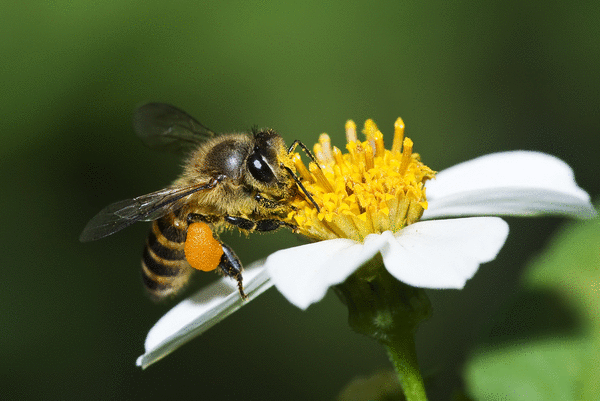
During National Pollinator Week (June 22–28), people across the country will celebrate bees and other pollinators while learning how to help protect them. As a master’s student in entomology, I’m doing some reflecting of my own after an assignment that left me questioning what “protection” really means.
My professor asked me to plan the route I would take as a migratory beekeeper. On paper, the assignment was about timing and logistics. But the more I worked through it, the harder it became to see it as only a business model.
Migratory beekeeping relies on moving managed honey bee colonies wherever there’s agricultural demand. Beekeepers load hives onto trucks at night, while the bees are inside, and haul them hundreds or even thousands of miles to pollinate almonds, apples, blueberries and other crops. Once a bloom ends, many of those colonies are sent to the next destination. From the perspective of agricultural planning, it’s efficient. From the perspective of the bees, it’s relentless.
Life on the road takes a toll on honey bees. Research has found that bees in traveling colonies have shorter lifespans and show signs of physiological stress compared with bees in stationary colonies. The journey itself can expose them to overheating and hours of vibration during transport, creating additional stress. Once they arrive, large numbers of hives are often concentrated in one place, increasing the potential for the spread of parasites and pathogens.
Honey bees are already dealing with disease, pesticides and forage limitations, and experts describe colony loss as the result of overlapping stressors rather than a single cause. That’s important because people often tout migratory pollination as a clever solution to agricultural timing. In reality, it’s a demanding workaround for a system that treats pollinators as a readily available resource.
But why are we so dependent on managed honey bees in the first place?
Honey bees may dominate discussions of pollination, but they aren’t native to North America. Long before their introduction, thousands of native pollinator species helped sustain healthy ecosystems and pollinated many of the plants people rely on today. The United States alone is home to about 4,000 native bee species.
Native pollinators can and do pollinate many crops, but they need places to nest and a variety of flowering plants throughout the season. Vast fields of a single crop may provide a burst of food during bloom but offer little during the rest of the year. As natural habitats disappear, local pollinator populations decline, and agriculture increasingly turns to managed honey bees to fill the gap.
I understand how we got here. Beekeepers are working within an economy that rewards pollination contracts, and farmers are trying to stay afloat in an industry that leaves little room for alternatives.
However, when you describe this arrangement plainly—millions of bees loaded onto trucks, transported across state lines, concentrated in enormous numbers for narrow bloom windows then moved again—it becomes very hard to call it benign. It may be common. It may be profitable. But none of that makes it ethical.
If we care about bees, we should also care about the conditions we ask them to endure. A healthier future for pollinators starts with healthier landscapes where they can thrive and where agriculture relies less on moving managed honey bee colonies around the country. Creating those landscapes is something we can all help with, whether by planting native flowers, forgoing the use of pesticides or supporting farming practices that leave room for wildflowers and nesting sites.
We say we need bees to survive. But what we’ve built is a system they may not survive.
____
Melissa Rae Sanger is a licensed veterinary technician and a senior writer for the PETA Foundation, 501 Front St., Norfolk, VA 23510; www.PETA.org.
_____
©2026 Tribune Content Agency, LLC.





















































Comments