Commentary: The only man who wants you to win
Published in Op Eds
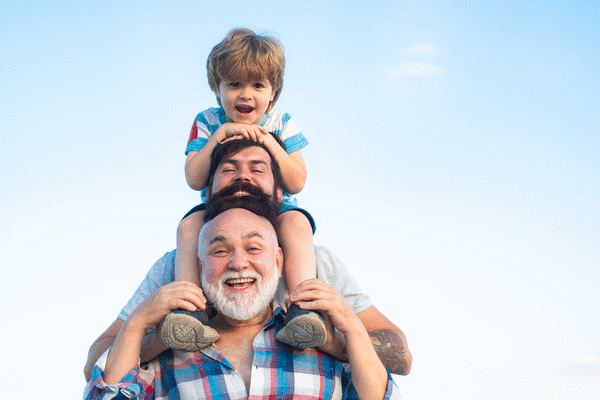
Earlier this year a short, viral video stopped me in my tracks. It featured Steve Harvey, who said your father is really the only man on earth who genuinely wants you to do better than him.
It hit me hard as a dad and a son. It is truer than it's comfortable to admit. As a man, it really seems that most men who love you tend to have a ceiling.
Some friends celebrate your success until it eclipses theirs. Mentors may champion you right up to the moment you'd take their chair. But a father's pride has no such limit. He wants you taller than he ever stood. He wants you to walk through doors he only ever knocked on. The day he sees you pass him is the day he wins.
I’m grateful for that thought this Father's Day, because it reminds our culture what a father is actually for.
Start with the thing we rarely say out loud (if we even think about it): Our understanding of authority and even the ultimate authority, God, was painted before we could pay attention in a church. It was painted at home by our father.
Long before we can reason about the divine, we’re already absorbing it — extrapolating from the first large authority who either showed up or didn't, who was either just or arbitrary, tender or cold. A father who is present and fair makes the idea of a loving, dependable Father in heaven feel plausible.
New research from Communio and the Institute for Family studies backs this up. Adults who reported a "very good" relationship with their father growing up had 58% higher odds of attending church weekly, 45% higher odds of praying daily, and 73% higher odds of believing in God, compared to those who had a bad or even just a somewhat good relationship. Communio has previously surmised that lack of quality fathers may offer the best explanation under the sun for Christianity’s decline in the United States.
A father who is absent or cruel adds a hurdle his children may spend decades trying to clear. You don't have to be religious to notice this pattern. The way we were fathered sets our expectations for how we will be led and loved by anything bigger than ourselves.
And here the social science is blunt in a way our politeness usually isn't. Fathers are not decorative. They are load-bearing. Removing them causes structural problems.
The numbers have been consistent for decades. Children in married-parent homes are dramatically less likely to grow up in poverty. Of course, father absence could be a stand-in for poverty and instability that would have hurt these kids anyway. These things travel together. But studies built specifically to separate the threads, using natural experiments and statistical controls, keep finding that the father’s presence itself matters.
None of this is an indictment of single mothers. A woman raising children alone, doing the work of two, is not the problem. After all, she is usually the heroic answer to someone else's failure. The point is not that she's doing it wrong. The point is that no one should have to do it alone. A culture that has quietly communicated fathers are optional has failed her at least as badly as it's failed her kids.
So what is a man supposed to bring? I’ve heard different working definitions of masculinity, but the one I like is this: strength, under control, in the service of others. Not strength hoarded for dominance or selfishness. This loud, self-exalting version currently being sold to lonely young men online is a destructive lie. And certainly not weakness or absence in real life and faux strength online.
Real strength is power that has been built and then deployed for others. Think about first responders, soldiers, and security guards. Men with these jobs model masculinity well. They train for strength, but are not to use it until it’s needed to counter the threats that are ever-present in our broken world. That’s the whole assignment. The family is where most men get to live out masculinity, one ordinary, unglamorous day at a time.
Here's the part for anyone reading this whose own father was absent or cruel.
The statistics describe odds, not destiny. They point us to what we should normalize and praise. They tell us what's likely across millions of lives; they do not tell us what's possible in ours. The cycle is real, but not unbreakable. And there is almost nothing more defiant, more inspiring, than a man who grew up without a father deciding that the absence stops with him. A man who shows up. Who stays. Who becomes, on purpose, the dad he never got.
If you had a father like that, be grateful. Call him if you can or tell someone about him.
And if you didn't, you can be the one who finally breaks the cycle and becomes the founding patriarch of a stronger tribe. One who wants your sons to surpass you.
____
Derrick Morgan is the executive vice president of the Heritage Foundation.
_____
©2026 Tribune Content Agency, LLC.




















































Comments