Commentary: Eisenhower's D‑Day leadership shows what America has lost
Published in Op Eds
On the anniversary of D-Day, I sat down to watch a movie and found myself unexpectedly in tears.
But that's what Pressure did to me. The new war film was directed and edited by Anthony Maras, written by Maras and David Haig, and starred Andrew Scott as the Scottish meteorologist James Stagg and Brendan Fraser as the burdened General Dwight D. Eisenhower.
The film strips D-Day down to its most improbable human element: not the beaches, not the battleships, not the paratroopers falling through the dark — but a general and a meteorologist, locked in a room, arguing over weather charts. The fate of the largest invasion in human history came down to one man's forecast, another man's willingness to trust it, and the overwhelming weight of a decision that could not be taken back.
What emotionally broke me wasn't the drama of the forecast. It was something quieter. It was watching men from different nations, America, Britain, Canada, sitting together in genuine trust, arguing fiercely, listening to each other, and ultimately choosing to be bound through a shared commitment. They didn't agree on everything. They didn't always like each other. But they showed up. They held the line together.
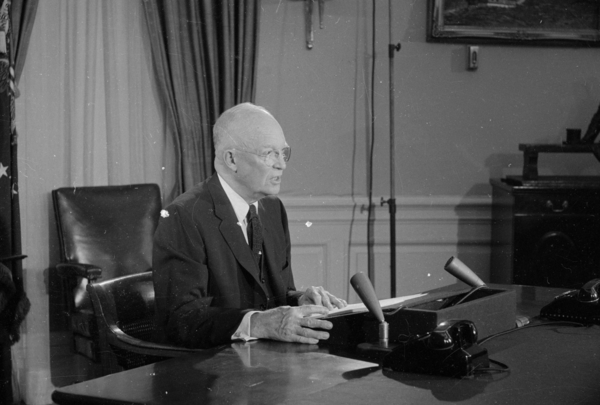
And then came Eisenhower's order to the Allied troops on June 6, and his words, delivered knowing that many of the men reading them would not survive the day.
Eisenhower warned them that the task would not be an easy one and that the hopes and prayers of liberty-loving people everywhere marched with them.
There was no bluster in it, no self-promotion. Just a commander laying down his own heart alongside the soldiers he was sending into the surf, bound together with allies from across the Atlantic in a cause that belonged to all of them.
We don't do that anymore
Something has gone quietly, profoundly wrong with American foreign policy — not in the way Washington debates it, as a matter of strategic interest or budget percentages, but in terms of basic character.
America has stopped being the country that shows up. We have started being the country that sends the bill.
The contrast that haunts me is simple. Eisenhower shouldered the weight of hundreds of thousands of lives — Allied soldiers, French civilians, a continent under occupation.
He wasn't thinking about his legacy. He wasn't thinking about leverage. He was thinking about his responsibility to something larger than himself: to an alliance, to a mission, to the idea that free nations owed each other their best effort.
Eisenhower would go on to become president, and that same disposition — sober, outward-looking, genuinely burdened by the cost of leadership — defined how he governed.
Compare that to the brand of leadership we have now, where the first question in every room seems to be what's in it for me? Where partnerships are treated as transactions, allies as customers, and American prestige as a personal asset to be monetized.
The difference isn't just political philosophy. Its character. Eisenhower understood that the office existed to serve something above the man who held it. That understanding feels very far away right now.
Let's not be naive, the postwar order America built wasn't selfless. It served American interests. But it also rested on something genuine: a recognition that the world works better when free nations stick together, that alliances are worth honoring, not simply when convenient, that a partner's credibility is a currency you can spend only once.
That architecture is fraying, if not nearly gone. Countries that have staked their entire security on the American promise are recalculating. They'd be fools not to.
America used to understand that a world of strong allies was a world in which Americans could prosper. We don't seem to understand that anymore, or we comprehend it and no longer care.
The retreat isn't solely strategic. It's moral. There is a difference between a superpower that leads through legitimacy — one that other nations follow because they trust its judgment and count on its word — and one that throws its weight around while dismissing the very partners its credibility depends on. The world has noticed.
In Pressure, Stagg gives Eisenhower the only honest thing he can: his best judgment with no guarantee that it is right. And Eisenhower does the hardest thing a leader can do — he trusts someone else, absorbs the uncertainty, and decides. Not for himself, rather for everyone counting on him.
Eighty-two years later, the question isn't whether we're capable of that again. It's whether we still believe it matters.
I'm not sure we do. And that is what brought me to tears.
____
Lynn Schmidt is a columnist and Editorial Board member with the St. Louis Post-Dispatch. She holds a master's of science in political science as well as a bachelor's of science in nursing.
_____
©2026 The Fulcrum. Visit at thefulcrum.us. Distributed by Tribune Content Agency, LLC.




















































Comments