Commentary: Treasurer's $8.65 check for the pope reveals the politics of unclaimed money
Published in Op Eds
When Illinois Treasurer Michael Frerichs met Pope Leo XIV at the Vatican, he brought an unusual gift: a check for $8.65.
The money came from an old PayPal account that had been turned over to Illinois as unclaimed property before Robert Prevost, an Illinois native, became the pope. The amount was insignificant. The publicity was priceless.
That is what makes the story so revealing.
The pope’s $8.65 windfall was not really about the money. It was about the politics of returning unclaimed property.
Frerichs later acknowledged that presenting the check would help draw attention to Illinois’ unclaimed property program. He was right. The story generated headlines around the world. But it also highlighted an uncomfortable truth that rarely gets discussed.
Returning unclaimed money is good politics. Returning most of it is much harder.
Across America, elected officials routinely hold news conferences celebrating the return of forgotten money. They announce six-figure checks to families. They pose with retirees who discovered old pension funds. They celebrate veterans who recovered long-lost benefits. Now, apparently, they can add popes to the list.
The stories are heartwarming. They are also politically useful.
Every returned dollar creates goodwill. Every successful claim becomes proof that the system is working.
What rarely gets equal attention is the money that remains behind.
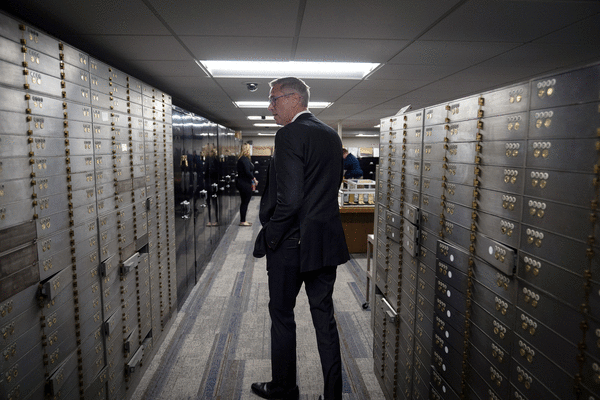
Today, state governments collectively hold more than $100 billion in unclaimed property. According to the National Association of Unclaimed Property Administrators, roughly 1 in 7 Americans have unclaimed money waiting to be claimed.
Yet despite decades of public awareness campaigns, more than $100 billion remains untouched, and that cash pile grows bigger every year. New York is sitting on $20 billion; California, $15 billion; Texas, $10 billion; New Jersey, $6.6 billion; and Illinois, $5 billion.
The fundamental problem is that the system still places most of the burden on citizens.
To recover your money, you must know that unclaimed property programs exist. You must know which states to search. You must remember addresses you may have lived at decades ago. You must search under every variation of your name. And then you must repeat the process because new records are added continuously.
In other words, the system depends on people finding the money rather than the money finding the people.
That made sense in 1985. It makes far less sense in 2026. The pope’s story exposes the contradiction.
Illinois somehow managed to identify an $8.65 account belonging to a man who now leads more than a billion Catholics around the world. The state knew enough to connect the account to Pope Leo. It knew enough to track down the rightful owner. It even delivered the claim personally.
If a state can find the pope for $8.65, why can’t it find millions of ordinary citizens who are owed much larger sums? The answer comes down to incentives.
Politicians receive credit every time money is returned. Returned money generates positive headlines. It creates compelling human-interest stories. It demonstrates responsiveness and consumer protection.
At the same time, states have relatively little incentive to build systems that would dramatically increase claim rates.
Many states use unclaimed property funds to support government operations, manage cash flow or generate investment income before claims are paid. Others rely on large unclaimed property balances as a stable financial resource. The specifics vary from state to state, but the result is often the same: Governments are very effective at collecting unclaimed money and far less effective at proactively returning it.
Imagine if a bank operated this way. Imagine if your bank discovered money in your account but required you to periodically search a government website to determine whether it belonged to you. Imagine if the bank then held a news conference every time someone successfully found their money.
You would not call that customer service. You would call it absurd.
Yet that is effectively how much of America’s unclaimed property system still works.
To be fair, some states have begun taking meaningful steps forward. Illinois has expanded automatic matching programs and has returned billions of dollars to residents. Other states have adopted direct outreach programs and simplified claims processes.
Those efforts deserve recognition. But they are still the exception rather than the rule.
The bigger opportunity lies in technology.
Artificial intelligence can identify faces in photographs, translate conversations in real time and detect fraudulent transactions in milliseconds. The same technology can be used to identify likely owners of unclaimed property, monitor databases continuously, notify consumers automatically and dramatically increase return rates.
Instead of requiring citizens to search dozens of government databases, technology can bring the results directly to them. That shift would transform unclaimed property from a passive system into an active one.
And that is where the politics become interesting. A system optimized for publicity produces stories about individual success. A system optimized for results would focus on returning as much money as possible, whether anyone notices or not.
The two goals are not always the same.
The pope’s $8.65 check made for a wonderful headline. It generated attention for a worthy program and reminded people that forgotten money can belong to anyone. But it should also prompt a tougher question.
If governments can find the pope, why are they still waiting for everyone else to find themselves?
The goal of unclaimed property should not be creating better photo opportunities. It should be returning people’s money. And until states make that their highest priority, the real story will not be the occasional check handed to a pope.
It will be the more than $100 billion still waiting for its rightful owners.
_____
Mark Lewyn is a former staff writer for BusinessWeek and USA Today’s Money section and the founder of the website UnclaimedMoneyGuy.com. He can be reached at mark@unclaimedmoneyguy.com.
_____
©2026 Chicago Tribune. Visit at chicagotribune.com. Distributed by Tribune Content Agency, LLC.




















































Comments