Politics
/ArcaMax
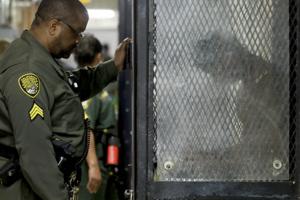
Commentary: California leads the way in bringing menopause care to prisons
Last week, the Senate Special Committee on Aging made history with the first congressional hearing on menopause. It was long overdue — and marked the latest development in a growing menopause movement reshaping access to treatment for women across the country.
This moment is ripe with potential — and in many ways, California is at the ...Read more

Editorial: Helicopter parenting shouldn't be required
The nanny state needs a timeout.
A judge recently found Karyann Parkinson, a Virginia mom of five, guilty of contributing to the delinquency of a minor. She was given a suspended jail sentence and placed on the state’s child abuse and neglect registry. She has appealed.
That charge makes it sound as if Parkinson committed a serious offense. ...Read more

Editorial: Why America lost the War on Poverty
The War on Poverty is proof that good intentions don’t produce good results.
In 1964, President Lyndon B. Johnson used his first State of the Union address to declare an “unconditional war on poverty in America.” He proposed a host of remedies to cure it. They included a “broader food stamps program,” higher minimum wage and revamping...Read more

John M. Crisp: The Democratic Socialists aren't communists
Not far from where I live, a very large billboard stands alongside one of the busiest interstate highways in the nation, in full view of many thousands of motorists every day. It reads: “Texans: Democrats Want COMMUNISM. Republicans Do Not.”
This is disingenuously misleading. It echoes, in tone and content, an allegation gathering steam ...Read more

Editorial: Trump and his gossamer skin are far too easily pricked
Here is one for the annals of editorials we never thought we would need to write: The president of the United States should not ban established and respected news outlets from reporting on his daily doings.
But, in fact, we do.
If Donald Trump won’t listen to this reason, those with thicker skin around said president should gang up on the ...Read more
Commentary: When neither party is the default -- Rethinking representation as America's electorate changes
For most of my career as a political scientist, representation was the central theme of my teaching and research. Early on, I studied how legislators understood their responsibilities to constituents — whether they saw themselves as delegates carrying out constituent mandates, trustees exercising independent judgment, or politicos combining ...Read more

Editorial: Fighting back on Trump's cruel public charge plan
President Donald Trump’s ever-cruel administration is wrongly trying to put up even more roadblocks to block legal immigrants from getting green cards and a coalition of states and cities, led by New York in the persons of Attorney General Tish James and Mayor Zohran Mamdani, is correctly fighting back.
The U.S. Citizenship and Immigration ...Read more
Justin Fox: Noncitizens don't sway elections, even in a pro-Trump tally
Last month, the Census Bureau published a strange little document claiming that “over 24,000” votes were cast by noncitizens in the 2020 U.S. general election.
The anonymous report has come under fire for its provenance and methods: It was reportedly produced outside of regular Census Bureau channels by political appointees and staffers at...Read more

Editorial: Time to panic about AI? Take a look at what we know about the job market
Far from the halls of Congress, researchers at the Federal Reserve Bank of St. Louis are making factual assessments about how artificial intelligence is affecting workplaces in the real world.
So far, the hype machine is getting a reality check. Contrary to the predictions of AI boosters, who have much to gain from promoting the technology, ...Read more
Commentary: 2001's Authorization for Use of Military Force is being treated like a forever law for forever wars
As of last Friday, a quarter century has elapsed since the 2001 Authorization for Use of Military Force (AUMF) became law. When U.S. Sen. Dick Durbin and U.S. Reps. Danny Davis and Jan Schakowsky depart D.C. in January, no Illinois legislator who voted for the AUMF will remain in office. In fact, only 32 lawmakers of the 2001 Congress will ...Read more

George Skelton: Three ballot measures on housing, medical research but only one no-brainer
SACRAMENTO, Calif. — Three state bond measures are on California’s November ballot. You probably haven’t paid much attention to them. So here’s my read on these big-ticket proposals.
One is a no-brainer “yes.” It would help middle-class Californians buy a new home by allowing them to borrow most of the down payment. And it wouldn�...Read more

Trudy Rubin: What I learned in Ukraine: Kyiv has the tech brilliance to force Russia to the table -- if Trump would stop backing the Kremlin
KYIV, Ukraine — It’s not easy to get to Ukraine, where the airports have long been closed and where Russia is now targeting the country’s essential railway network, hitting tracks and destroying hundreds of locomotives.
On my sixth visit since 2022, I decided to fly to neighboring Moldova and taxi across the border, even though Moscow has...Read more

Editorial: Quantum is not AI, folks, and Chicago is not building a lakefront data center
Repeat after us: The Illinois Quantum and Microelectronics Park (IQMP), in development on 128 acres of the former U.S. Steel South Works site on Chicago’s South Side, will not be a collection of power-sucking, water-drinking data centers.
Repeat after us: Quantum computing is not threatening to take over humanity.
The emergent technology ...Read more

Mark Z. Barabak: The worst, most vile candidate in Texas isn't who you might think
In the second week of the college football season, in a clash of titans, the University of Texas scored 21 unanswered points to surge past Ohio State in the fourth quarter and win, 24-23.
The comeback, Gov. Greg Abbott decreed, was the greatest home victory in more than 130 years of Longhorn football.
A screen grab of one celebratory moment ...Read more

Commentary: Some of Bob Mackie's tiniest dresses, for 11.5-inch Barbie, made the biggest splash
As a young adult Barbie collector, I vividly remember seeing the first Bob Mackie Barbie doll in a print ad of Barbie Bazaar magazine in 1990. I was mesmerized by this plastic goddess. Mackie, the fashion designer who died last Monday at 87 years old, had taken inspiration from Cher’s wardrobe, sheathing Barbie in a sleek, gold-sequined gown. ...Read more
Editorial: Democrats charge forward to protect immigrant handouts
A country that’s $40 trillion in debt can’t afford to provide generous welfare benefits to the world.
On Monday, a group of states sued the Trump administration over its efforts to limit green cards for immigrants who receive government assistance. The contested rule was set to go into effect this week. Nevada Attorney General Aaron Ford, ...Read more

Editorial: Michigan's Abdul El-Sayed is failing to remove the Hasan Piker deadweight from his Senate campaign
As Democratic senators in Washington, D.C., coalesce awkwardly — and in some cases reluctantly — around the Michigan Senate campaign of liberal firebrand Abdul El-Sayed, the candidate himself has his own uncomfortable relationship to navigate.
We refer to the incendiary Twitch streamer Hasan Piker, with whom El-Sayed seemed almost ...Read more

Commentary: Block Trump's push to lock up disabled people
During the same summer in which Americans marked the 250th anniversary of the signing of the Declaration of Independence, disabled Americans have faced a renewed threat to their freedom: an effort by the administration of President Donald Trump to reopen the door to forced institutionalization.
On June 18, Trump’s Department of Justice issued...Read more

Martin Schram: Mirror, mirror on the wall, who's the most presidential…
Chroniclers of history and masters of geometry have every reason to be equally confounded by what we have witnessed happening to President Donald Trump – not just once, but time and again, this year.
Trump seems to keep painting himself into a corner of his cornerless Oval Office. He’s looking trapped and unable to see he can deliver on ...Read more
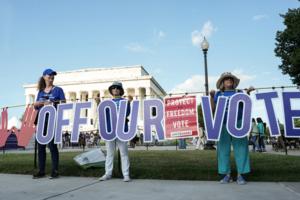
Commentary: The real test of the 2026 midterms comes after the vote
Less than three months before Americans vote in the 2026 midterms, a federal judge on August 11 blocked the U.S. Postal Service from implementing part of President Donald Trump’s executive order tightening mail-in voting rules.
The ruling came amid an intensifying fight over how November’s elections will be administered. That fight ...Read more
Related Channels

ACLU
By The ACLU

Amy Goodman
By Amy Goodman

Armstrong Williams
By Armstrong Williams

Austin Bay
By Austin Bay

Betsy McCaughey
By Betsy McCaughey

Bill Press
By Bill Press

Bonnie Jean Feldkamp
By Bonnie Jean Feldkamp

Cal Thomas
By Cal Thomas

Clarence Page
By Clarence Page

Danny Tyree
By Danny Tyree

David Harsanyi
By David Harsanyi

Dick Polman
By Dick Polman

Erick Erickson
By Erick Erickson

Froma Harrop
By Froma Harrop

Jacob Sullum
By Jacob Sullum

Jamie Stiehm
By Jamie Stiehm

Jeff Robbins
By Jeff Robbins

Jessica Johnson
By Jessica Johnson

Jim Hightower
By Jim Hightower

Joe Conason
By Joe Conason

John Stossel
By John Stossel

Josh Hammer
By Josh Hammer

Judge Andrew Napolitano
By Judge Andrew P. Napolitano

Laura Hollis
By Laura Hollis

Marc Munroe Dion
By Marc Munroe Dion

Michael Barone
By Michael Barone

Mona Charen
By Mona Charen

Rachel Marsden
By Rachel Marsden

Rich Lowry
By Rich Lowry

Robert B. Reich
By Robert B. Reich

Ruben Navarrett Jr
By Ruben Navarrett Jr.

Ruth Marcus
By Ruth Marcus

S.E. Cupp
By S.E. Cupp

Salena Zito
By Salena Zito

Star Parker
By Star Parker

Stephen Moore
By Stephen Moore

Susan Estrich
By Susan Estrich

Ted Rall
By Ted Rall

Terence P. Jeffrey
By Terence P. Jeffrey

Tim Graham
By Tim Graham

Tom Purcell
By Tom Purcell

Veronique de Rugy
By Veronique de Rugy

Victor Joecks
By Victor Joecks

Wayne Allyn Root
By Wayne Allyn Root
Comics