Commentary: Social media bans bring problems and don't work
Published in Op Eds
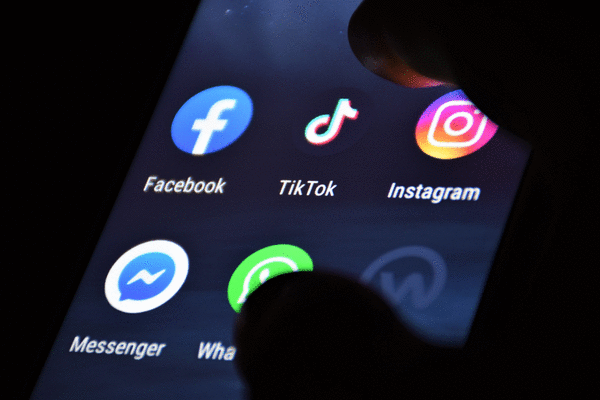
Bans on social media for minors are having a political moment. Parents’ sincere concerns and politicians’ instincts to capitalize on those fears are driving federal and state legislation like the kind already in effect elsewhere in the world. But no amount of good intentions makes these efforts good policy.
At the federal level, bipartisan legislation seeks to ban some age groups from creating or maintaining a social media account and restrict older youths from algorithmic recommendations. Most recently, the Massachusetts House passed legislation banning children under 14 from social media and requiring parental consent for 14- and 15-year-olds. Numerous other states are in varying stages of considering or implementing similar rules.
Despite consensus across the political aisle and around the country, these proposals are filled with problems.
Practically, online bans and restrictions for children trigger age verification for everyone. Since there’s no way to prove you’re a kid, adults will instead have to prove that they are not a minor. That requires the mandatory uploading of government identification, facial age estimation (which is especially unreliable when discerning 15-year-olds from 16-year-olds), or using third-party verification (which also demands your government I.D. or biometric data) for all adults.
That surge of uploading data marks the end of much anonymity and the beginning of increased privacy and security risk for everyone. Earlier this year, 438 security and privacy scientists and researchers from 32 countries signed an open letter warning that these age verification mandates may “cause more harm than good” by reducing users' privacy, security, and access to information online.
These harms aren’t just theoretical; a 2025 hack of the third-party age verification firm employed to comply with the U.K. and Australia’s laws exposed the government I.D.s of approximately 70,000 Discord users. Examples of similar data breaches are plentiful. Mandating that users hand over their sensitive information puts a target on those repositories of data that hackers and criminals will surely find alluring.
Constitutionally, these measures likely violate the First Amendment. Already, many state-level efforts to restrict youth activity online have been thwarted or delayed in court. While we regulate many things out of youth’s easy reach, speech is not alcohol or cigarettes. Even pornography receives different treatment under the law. General speech has special protections from government restrictions that physical substances (and porn) do not have.
The Supreme Court has recognized and affirmed this many times over, most similarly in 2011 against an effort to mandate parental consent for video games. In striking down the California law, the Court wrote, “the Act’s purported aid to parental authority is vastly overinclusive” because “(w)hile some of the legislation’s effect may indeed be in support of what some parents of the restricted children actually want, its entire effect is only in support of what the State thinks parents ought to want.” And added, “This is not the narrow tailoring to “assisting parents” that restriction of First Amendment rights requires.” Certainly, the same can be said of the many parents who believe their 13-year-old child should be allowed to access Instagram.
All the privacy risks and threats to free speech these laws brought by these laws are unnecessary. Not only may some parents be satisfied with their children’s access to social media, but all parents are already in control of their kids’ experience online.
There is no “market failure” that justifies government regulation. Parents dictate their children’s access to smart phones, the device overwhelmingly used to access social media, in that they are the ones proactively choosing to purchase them. “No,” is still a viable, if unpopular, option in parenting. Widely available flip phones provide all the connectivity parents want without the exposure to social media platforms they may not.
Intermediately, there are a host of parental control tools that allow parents to block social media, require approval for apps, and set time limits. All of this can be accomplished today and without the First Amendment or data security risks introduced by government bans.
Before breaking that parent-centric approach to keeping kids safe, it’s helpful to look at how media bans are working elsewhere. Late last year, Australia outlawed much of social media for all residents under 16 years of age. The country’s eSafety Commissioner reports that they, “have not observed a notable change in the number of cyberbullying and image-based abuse complaints involving age-restricted accounts across the platforms in January and February 2026 when compared to the same period in 2025.”
The Commissioner’s research further revealed that among parents whose children held accounts on Instagram, Snapchat, and TikTok before the ban, about 70 percent reported that their child still had access. In part that’s because, as Reuters reports, Australian Virtual Private Network (VPN), tools that hide user identity (and age), downloads nearly tripled leading up to the ban.
Social media bans for youth don’t work in practice and bring substantial downsides to privacy and free speech. Bipartisan though they may be, they are bad policy.
_____
Jessica Melugin is director of the Center for Technology and Innovation at the Competitive Enterprise Institute and an Innovators Network Foundation Antitrust and Competition Policy Fellow.
_____
©2026 Tribune Content Agency, LLC.



















































Comments