Commentary: The Founders built safeguards. Our politics rendered them useless
Published in Op Eds
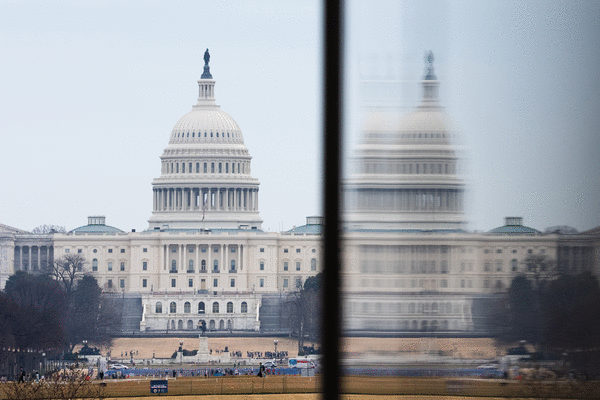
The men who gathered in Philadelphia in 1787 were students of history, and it taught them a singular lesson: power corrupts, and unchecked power can destroy a republic.
They designed our experiment with overlapping safeguards to ensure that no single faction, branch, or man could hold the nation hostage. What remained unresolved was agency: who, exactly, can determine when to trigger those safeguards? History has since exposed this as the system's deepest vulnerability.
The Constitution assigns Congress the power of impeachment but says nothing about the political will required to use it. It grants the cabinet the authority to remove an incapacitated president but assumes that cabinet members will prioritize constitutional duty over personal loyalty. It tasks Congress with checking executive overreach, yet it cannot compel a partisan legislature to act.
In each case, accountability mechanisms exist. The decision about when to use it was delegated to individuals in a political system. The Founders hoped this system would produce honorable leaders, though they could not guarantee it. Nearly two and a half centuries later, we are forced to confront the consequences when it fails to do so.
Impeachment has become a partisan exercise. The 25th Amendment, ratified in 1967 for genuine incapacity, remains a theoretical option no cabinet has ever invoked, regardless of circumstances.
Congress is the branch the Founders designed to be the most powerful and responsive to the people. Yet it has retreated into near-total dysfunction, unable to check the executive even when majorities of its members privately believe it should.
One need look no further than April 7 for a clarifying illustration of how completely those safeguards have collapsed. President Donald Trump posted on Truth Social that "a whole civilization (Iran) will die tonight, never to be brought back again," coupled with vows to destroy every bridge and power plant in the country.
Legal experts quickly warned that threatened strikes on civilian infrastructure could be war crimes. Congressional Democrats demanded that Republicans invoke the 25th Amendment or call Congress back for impeachment. Neither happened. Congressional Republicans stayed mostly silent. The cabinet did not meet. Congress remained on vacation. The guardrails, in other words, held as well as they ever did now—not at all.
Article II of the Constitution states the president "shall be removed from Office on Impeachment for, and Conviction of, Treason, Bribery, or other high Crimes and Misdemeanors." The phrase "high crimes and misdemeanors" is intentionally vague. The Founders knew future abuses might take unexpected forms.
They did not anticipate the Senate trial becoming a foregone conclusion before the first witness was called. Now, acquittal or conviction is predetermined by the party that holds the chamber. When a remedy exists only on paper and cannot be applied, it is not a remedy; it is theater.
The 25th Amendment presents a different, but equally sobering, dilemma. Section 4 allows the vice president and a majority of the cabinet to declare a president unable to discharge his duties. It has never been used. Not once.
The issue is not that modern presidents have never shown troubling behavior. Instead, cabinet members are political appointees loyal to the person who selected them, not to an abstract constitutional duty.
The question is not if April 7 alone warranted action but whether any situation today would prompt the Cabinet to act.
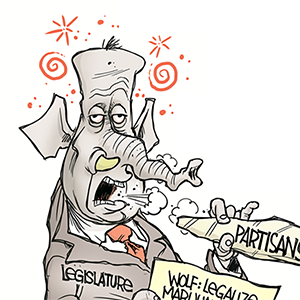
And then there is Congress, or rather, the hollow shell where Congress used to be. The body the Founders envisioned as the most muscular branch of government was also the branch closest to the people. It has spent decades ceding authority to the executive. At the same time, it has become too partisan to use the powers it keeps.
The Founders feared factionalism above almost everything else. George Washington devoted much of his Farewell Address to warning against "the baneful effects of the spirit of party."
James Madison, in Federalist No. 10, acknowledged the danger of faction. He believed the constitutional structure would contain it. He was right about the danger, and wrong about the cure. The constitutional structure did not contain faction. Faction consumed it.
None of this means the republic is doomed. But we must be honest about the distance between the Founders’ safeguards and today’s political culture. Impeachment is a high bar. The 25th Amendment is even higher. Yet a system that refuses even to ask whether those bars have been reached has forgotten how to protect itself.
One check remains—the voters. Whether that is enough is the defining question of our time.
_____
Lynn Schmidt is a columnist and Editorial Board member with the St. Louis Post-Dispatch. She holds a master's of science in political science as well as a bachelor's of science in nursing.
_____
©2026 The Fulcrum. Visit at thefulcrum.us. Distributed by Tribune Content Agency, LLC.

















































Comments