Politics
/ArcaMax

Commentary: Donald Trump's fight with Volodymyr Zelenskyy reveals a deeper frustration
The last 10 days have arguably been one of the toughest periods of Ukrainian President Volodymyr Zelenskyy’s tenure since the war with Russia commenced more than four years ago. Ukrainian cities are getting pummeled daily with Russian missiles. Ukraine’s stock of missile interceptors is running dangerously low. And Ukraine’s political ...Read more
Editorial: At St. Louis airport, ICE parks its arrogance
It’s not just masked U.S. Immigration and Customs Enforcement agents that are prowling America’s streets incognito. Turns out even ICE’s vehicles — one of them, anyway — are also hidden behind a veil of menacing secrecy that would be more appropriate in some third-world totalitarian dystopia than in what is putatively the most free and...Read more
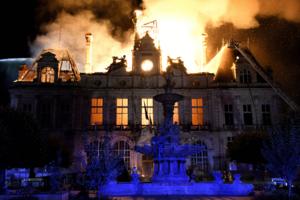
Editorial: France's fiscal mess has only one true solution
France’s crisis keeps getting more extreme, spilling over the weekend into broader protests that precipitated hundreds of millions of euros in damage and nearly 2,400 arrests. The country’s leaders are rightly focused on curtailing the violence. Yet as they seek ways to placate a frustrated populace, they must be careful not to make a bad ...Read more

Jill Burcum: Minnesota candidates should make their stances clear on childhood vaccines
With measles’ alarming resurgence in Minnesota and across the nation, voters should know where political candidates stand on the most effective protection available against this disease and many other dangerous infections: vaccination.
Specifically, do candidates intend to protect — or weaken — longstanding immunization requirements for ...Read more

John M. Crisp: Trump concedes too much for too little
If you watch as many of President Donald Trump’s rally speeches as I do—and I watch them at levels no one has ever seen before—you begin to hear the same lines, phrases and anecdotes again and again.
Watch enough of his speeches and you can predict the next sentence: We were a “dead” country when Trump took over; now we’re the “...Read more

Commentary: As a thwarted mass shooting shows, we can't ignore hate against Hindu Americans
“If you see something, say something,” the public awareness campaign tells us. A Taco Bell employee recently did just that — he called the police about a co-worker’s disturbing, hate-filled behavior. Police moved swiftly and thwarted an unprecedented attack on the largest Hindu temple in Aurora, Illinois, potentially saving hundreds of ...Read more

Commentary: In 2001, a Chicago ad agency foresaw the livestreamed execution
On the morning of June 11, 2001, readers of the Terre Haute Tribune-Star turned to an inside page of the main section and saw a family in front of a television. In the full-page ad, the father shakes his fist at the TV while the mother and children lean in as the set casts its light across the darkened den like a projector in a picture palace. A...Read more

Commentary: Youth mental health emergency requires sustained commitment and meaningful action
Five years ago, youth mental health was at a tipping point. Pediatricians, child and adolescent psychiatrists and children’s hospitals saw this crisis playing out on the frontlines and our organizations took the step together to declare a national emergency in youth mental health.
While we’ve seen some bright spots of progress, children ...Read more

Adam Minter: ESPN is gambling with its credibility
Nicole Noren spent 24 years at ESPN, much of that time producing award-winning investigative journalism on difficult topics, including human trafficking, sexual abuse, and concussions. But as ESPN embraced sports betting, Noren, in a new interview with Columbia Journalism Review, says the network repeatedly rejected her proposals to investigate...Read more
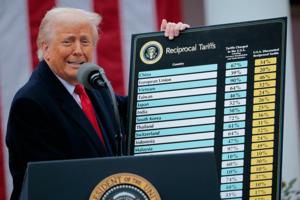
Commentary: Make America free again
As we close in on the halfway point of President Donald Trump’s second term in office, it is a good time to take stock of how the American system of free enterprise is holding up.
The Economic Freedom of the World (EFW) index was just released by the Fraser Institute. It uses 46 indicators grouped into five areas to assess the degree to ...Read more
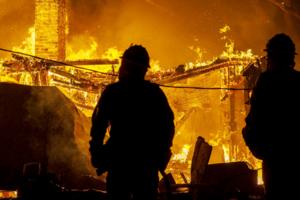
Commentary: Despite having the playbook, LA still failed to command the 2025 fires
On Jan. 7, 2025, leaders from the Los Angeles County Fire Department, L.A. County Sheriff’s Department and Pasadena Police and Fire departments worked tirelessly from separate trailers in the Rose Bowl parking lots as they managed the Eaton fire response.
The county’s incident commander didn’t even learn the fire had swept through west ...Read more

George Skelton: CEQA needs reform, but not like this
SACRAMENTO, Calif. — When does positive reform become negative regression? That’s what Californians need to answer before voting on Proposition 45, which would substantially change the state’s landmark environmental protection law.
The business-backed ballot measure would make it much easier and less costly to build loads of projects —...Read more
Editorial: NYC sanctuary stands as judge rejects Trump attack
Another federal judge, this time Ramon Reyes in Brooklyn, has rightly concluded that the Trump administration cannot compel states and cities to participate in federal immigration enforcement.
Thursday’s ruling comes from a case that was filed last year against New York City on the theory of the Supremacy Clause of the United States ...Read more

Robin Abcarian: Shane Gillis' dumb joke raised serious issues about women, fashion and sexuality
LOS ANGELES -- It was a sexist joke, and not very funny at that.
During his recent "Saturday Night Live" monologue, comedian Shane Gillis observed that women working out in gyms these days dress like "w—." And then, proving his powerlessness in the face of so much Lycra, he added, "There's no other way to describe it."
Well, Shane, it's ...Read more

Mark Z. Barabak: Despite a blue tide, this Democratic governor is fighting to survive
With just two weeks left until election day, Democrats can barely contain their glee.
Control of the House seems about to fall into their eager laps. Senate races in states that are normally cardinal red — Alaska, Iowa, Kansas and Texas among them — have grown fiercely competitive.
And, for the first time since 2010, a Democrat may soon be...Read more

Editorial: Bye-bye, Katie Zacharia; here comes Trump's new liar
Katie Zacharia was a good fit to be Donald Trump’s White House press secretary, meaning she would to say anything to please the boss. But she was a lousy liar who became ridiculed for calling herself a lawyer despite never passing the bar exam and Trump canned her after five days and a single brief single disastrous press conference on Tuesday...Read more

Steve Lopez: It's been a great romance, but it's time to rethink our relationship with the California coast
If you'd like to live near the water along the spectacular California coast at some point in your life, you have a number of options.
You can settle in, say, Culver City, which is several miles inland, and wait for rising tides to arrive.
Or, if you just can't wait that long, I saw a listing you might be interested in. It's in Capitola, near ...Read more

Andreas Kluth: The US-Iran war is making world hunger much worse
Step away from the minute-by-minute news cycle for a moment and consider what two of the five permanent members of the United Nations Security Council have wreaked: Russia and the United States, with their illegal wars against Ukraine and Iran, share much of the blame for reversing a whole generation’s progress in the fight against hunger.
...Read more
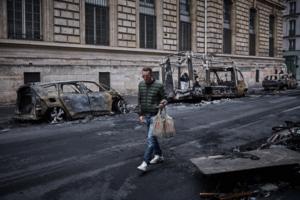
Lionel Laurent: Liberte, egalite, misery? Why France is burning
Anyone walking along the boulevards of Paris on Sunday afternoon will have sensed the “shame and anger” described by President Emmanuel Macron after a weekend of rioting.
Smashed-in storefronts, boarded-up windows and charred makeshift barricades hinted at the looting that hit some 1,500 stores across the country. Dozens of armored cops ...Read more

Commentary: Listen to what single moms are saying
I didn’t need a national report to tell me what single mothers need to survive because I’ve been there; I’ve lived it.
In partnership with the Urban Institute, my group, the Jeremiah Program— a national nonprofit working to make economic mobility possible for single mothers and their children — published “Elevating Their Voices: ...Read more
Related Channels

ACLU
By The ACLU

Amy Goodman
By Amy Goodman

Armstrong Williams
By Armstrong Williams

Austin Bay
By Austin Bay

Betsy McCaughey
By Betsy McCaughey

Bill Press
By Bill Press

Bonnie Jean Feldkamp
By Bonnie Jean Feldkamp

Cal Thomas
By Cal Thomas

Clarence Page
By Clarence Page

Danny Tyree
By Danny Tyree

David Harsanyi
By David Harsanyi

Dick Polman
By Dick Polman

Erick Erickson
By Erick Erickson

Froma Harrop
By Froma Harrop

Jacob Sullum
By Jacob Sullum

Jamie Stiehm
By Jamie Stiehm

Jeff Robbins
By Jeff Robbins

Jessica Johnson
By Jessica Johnson

Jim Hightower
By Jim Hightower

Joe Conason
By Joe Conason

John Stossel
By John Stossel

Josh Hammer
By Josh Hammer

Judge Andrew Napolitano
By Judge Andrew P. Napolitano

Laura Hollis
By Laura Hollis

Marc Munroe Dion
By Marc Munroe Dion

Michael Barone
By Michael Barone

Mona Charen
By Mona Charen

Rachel Marsden
By Rachel Marsden

Rich Lowry
By Rich Lowry

Robert B. Reich
By Robert B. Reich

Ruben Navarrett Jr
By Ruben Navarrett Jr.

Ruth Marcus
By Ruth Marcus

S.E. Cupp
By S.E. Cupp

Salena Zito
By Salena Zito

Star Parker
By Star Parker

Stephen Moore
By Stephen Moore

Susan Estrich
By Susan Estrich

Ted Rall
By Ted Rall

Terence P. Jeffrey
By Terence P. Jeffrey

Tim Graham
By Tim Graham

Tom Purcell
By Tom Purcell

Veronique de Rugy
By Veronique de Rugy

Victor Joecks
By Victor Joecks

Wayne Allyn Root
By Wayne Allyn Root
Comics