Noah Feldman: The shadow docket is John Roberts' disappointing legacy
Published in Op Eds
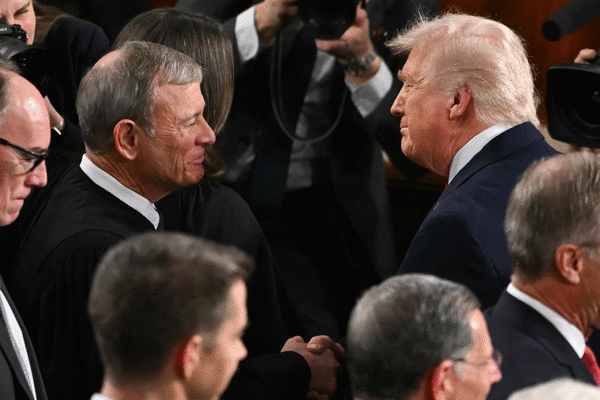
Chief Justice John Roberts was the driving force behind the rise of the Supreme Court’s emergency docket as a powerful tool to empower the activist conservative majority — that’s the main takeaway of a cache of memos leaked to the New York Times.
Roberts’ immediate motivation was to enforce the major questions doctrine, another tool of conservative activism that he has made his signature contribution to the court’s jurisprudence. In retrospect, the convergence between the emergency docket and the major questions doctrine was no coincidence. Taken together, the docket and the doctrine will define the legacy of the Roberts Court.
It was already public knowledge that the 2016 environmental case of West Virginia v. EPA marked the first time the Supreme Court used its emergency powers in a new way that has since become standard. To simplify, the court broke precedent by issuing an order blocking the Obama administration’s Clean Power Plan from going into effect. The court did so even though a challenge to the legality of the Environmental Protection Agency’s plan hadn’t yet been addressed by the U.S. Court of Appeals for the DC Circuit — and even though the appellate court had turned down the petitioner’s request to block the regulation in the meantime.
What makes the leaked memos newsworthy is that, when the Supreme Court issued its order in the emergency docket in 2016, it didn’t give an explanation. In the memos, you can see Roberts giving his explanation; the support he received from Justice Samuel Alito; the pushback from the liberal justices; and the basis for the decisive vote cast by Justice Anthony Kennedy.
In his memo to the other justices recommending the new use of the emergency docket, Roberts did not acknowledge that anything fundamentally new would be happening if the court granted the request to stop the Clean Power Plan from going into effect. He just recited the ordinary test the court uses to determine whether a stay is justified, which includes a reasonable probability that four justices would vote to hear the case; a fair prospect that a majority of the court would then reverse the decision below; and a likelihood of irreparable harm to the applying party.
Applying those factors, the chief justice prefigured privately the major questions doctrine that he would deploy publicly when the Supreme Court ultimately decided the case six years later. According to that doctrine, the justices can and should block the executive branch when it proposes a new or novel interpretation of an old statute to make a significant change in its regulatory authority without clear congressional authority.
Then, equally important, the chief justice insisted that the industry actors who were seeking the stay would experience irreparable harm if they had to wait for the DC Circuit to rule on the case. His rationale was that industry would have to start preparing for new performance standards right away, even though the legal rules would not go into effect until at least 2022. “Given the long lead times and high capital expenditures required for the construction of new plants,” he wrote, “once a utility takes steps to comply with the rule, its actions are not likely to be undone.”
Justice Stephen Breyer, ever the pragmatist, wrote back to the chief proposing a modest compromise: to deny the stays but reassure the industry that power companies were entitled to extensions under the regulation.
After Roberts disagreed, Justice Elena Kagan wrote a frank and clear memo explaining that it would be unprecedented to block the regulation given that the DC Circuit had already refused the stay and was considering the case. While she was at it, Kagan objected to Roberts’ major-questions line of argument and rejected the idea of an irreparable harm to the industry actors.
Ultimately, the decision came down to Kennedy, as many did at that time in the history of the court. In a two-sentence memorandum, Kennedy said simply that he expected that the Supreme Court would grant the stay anyway four to six months later, when the DC Circuit would have ruled. “Fairness to the parties counsels that we should grant it now,” he wrote.
It seems probable that in 2016, Roberts did not fully anticipate just how important — and how controversial — the emergency docket would soon become. Rather, he was concerned about the core issue that lay behind his major questions doctrine: his fear that the executive branch could use the tools of statutory interpretation to bring about major policy changes, as the Obama administration had done with the Clean Power Plan. Since then, the doctrine — now called “MQD” by court-watchers — has become Roberts’ most powerful tool. It’s also the court’s most effective activist doctrinal tool to block executive action.
Mostly that activism has been conservative. In addition to using MQD in 2022 to overturn the Clean Power Plan, the court relied on it the same year to block the COVID-era vaccine-or-test mandate issued by the Occupational Safety and Health Administration. Then, in 2023, the court’s conservative majority used it to block the Biden administration’s student loan forgiveness program.
More recently, Roberts wrote the opinion for the court using MQD to block President Donald Trump’s tariffs. This was an important showing that the doctrine could be used against Republican presidents and not only against Democratic ones. But it’s noteworthy that the court didn’t use the emergency docket to stay the tariffs before hearing that case, apparently considering hundreds of billions of dollars in tariffs not to count as irreparable injury for those who paid them.
History will see the emergency docket and MQD as twin drivers of the Roberts court’s conservative activism. That’s a surprising legacy for a chief justice who came to the court as an advocate of judicial restraint, and has long positioned himself as a judicial moderate committed to neutrally calling balls and strikes.
_____
This column reflects the personal views of the author and does not necessarily reflect the opinion of the editorial board or Bloomberg LP and its owners.
Noah Feldman is a Bloomberg Opinion columnist. A professor of law at Harvard University, he is author, most recently, of “To Be a Jew Today: A New Guide to God, Israel, and the Jewish People."
_____
©2026 Bloomberg News. Visit at bloomberg.com. Distributed by Tribune Content Agency, LLC.


















































Comments