Commentary: Regulate the 'Enhanced Games' as a medical experiment and a marketing stunt
Published in Op Eds
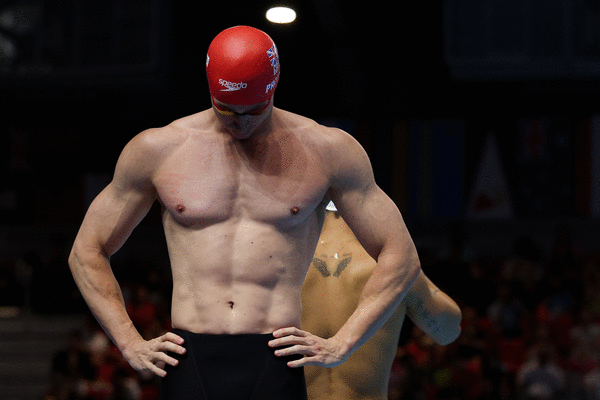
It felt like the Olympics. Crowds cheering. The American flag stands tall above the bleachers. Trainers jumping with anticipation. A swimmer staring in disbelief at the clock after his final stroke. The Jumbotron announced: Kristian Gkolomeev — 20.89 seconds. A new world record in the 50-meter freestyle.
Well, kind of.
I’ve left out some details. There was only one swimmer. The crowd? Just doctors, trainers and filmmakers. This was not in an Olympic city nor an Olympic year, but in Greensboro, N.C., in 2025. And there were no iconic rings on the banners, just “Enhanced Games.”
Yes, Gkolomeev swam faster than César Cielo, the official record holder at the time (20.91 seconds). But he did it “enhanced” — a polite way to say that he used performance-enhancing drugs. At the Enhanced Games, doping isn’t punished. It’s required.
The concept, as described by the organization: “to create the definitive scientific, cultural and sporting movement that safely evolves mankind into a new superhumanity.”
Backed by investors such as Peter Thiel and Donald Trump Jr.’s 1789 Capital, the Enhanced Games embodies a techno-utopian ideal: athletes as canvases for chemical optimization, testing the limits of human health for a lot of money. Gkolomeev earned $1 million for his record.
So far, the competition has happened at one-off pop-up events. But in May, Las Vegas will host the first full-scale Enhanced Games, a four-day meet in swimming, track and field, and weightlifting. The group advertises a “potential prize purse of $7.5 million for just a single day of competition,” plus appearance fees.
Does it need to be said? Apparently yes: The Enhanced Games glorifies the risky use of enhancement drugs.
Steroids can harden arteries, elevate stroke risk, damage the liver and permanently alter hormone systems. They are not electrolyte tablets or a little preworkout creatine. If Lance Armstrong had been rewarded — rather than sanctioned — for doping, what would have happened to competitive cycling?
Fans — and especially kids — mimic their idols. As risky as the drugs are for athletes at the Enhanced Games, with its “medical commission” to give the illusion of safety, the substances are even more dangerous when used by people without medical supervision.
The games also expose the economic neglect that drives athletes toward such competition. As Benjamin Proud, the British silver medalist who recently joined the Enhanced Games, put it: “It would have taken me 13 years of winning a World Championship title in order to win what I could win in one race at these games.”
Indeed, the Enhanced Games might look like an easy way out. Only nine swimmers worldwide received prize money and performance bonuses above $75,000 in 2025, according to World Aquatics.
Investors clearly hope to make money off the games as well. The organization is moving closer to becoming a publicly traded company. The economics are not mysterious.
But the Enhanced Games are not just another sporting event. They are an arena for biomedical experimentation and should be regulated as such. The games should face limits similar to those imposed on other high-risk industries, including age restrictions and strict advertising rules.
We already know how to govern legal, profitable activities that carry serious health risks.
In the United States, that means oversight from the Food and Drug Administration and the Federal Trade Commission — bodies that regulate drug protocols and police misleading commercial claims. A steroid-based competition should not be treated as a sport but as a medical experiment and a marketing stunt.
Regulations on pharmaceutical advertising offer a useful model for the Enhanced Games. Prescription drugs are advertised every night on television, but only under strict rules. They require fair balance (content must present benefits and risks with comparable prominence, readability and duration) and a “major statement” of risks (most serious risks must be spoken aloud and not obscured by visuals or music).
Right now, when you play Gkolomeev’s “world-record” video on YouTube, a medical-risk warning appears for barely five seconds — then vanishes. If a cholesterol drug must audibly warn viewers of stroke risk, why shouldn’t a steroid-based competition do the same?
Enhanced Games content should be accompanied by clear warnings of the risks of performance-enhancing drugs and be clearly labeled, age-gated and distributed as high-risk content more akin to pornography than to a boxing match.
Prohibition is not the answer. Trying to shut down these games only fuels a controversy-driven brand. Just recently, the Enhanced Games sued organizations such as World Aquatics and the World Anti-Doping Agency, alleging antitrust violations and that blocking athletes from participating at the Enhanced Games is illegal. As those organizations fight back, they will be seeking to protect the integrity of mainstream sports, but they will also inadvertently be promoting the Enhanced Games.
If we want kids to admire clean athletes rather than those using banned drugs, the Las Vegas launch must not reach the world as a Super Bowl would. The Enhanced Games should not be televised or allowed to stream online to minors. Otherwise, Las Vegas, in May, risks becoming an unregulated public-health experiment mislabeled as a sporting event.
_____
Fabricio Ramos dos Santos is a lawyer, entrepreneur and sports investor.
_____
©2026 Los Angeles Times. Visit at latimes.com. Distributed by Tribune Content Agency, LLC.




















































Comments