Abby McCloskey: Why MAGA takes the evangelical vote for granted
Published in Op Eds
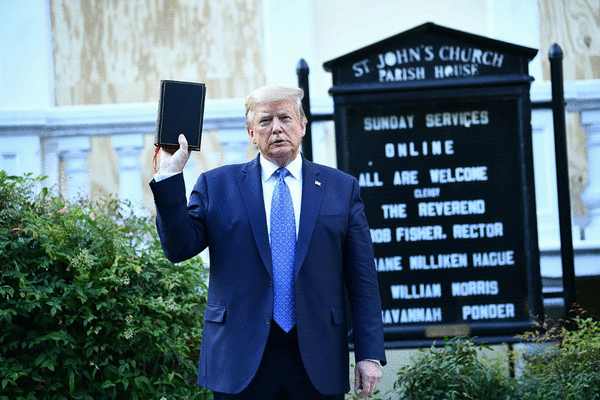
White evangelical Christians helped bring President Donald Trump to power. They remain among his most ardent supporters. This, even as the president seemingly has gone out of his way to mock Christianity and its first commandment.
One year in, the vast majority (69%) of White evangelicals continue to approve of Trump’s job performance, according to 2026 Pew Research data. This is compared to his 39% approval rating nationally.
It’s true that support for Trump among all religious groups — including White evangelicals and White Catholics — has steadily dropped since he took office, with the exception of Black Protestants who were already near rock-bottom approval levels and are largely Democratic. But it has not collapsed.
It’s not just that there’s nowhere else to go, although that’s likely part of it given Democrats’ trouble with religious voters. It’s that many Christians actually seem to like Trump’s policies.
A solid majority (58%) of White evangelicals and nearly half of white Catholics (46%) say they support all or most of his plans and policies, compared to 27% support nationally. They also trust his judgment. White evangelicals are twice as likely (40%) as the general public (21%) to say they are confident that Trump acts ethically in office.
This, even though Trump has depicted himself as Christ in an AI-generated image, hired a spiritual advisor who compared him to the risen Christ, tweeted praise to Allah on Easter Sunday before threatening to destroy a civilization, used his 2026 National Prayer Breakfast speech to re-air his 2020 election grievances and continues to disparage the pope.
At some point, these aren’t random missteps. They are a pattern.
I ask because I don’t know: What are Christian groups getting in exchange for such embarrassment and harassment? Or have they so fully given their allegiance to Trump and the GOP that their priorities have become indistinguishable from his own?
There’s no longer much daylight between the MAGA policy agenda and evangelical support, even on issues that would seem to be very far from the pulpit. Whereas 44% of U.S. adults support getting rid of DEI policies in the federal government, this jumps to 75% among White evangelicals, according to a 2025 Pew survey. The same percentages hold for cuts to federal departments and agencies. While only 39% of U.S. adults approve substantially higher tariffs, this jumps to 69% among White evangelicals. A vast majority (65 to 71%) support the decision to use military force in Iran.
In places where the administration has directly bucked evangelical political priorities, the religious right has looked away. For example, the vast majority (74%) of White evangelical Protestants say abortion should be illegal in all or most cases. But Trump is the first Republican president to suggest the U.S. should allow taxpayer-funded abortions, and he had longstanding anti-abortion language removed from the GOP platform prior to the 2024 election.
Seven in 10 evangelicals say the U.S. has a moral responsibility to accept refugees, according to polling by Lifeway. But Trump suspended the U.S. refugee program last year, and it’s now functioning at its lowest level in half a century.
To be clear, the president is not a pastor-in-chief. America is unique in its religious freedom. History is replete with state-based religions or forced secularism (the latter of which MAGA is in some ways a reaction against). Our founders intentionally forged a pluralistic path.
But Trump’s second term is making it obvious that we have entered a new era of church and state — even if it’s not exactly clear yet what it looks like.
For most of American history, Christians were not beholden to a single political party. They could function as an independent constituency and source of political accountability with priorities drawn from outside of party platforms. I’m thinking here of the religiously motivated campaigns for the abolition of slavery in the 19th century or the whole-life movement and restrictions on child labor in the early 20th.
The rise of the religious right in the 1980s was an inflection point, with evangelicals consolidating within the GOP and making demands of political leaders in Reagan and Bush eras on everything from school prayer to fighting communism to the Equal Rights Amendment. Today, the demands seem to work the other way around. MAGA elected officials — and particularly Trump — direct the priorities of the religious right.
My sense is that, in our time of deep political polarization, it has become unacceptable to draw one’s political priorities from an independent source (such as religious beliefs) and not a party platform. To question the actions of one political party or to criticize its leader is seen as proclaiming loyalty to the other side. Gone is the long-held religious ideal that the church ought to be a counterweight to political power. These days, partisan blasphemy has become worse than the religious sort. This is a problem considering that Christian teachings don’t line up cleanly with any political party or government.
For now, evangelicals are sticking by the president. But when even outright blasphemy doesn’t warrant an apology, one might wonder who else is being mocked.
_____
This column reflects the personal views of the author and does not necessarily reflect the opinion of the editorial board or Bloomberg LP and its owners.
Abby McCloskey is a columnist, podcast host, and consultant. She directed domestic policy on two presidential campaigns and was director of economic policy at the American Enterprise Institute.
_____
©2026 Bloomberg News. Visit at bloomberg.com. Distributed by Tribune Content Agency, LLC.





















































Comments