Marc Champion: The Iran ceasefire offers the best path to regime change
Published in Op Eds
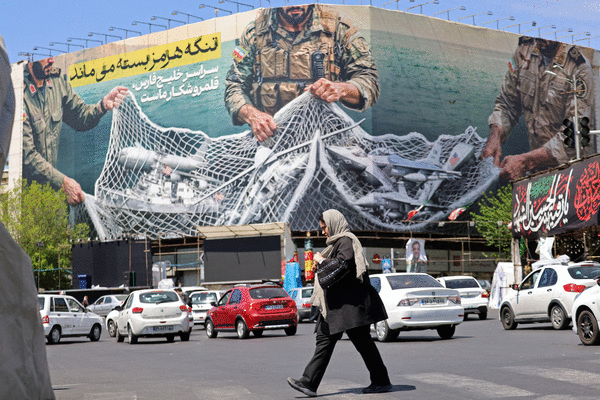
Judging by my inbox, there’s a misapprehension about how to deal with Iran among many supporters of the “finish the job” line of thinking. They contend that the choice between continuing or ending the war boils down to whether you want to destroy the Islamic Republic, or are happy to let it go on bringing misery to the Iranian people and their neighbors. But what if ending the Republic requires ending the war?
There are, of course, no guarantees this would happen. But it’s also no less likely than the alternative proposition which is that, having failed to produce regime change in the first two months of war, the U.S. and Israel will be able to deliver it through another month or so of the same. The key difference lies not in the outcomes that the two paths would produce, which we don’t know, but in their respective costs, which we do.
A return to war would take an immense toll in lives on top of the thousands already lost, as well as on the infrastructure and development prospects of the Gulf states (against which Iran inevitably would retaliate) and the global economy. It may eventually turn Iran into a failed state, which is a form of regime change — but that would be both unconscionable and pose a huge and uncontrollable threat to the region.
This is what U.S. President Donald Trump has now implicitly recognized, by extending the ceasefire he said he wouldn’t and by letting Iranian oil tankers sail through his supposedly ironclad blockade of Iranian ports. Both concessions aim to avoid a showdown with Iran’s Islamic Revolutionary Guard Corps and the considerable military escalation that would entail, though whether his goal is to stop the war or prepare for a new phase of it remains unclear.
Trump says he’s giving time for Tehran’s “fractured” leadership to sort itself out and come back to him with a unified proposal for negotiation. He’s right that the regime, never monolithic, has split over talks. But he’s wrong about what that means. What Iran’s leaders are fighting about is how best to assure the regime’s further survival once the war ends.
Iran’s claims of victory over the U.S. and Israel are as hollow as Trump’s have been. The Islamic Republic has won only insofar as it has survived the initial onslaught, and its backers and officials can only hope that lasts. Yet the country, already in dire economic straits before the start of the U.S.-Israeli air campaign, is in a far worse position today than it was before Feb. 28.
As Bloomberg News reported on Wednesday, satellite images show the significant levels of damage the campaign of air strikes has inflicted, especially in and around Tehran. Of 2,816 buildings hit, 65% were either industrial, commercial or civilian. Core downstream steel and petrochemical industries have been damaged, forcing closure of the car, plastic-packaging and other factories they supply.
The Iranians know this better than anyone, so you’d think that those in charge would sue for peace on almost any terms. Trump certainly has seemed to believe that and has been transparently frustrated by Tehran’s failure to cave to his demands. But the IRGC believes it has proved it can survive any air strikes. It’s the terms of any peace deal that will determine whether the regime endures — and there is a genuine debate in Tehran about how best to secure post-war survival.
As Ali Alfoneh, a senior fellow at the Washington-based Gulf Arab States Institute, argued since before the war, Iran has been changing since the mid-2000s, from a theocracy into a military state. And since about a year before the war, it has — first in part, now in full — been run day to day by a committee of five people, none of whom are senior clerics.
The late Supreme Leader Ali Khamenei empowered this five-member council to implement and promulgate decisions with which he did not want to associate himself, including a relaxation on female dress codes and the June 2025 ceasefire deal that ended U.S.-Israeli airstrikes on Iran’s nuclear-related facilities.
The current committee includes President Masoud Pezeshkian, Parliament Speaker Mohammad-Bagher Ghalibaf, and the head of the judiciary, Gholam-Hossein Mohseni-Ejei. There are also two members from the IRGC, who aren’t publicly acknowledged but Alfoneh — speaking on a panel hosted by the Middle East Institute on Tuesday — identified as Brigadier Generals Ahmad Vahidi and Ebrahim Zolfaghari.
The IRGC doesn’t have to share power with civilians. It wants to because it doesn’t have answers to most of Iran’s intractable economic problems and doesn’t want to be held solely responsible for failing to cure them. At the same time, it’s unwilling to countenance any end to the war that doesn’t provide the IRGC with a future. That means, at least from its point of view, that any deal should provide a source of funding, whether this takes the form of outright reparations from the U.S. (not happening), or a new cash flow provided by some form of tolling in the Strait of Hormuz, the lifting of sanctions, or whatever euphemism for financial transfers Trump chooses.
In addition, the IRGC — much like Trump — needs tangible wins it can point to in justifying the war, which its actions over the last 20 years or more have invited. It also needs guarantees that neither Israel nor the U.S. will renew their air strikes, and that Iran will be allowed to keep whatever deterrents it still has, from damaged missile and nuclear programs to an equally degraded network of regional proxies.
This is why Vahidi called the Iranian negotiating team back from Islamabad earlier this month for expressing even a willingness to discuss proxies. It’s also why the IRGC is refusing to endorse a further round of talks until the U.S. reduces its demands, namely that Iran should forgo all of the above guarantees.
It’s worth looking at the defense of negotiations that Ghalibaf gave on Iranian state television on April 18. His language — filled with references to martyrdom and God — was enough to remind you of what this regime is. Ghalibaf seeks regime survival through diplomacy, which he describes as just another mode of fighting “the battle.” He’s trying to persuade the IRGC and regime faithful that talking is more effective than inviting renewed punishment from the world’s most powerful military, but he does not and never will argue for the capitulation the U.S. and Israel are demanding.
Both sides in Iran’s internal debate want to keep power. Both want to end the international isolation that’s been a significant source of the country’s economic woes. In this case, diplomacy is — to adapt a well-worn cliche — just war by other means. Even if no agreement is reached — because an accord would give the IRGC the means to survive — the true art of Trump’s dealmaking will be to use his indefinite ceasefire to force the regime in Tehran to face its economy and people.
_____
This column reflects the personal views of the author and does not necessarily reflect the opinion of the editorial board or Bloomberg LP and its owners.
Marc Champion is a Bloomberg Opinion columnist covering Europe, Russia and the Middle East. He was previously Istanbul bureau chief for the Wall Street Journal.
_____
©2026 Bloomberg L.P. Visit bloomberg.com/opinion. Distributed by Tribune Content Agency, LLC.



















































Comments