Commentary: America is already diminished by this war
Published in Op Eds
History will not judge President Donald Trump’s decision to start this war by what it did to Iran. It will hold its harshest judgment for what it has done to America.
However this ends, the United States is already diminished by it, militarily, diplomatically, economically and morally. None of that damage is hypothetical. It is clear in the absence of a durable strategic outcome, in the strain it has placed on allies and markets, and in the erosion of America’s claim to be the defender of the rules and norms that long rested on its power.
After weeks of attacks, and the loss of American lives, aircraft and some of the most sophisticated munitions in the American arsenal, the U.S. has remarkably little strategic gain to show for that investment. Iran has been damaged, but the core political problems remain unresolved.
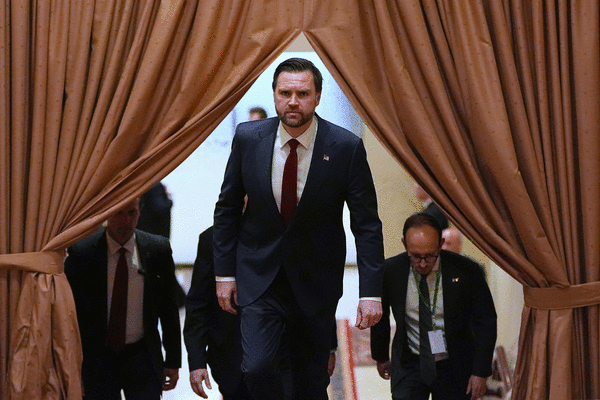
Earlier this month, an initial round of peace talks led by Vice President JD Vance did not result in anything reliable. Washington keeps leaning on threats of more force because it has not secured an end state that can hold. High-end ordnance used up in Iran is ordnance unavailable for other contingencies, whether in Europe or the Indo-Pacific. Military power expended at that scale without a durable political result drains readiness and narrows U.S. options elsewhere.
America is also diplomatically weaker. European allies now worry that the U.S. is pressing for a swift framework agreement that leaves the hardest disputes about enriched uranium and sanctions relief unresolved. That concern reflects a broader collapse in confidence in the seriousness of the American approach. Critical negotiations are being shaped by a rush for the appearance of closure. They are being handled by political loyalists and presidential insiders rather than the kind of diplomatic expertise such a crisis demands. The U.S. looks less like a steward of order than a power improvising its way through a crisis it created.
The economic and systemic damage is already being felt. Roughly a fifth of the world’s oil and natural gas passes through the Strait of Hormuz. Disruption there has immediate effects far beyond the Gulf. It raises energy prices, rattles markets and adds to inflation and supply-chain strain elsewhere. The International Monetary Fund has warned that a worsening conflict could push the global economy toward recession. U.S. allies are now being warned that this war could delay American military deliveries elsewhere. A war launched in the name of strength has raised global costs, unsettled allies and made U.S. power less available where it may be needed next.
Perhaps America’s greatest loss is legitimacy. For decades, U.S. power rested not only on force, but on a claim, however imperfectly honored, that the United States operated within a rules-based order it said it was defending and expected others to do the same. It mattered that the U.S. at least felt obliged to make a legal and strategic case for force. This war has eroded that credibility. By abandoning the rules-based order it once underwrote, the U.S. has weakened one of the foundations of its global influence.
Supporters of this war often try to shut down criticism by suggesting that anyone who questions it is somehow siding with Iran. This is both lazy and wrong. Iran is a malign regime. But the issue was never whether Tehran posed a danger. It was whether this war would leave the U.S. and the world in a stronger position.
Any serious strategy would have anticipated Iran’s response and accounted for the second- and third-order effects of attacking it. This one clearly did not. Once attacked, Iran moved to exploit disruption and uncertainty in ways that imposed wider costs on everyone else. This war made an already dangerous problem bigger and harder to contain.
There is no clear sign that Iran is eager to accept favorable U.S. terms. Washington is trying to restart talks, but no U.S. delegation has departed for Pakistan and Tehran has not confirmed participation while the blockade remains in place. Even if some settlement is eventually reached, it will not reverse the military depletion, diplomatic damage, economic disruption or lost legitimacy this war has already caused. At this point, a settlement would look less like vindication than damage control.
That is the real verdict on this war. Trump may claim he was the first president with the “guts” to confront Iran. But strategy is judged by outcomes, not bravado. So far, the outcome is that America has emerged from this war weaker than before. Hurting Iran may have been politically satisfying, but it was never enough. The question was whether doing so would leave the United States stronger, safer and better able to shape the world that follows. It has done the opposite.
_____
Jon Duffy is a retired naval officer. He writes about leadership and democracy.
_____
©2026 Chicago Tribune. Visit at chicagotribune.com. Distributed by Tribune Content Agency, LLC.

















































Comments