Michael Hiltzik: Trump's Labor secretary departs, leaving scandal and vast disappointment in her wake
Published in Op Eds
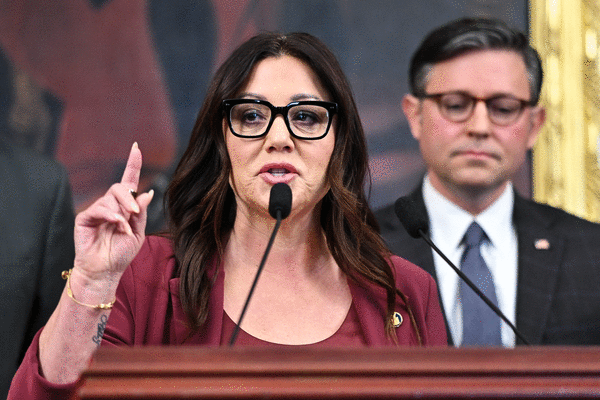
It has long become clear that those of us who saw a glimmer of hope in President Donald Trump's appointment of Lori Chavez-DeRemer as secretary of Labor got snowed.
It wasn't just, or even chiefly, the miasma of sleaze and corruption that seemed to surround her wherever she went. Or her slavish sucking up to Trump in public, notably at a Cabinet meeting in which she pleaded with Trump to send his immigration goons into Portland, Ore., to "crack down." ("Thank you for what you're doing with your agents on ICE," she said at the August 2025 session.) Fun fact: She had represented a Portland suburb as a Republican for a single House term.
No. It was the gulf between the expectations, even among Democrats, that she might be a decent pick for the job, and the reality.
After all, she had been one of only three Republicans in the House to vote in favor of the so-called PRO Act, which would significantly strengthen collective bargaining rights. (The measure passed the House in 2019 and 2021 but hasn't gotten out of committee in the current Congress.)
As I reported after her nomination, labor activists and pro-labor politicians made encouraging noises about her. Among them was Sen. Elizabeth Warren, D-Mass.,: "It's a big deal that one of the few Republican lawmakers who have endorsed the PRO Act could lead the Department of Labor," Warren said. "If Chavez-DeRemer commits as Labor secretary to strengthen labor unions and promote worker power, she's a strong candidate for the job."
She received an explicit endorsement from Randi Weingarten, president of the American Federation of Teachers. "Her record suggests real support of workers & their right to unionize," Weingarten tweeted. "I hope it means the Trump admin will actually respect collective bargaining and workers' voices from Teamsters to teachers."
The betting was that Chavez-DeRemer would be, at the very least, an upgrade from Trump's previous appointee as Labor secretary during his first term. That was Eugene Scalia, son of the late Supreme Court justice, who had been a lawyer for big corporations fighting unions and resisting workplace regulations.
The most commonly expressed doubt about Chavez-DeRemer was whether she would have the fortitude to maintain a pro-labor stance in the face of the open hostility to workers displayed by Trump and the rest of his administration.
Within months, the answer was clear, and it was no. In May, she ceased enforcing a Biden administration rule that had discouraged businesses from designating their workers as independent contractors, depriving those workers of the legal protections and wage and hour benefits they would have received as employees.
The budget she submitted to Congress last year would slash her agency's discretionary funding by more than 35%, to $8.6 billion from $13.2 billion, and cut its workforce by nearly 4,000 full-time workers, or more than 26%. In July she announced a plan to rescind 63 regulations that had been designed to help workers.
With language that sounded cribbed from the MAGA playbook, she said her goal is to "eliminate unnecessary regulations that stifle growth and limit opportunity." Most of the regulations facing the guillotine related to worker health and safety protections.
Brief as it was, Chavez-DeRemer's tenure wasn't the first time that the Department of Labor was ill-served by its management. Republican presidents have displayed a decades-long tendency to fill the top spot with political cronies or pro-business activists masquerading as worker advocates, or worse.
Frances Perkins, Franklin Roosevelt's Labor secretary, recalled having to clean up the agency — not just morally and ethically, but with broom and bucket, when she took over from William Nuckles Doak, Herbert Hoover's appointee.
The Labor Department was located in a converted apartment building, its interior dark and foreboding, its shadowy corners occupied by silent, hulking men whom Perkins mentally labeled "cigar in the corner of the mouth types. Stale ashtrays and spittoons were everywhere, along with wastebaskets surrounded by mounds of misaimed and crumpled papers. (Its current Washington quarters are in the Frances Perkins Building.)
Doak didn't seem inclined to leave the premises. Perkins got rid of him by sending him to lunch and packing up his personal effects while he was out.
Perkins' first step as secretary was to disband an anti-immigrant squad that shook down foreign-born laborers for cash and helped employers harass labor organizers. She set a high standard for the agency, pushing forward legislation establishing the 40-hour workweek and the National Labor Relations Board — and also creating Social Security.
Many of Perkins' Democratic successors have watched sadly as their efforts have been undone with a change in administrations. Robert Reich, who served under Bill Clinton (and is now an emeritus professor of public policy at UC Berkeley and an assiduous blogger), wrote Tuesday of having loved the agency's mission: "to protect and raise the standard of living of working Americans."
With Reich at Labor, the Clinton administration raised the federal minimum wage in 1997 from $3.35 an hour, where it had been stuck since 1980, to $5.15 (albeit still a cheeseparing $10.69 in today's buying power). "We fought against sweatshops," Reich recalled. "We took on big corporations that were cheating their employees. We kept workers safe."
That the agency has been "treated like crap is an insult to generations of hardworking DOL employees, to American workers, to America," Reich wrote.
Under Trump, the Department of Labor has become just another pro-business front pretending to advocate for workers. Genuine labor advocates are infuriated by its decline, which has proceeded under Republican and Democratic administrations alike.
The budget for its all-important wage and hour division, which enforces laws governing the minimum wage, overtime and prohibitions on child labor, has shrunk by 26% over a decade, according to David Weil, who headed the division under Obama and whose appointment by Biden to head the division was derailed by opposition from Big Business.
"There were 1,050 investigators working for the agency when I had the honor to lead it in the Obama administration," Weil, who is a professor of social policy and management at Brandeis University, wrote last year. "It is barely over one-half that number now. The agency had 63 times more investigators per workplace in 1939 than in 2024."
Trump poses as a pro-worker force, but his policies are atrocious for the laboring class. His Labor Department "walked away from a rule that expanded overtime protections to millions of workers," Weil observed.
"While Congress's 'big beautiful bill' boasts its worker-friendly removal of taxes on overtime, that provision benefits only a small slice of workers and revoking the overtime regulation further reduces the number of workers eligible for overtime protections when working long hours," he wrote. "Or take the administration's attack on low-paid workers whose employers hold federal contracts, by rescinding a $15 minimum wage for contractors covered by a Biden-era executive order, which benefited construction workers, purportedly a key Trump constituency."
The Labor Department plays a role not only in regulating current workplace conditions but looking ahead at the "long-term prospects of our labor markets," Weil told me Tuesday. "For example, the discussion of 'affordability' is rooted not only in rapidly rising price levels but also the low level of long-term earnings growth. Equally, our beliefs about the future prospects of employment and opportunity for college-educated workers are being upended by the potential impacts of AI."
He added, "Questions like these require that the Labor Department be led by serious and knowledgeable individuals who place the interests of workers as their focus. So far, this administration has shown contempt for this mission," as is shown by the decline and fall of Chavez-DeRemer.
Sometimes, the departure of an underperforming executive or official presages improvements ahead. That hasn't been the pattern under Trump, and sadly, it's not likely to happen at Labor.
____
©2026 Los Angeles Times. Visit at latimes.com. Distributed by Tribune Content Agency, LLC.




















































Comments