Allison Schrager: A wartime economy would be different this time
Published in Op Eds
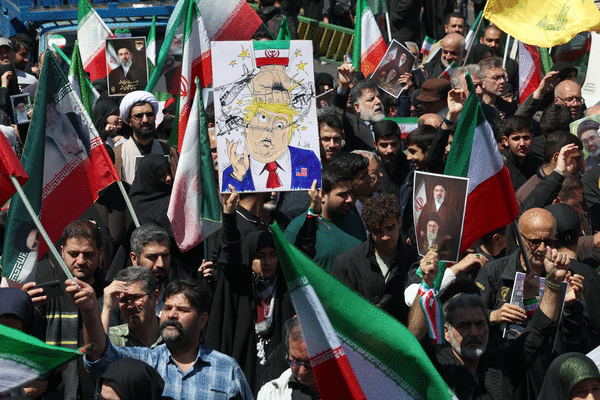
I recently heard a terrifying prediction: Advances in defense technology will change the way war is waged today as much as industrialization did in World War I. If true — and I don’t know one way or another, my area of expertise is economics — then we could be facing casualties on an unimaginable scale, just as the mechanization of weaponry produced in the early 20th century.
As I said, however, I am an economist, and this prediction got me to thinking: What will this transformation mean for the U.S. and global economy? In the past, increases in military spending have acted as a kind of stimulus. But there are reasons to doubt that will happen this time, at least in the same way.
As in the early 20th century, global politics and technology are resulting in more spending on defense. A more fragmented world brings more risk and less cooperation, so countries are spending more on their own military capabilities just as technology is producing new tools of warfare.
Over the second half of the 20th century, military spending as a percentage of GDP fell. Despite the Cold War, stronger alliances enabled many countries to spend less on defense. After the fall of the Soviet Union and the rise of technology in the 1990s, many in the U.S. military actually argued that the U.S. could spend less. Military spending rose some in the 2000s, with wars in Iraq and Afghanistan, but stayed relatively low.
The world is now entering a new era of more military spending, as highlighted recently in both the International Monetary Fund’s World Economic Outlook and the Economic Report of the President. NATO countries have already started to increase their spending in response to President Donald Trump’s actions.
Meanwhile, the U.S. — facing the prospects of more conflicts and a rising military in China — is not reducing its own spending. Congress will have the final say, but the administration has just proposed a $1.5 trillion defense budget for 2027, a more than 40% increase from 2026, much of it dedicated to implementing and defending against new technology.
The IMF draws on data from the postwar era to speculate on what this might mean for the world economy. In the past, military spending was similar to other forms of fiscal stimulus: It created jobs not only in the military but also for people who make things like submarines and fighter jets, as well as those who live in those communities. But the IMF cautions it can take away from spending on social services. It estimates that military spending has a multiplier of 1, meaning governments get out what they put in, at least in GDP terms.
But while higher spending levels may resemble those of the past, the impact on the economy may be very different because the money will be spent differently. Current and future wars will involve more AI-powered autonomous technology and perhaps fewer people fighting, but they may also go on for longer and have more ambiguous outcomes. There will probably be smaller technology firms involved, which will create jobs, wealth and entrepreneurial activity, but the benefits won’t be as widely felt as they were with major defense contractors.
In the past defense spending was an important creator of middle-class, blue-collar jobs. But modern warfare requires a smaller military and more precision weapons, which tend to be created by more educated workers.
The good news is that defense spending will probably continue to act as an important subsidy for innovations that have broader benefits. The Defense Advanced Research Projects Agency, founded in 1958, produced the technology that made the internet possible. The AI-powered future of warfare could also produce innovations that transform the economy in ways we can’t yet imagine.
There is another difference with the past that could prove pivotal: what all this spending does to interest rates. Niall Fergusson has argued that once a country spends more on interest payments than on its military, its greatest days are behind it. This was true for Spain, France and Great Britain, which became so overwhelmed by debt that they could not adequately fund their military and maintain their global hegemony.
One of Trump’s economic advisers, Acting CEA Chair Pierre Yared, has made a related point. Being the world’s only superpower confers what is known as the “exorbitant privilege” on a nation — that is, it can borrow money at lower interest rates. Losing a military conflict, in contrast, tends to mean higher interest rates and inflation. A high-spending hegemon such as the U.S. has to strike a fine balance: If it spends too much, debt-service payments can crowd out military spending. If it doesn’t spend enough, it becomes weaker, which could increase rates even further.
The question of how long America’s dominance will last, then, may be less about military might than about national debt. On that score, a reckoning could come sooner rather than later, especially if Washington decides (as it almost certainly will) to increase defense spending without reducing social spending.
Alternatively, if the U.S. prioritizes military spending, it will be the first time this century that it has chosen to spend on the young instead of the old. Small victory.
_____
This column reflects the personal views of the author and does not necessarily reflect the opinion of the editorial board or Bloomberg LP and its owners.
Allison Schrager is a Bloomberg Opinion columnist covering economics. A senior fellow at the Manhattan Institute, she is author of “An Economist Walks Into a Brothel: And Other Unexpected Places to Understand Risk.”
_____
©2026 Bloomberg News. Visit at bloomberg.com. Distributed by Tribune Content Agency, LLC.


















































Comments