Commentary: Zionism is often used as a slur. We must reclaim the term
Published in Op Eds
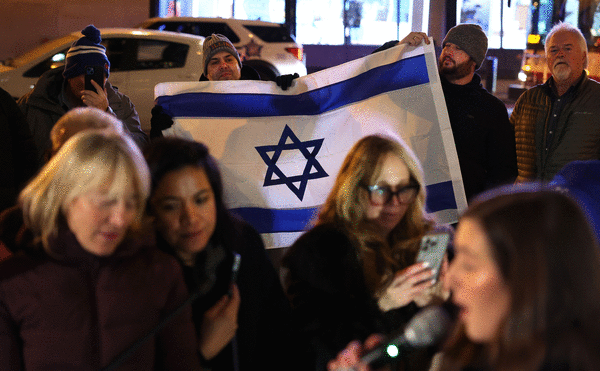
On Israel’s Independence Day on Wednesday, as Israelis mark 78 years since the founding of our state, a word that once expressed hope and liberation has become, for many, a source of confusion and division. That word is “Zionism.”
In today’s discourse, “Zionism” is often used as a slur or stand-in for “Jew,” conveying prejudice against the Jewish people. It is portrayed as a form of colonialism, racism, white supremacy or as an ideology that denies others their rights. These misconceptions obscure Zionism’s essential truth.
Zionism is the national movement of the Jewish people, the belief that the Jewish people, like any other people, have the right to self-determination in our ancestral homeland. It is about a people seeking to live freely, safely and with dignity in the land that has been at the core of our identity, history and faith for thousands of years. Accordingly, Jews around the world have long prayed facing Jerusalem, and there is a reason we end the Passover Seder each year with the words, “Next year in Jerusalem.”
The Jewish connection to the land of Israel stretches back thousands of years. Throughout this time, long before the rise of modern nation-states, Jews have maintained a continuous presence in the land and an enduring spiritual and cultural bond to it. Claims that Zionism created a facade of Jewish indigeneity to the land are therefore misguided.
The modern Zionist political movement began in the late 19th century and gave political expression to our connection to the land of Israel in a modern world shaped by nation-states. It was driven by the realization that Jews, even in the most enlightened societies, were vulnerable without a state of their own. Contrary to a common misconception, the Holocaust did not serve as the impetus for establishing the Jewish state but underscored its urgency. The longing for a Jewish homeland in the land of Israel was already well established.
In 1947, the United Nations adopted Resolution 181, known as the Partition Plan, endorsing the establishment of two states, one Jewish and one Arab, in the land then under British mandate. The leadership of the Zionist movement accepted this compromise. The Arab leadership rejected it. This is an important historical fact that is often overlooked.
At its core, Zionism embraces the idea of regional coexistence, reflected in Israel’s long-standing efforts to pursue peace, from its agreements with Egypt and Jordan to the Abraham Accords and other regional initiatives. As our Declaration of Independence put it, Israel “will ensure complete equality of social and political rights to all its inhabitants irrespective of religion, race or sex” and “will extend our hand to all neighboring states and their peoples in an offer of peace and good neighborliness.” The regional conflict that followed did not stem from the existence of Zionism, but from others who reject that vision of coexistence. That rejection, in its different forms, continues to shape the conflict to this day.
None of this means that Israel is beyond criticism. Like any democracy, Israel is imperfect. Its policies, its governments and its decisions are subject to debate and disagreement, both in Israel and beyond.
That debate exists within Jewish communities as well. There are Jews who are critical of Israel, yet disagreement does not negate our fundamental right to self-determination, and the existence of dissent does not erase our shared identity. Those who reject the very idea of a Jewish state represent a very small minority of the Jewish community. The overwhelming majority of Jews, even when critical of Israeli policies, support the existence of Israel.
However, there is a difference between criticizing a government and denying a people’s right to exist. When Zionism is redefined as inherently illegitimate, when the Jewish connection to our ancestral homeland is dismissed or erased, the conversation becomes not about Israel’s actions but about whether it should even exist.
That distinction matters. We are living through a moment of rising global antisemitism. In some cases, the distortion of Zionism feeds into this trend, blurring the line between political critique and the delegitimization of the Jewish right to self-determination.
Here in Chicago and across the Midwest, I have seen the possibility of a different kind of conversation. I have seen communities that value dialogue, understand complexity and are committed to building bridges. Chicago is a city of immigrants, of communities that carry deep ties to their heritage while contributing to a shared civic life. That is not so different from the story of Israel, a country built by people from diverse backgrounds, united by a common aspiration for self-determination.
The relationship between Israel and the United States is grounded in shared values and mutual interests. Together, we can help make the world a better place, guided by the idea of repairing the world, what Jewish tradition calls tikkun olam. This partnership is not one-sided. It brings tangible benefits to American communities, from health care innovations to agriculture and climate solutions. It is also expressed in a shared commitment to democracy, even when that democracy is tested.
On Israeli Independence Day, reclaiming the true and original meaning of Zionism is not about winning an argument. It is about restoring clarity and truth. For those who believe in equality, in the rights of peoples to define their own future and to have self-determination, Zionism should be understood as an expression of these broader human aspirations.
Zionism is a belief I hold with pride, and I am not alone. In reclaiming the true meaning of Zionism, we can move past the noise and begin the more important work of building peace, coexistence, security and dignity for all, Jews and non-Jews alike.
Zionism is a lived reality. As our national anthem Hatikvah (“The Hope”) says, “to be a free people in our homeland, the land of Zion and Jerusalem.” Emblematic of Zionism’s essence, we are still dreaming, still debating and still working to build a better future for Israel’s tomorrow.
_____
Elad Strohmayer is the consul general of Israel to the Midwest, based in Chicago.
_____
©2026 Chicago Tribune. Visit at chicagotribune.com. Distributed by Tribune Content Agency, LLC.




















































Comments