John Rash: Uncertainty clouds US-Iran peace talks
Published in Op Eds
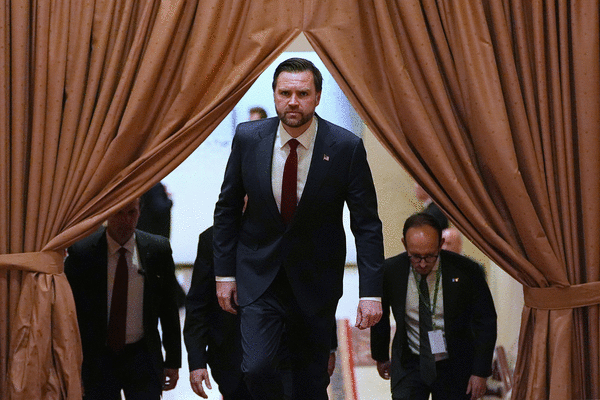
In the Mideast, the fog of war has also shrouded the peace talks intended to end it.
Indeed, seemingly on a daily, even hourly, basis, conflicting signals on the status of the Strait of Hormuz and other components of the conflict have come not just from the U.S. and Iran but from within Washington and Tehran themselves. And after days of mixed messages, it’s unclear whether peace talks between the two nations would proceed in Pakistan, right as a shaky ceasefire was extended by President Donald Trump.
As is increasingly the case, the tentative peace process was preceded not by quiet correspondence sent in diplomatic pouches but by loud social-media posts, including one from Trump on April 20 that stated, “if Iran’s new leaders (Regime Change!) are smart, Iran can have a great and prosperous future!”
With the killing of the theocracy’s supreme leader in the initial attack, there is indeed new leadership in Tehran. “But it’s not the kind of regime change (Trump’s) advertising,” said Vali Nasr, a professor of international affairs and Middle East studies at the Johns Hopkins School of Advanced International Studies.
In an interview in advance of his appearance at a Global Minnesota event at the Humphrey School on Wednesday, April 22, Nasr, who’s also advised diplomats, posited that Iran’s new leaders “are far more hawkish than the ones that they replace; they have a much more dark record when it comes to the suppression of the people of Iran in past uprisings and student demonstrations.” (A fact evidenced by the high-profile hanging of protesters as the new regime builds on the heinous human-rights record of the old.)
While it’s possible these leaders will prove more pragmatic at the negotiation table, Nasr emphasized that it’s not the kind of change to a “more West-friendly, open, democratic, liberal (regime); it’s actually the opposite.”
While the Obama-era Iran nuclear deal was widely derided by Trump and many Mideast leaders for the pact’s perceived weakness on Iran’s conventional weapons program and propping up proxies like Hamas, Hezbollah and the Houthis, Nasr said that the Iranians actually upheld the nuclear portion of the pact, a fact confirmed by International Atomic Energy Association (IAEA) inspectors, and Iran itself thought it was a bad deal because Obama “did not actually implement much of what he promised,” including lifting sanctions.
Now the war, “if anything, gives Iran more incentive to build a nuclear weapon, because if before the warfare they had not thought they needed that kind of deterrence, they now definitely do think they need some kind of deterrence to dissuade America and Israel from attacking them again.”
Iran may not be the only country reconsidering proliferation, in part because of Trump’s anger that no NATO nation heeded his call to join the fight.
But the alliance is designed as defensive, not an on-call collection of countries that enter conflicts they weren’t even consulted on. “It’s good to draw the distinction between a NATO operation” like post-9/11 Afghanistan, said Rose Gottemoeller, a veteran envoy who keynoted a Global Minnesota “Great Decisions Conference” on April 14.
Gottemoeller, whose distinguished diplomatic career included being the deputy secretary-general of NATO during the first Trump administration (she’s now at Stanford University), said in an interview that she takes “the opposite view of the president,” whom she said has “two different concepts of NATO in his head.”
One is a “NATO-operation consensus” like when the alliance unanimously responded after 9/11, when the U.S. became the only country to invoke the mutual-defense mechanism known as Article 5. The other seems to be when NATO nations take part in U.S. operations, as many did on individual, but not alliance, basis in Iraq. “I don’t see this operation in the Strait of Hormuz as a NATO operation, per se; that’s not the request that’s been made by Washington to NATO.”
Gottemoeller’s diplomatic deployments also included undersecretary for arms control and international security and chief U.S. negotiator of the New Strategic Arms Reduction Treaty with Russia. That experience and expertise give added consequence to her concern that Trump’s open questioning of the alliance could promote proliferation among allies, something the Nonproliferation Treaty is meant to prevent. While the U.K. and France have a handful of nuclear weapons, America’s nuclear-security guarantee “has been a great tool to guard against nuclear proliferation among our allies. Now, with the confidence in Trump shaken, a lot of allies are musing about taking the opportunity of building their own.”
Nasr similarly perceives “a problem with President Trump’s foreign policy, which is a lack of interest he has in alliances.” In Europe, to be sure. But elsewhere as well, including in the ever-volatile Mideast. “Let’s say Saudi Arabia was thinking about a defense pact with the U.S.,” said Nasr. “Do they actually really trust any kind of a promise of security guarantees by the United States, given the fact that the U.S. is abandoning its strongest security guarantees, which are to European countries?”
The prospect of proliferation also worries IAEA Director General Rafael Grossi, who told the Guardian newspaper on Monday, April 20, that the international instability could lead to a “crack in the system” of nonproliferation that could send up to 20 countries to dash for deployment, up from the already unstable nine nations with nukes.
Preventing Iran from being one of them has rightfully been the objective of administrations across decades and parties. And while the Iran nuclear deal didn’t change the fundamental nature of the ruthless regime, it did provide the U.N. a mechanism to monitor its nuclear activity. And despite dominating militarily in last year’s 12-day war (in which Trump said the program was “obliterated”) as well as the current conflict, diplomacy, it turns out, is still required.
That’s not the only way this war hasn’t gone as planned.
The U.S., Nasr said, “overestimated the idea of how quickly the Islamic Republic was going to collapse if you kill this leadership, or that there would be a mass rebellion in Iran, and that Iran would very quickly throw in the towel, come to the table and you might have a Venezuela scenario” as well as Iran’s willingness and ability to “wreak havoc on the global economy.”
The global economy and geopolitics generally will remain shrouded unless and until the fog of war lifts. And that won’t happen without peace talks, which themselves are clouded in uncertainty.
_____
©2026 The Minnesota Star Tribune. Visit at startribune.com. Distributed by Tribune Content Agency, LLC.

















































Comments