Editorial: There's good news in the war against opioid addiction, but no victory in sight
Published in Op Eds
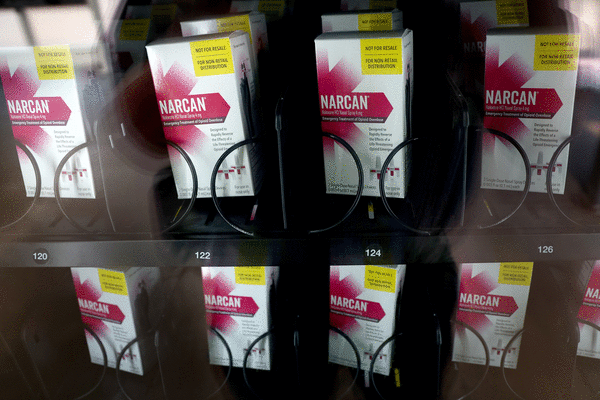
The opioid epidemic has claimed thousands of lives in Illinois since it started in the late 1990s. Finally, there’s some good news to share.
Overdose deaths from opioids are falling sharply, down 35.6% in 2024 from the previous year, according to the Illinois Department of Public Health’s latest report. After rising inexorably through 2022, when these dangerous drugs killed 3,160 Illinois residents in a single year, the trend finally has reversed.
National figures show a similar reversal. Based on the latest numbers, it’s reasonable to expect the tally in Illinois will be down again for 2025.
That relief can’t come soon enough, as the death toll has been shocking. In the decade from 2015 to 2024, some 23,726 died of opioid overdoses in Illinois.
That’s about the same number as the entire population of cities like Maywood, Kankakee, Elmwood Park, Carbondale, Darien or Freeport. Indeed, people died not only in Chicago, but in quiet suburbs. High overdose death rates were not confined to any one geography — they cut across urban, suburban and rural Illinois alike. Black Illinoisans, especially middle-aged men, were especially hard hit.
Today is an appropriate time to reflect on the lives lost, and the price paid by the families and communities of those who died. But it would be a terrible time to start moving on as if the problem were solved.
Chillingly, a new wave of overdoses could be on the horizon.
According to the Centers for Disease Control and Prevention, the epidemic had three previous waves. The first began when Purdue Pharma, the company controlled by members of the Sackler family, aggressively marketed new prescription painkillers while downplaying their risks and generating enormous profits.
The second wave began around 2010, after medical providers had realized that Purdue’s OxyContin and similar opioids were much more dangerous than portrayed. After years of liberal prescribing, they cracked down on prescriptions. Addicts turned instead to heroin, leading to another increase in overdose deaths.
The third wave involved fentanyl, a potent synthetic opioid now produced illicitly in mass quantities. Drug dealers laced their products with this treacherous substance, which can be fatal in amounts as tiny as a few grains of salt. Opioid overdose deaths have skyrocketed since about 2013, when synthetic opioids became more prevalent, according to the CDC.
The death toll is now declining after years of bitter experience. Narcan, an easily administered nasal spray that can reverse overdoses and save lives, is far more widely available than in the past. First responders and public-health workers are routinely armed with the stuff, and it’s stocked in public libraries and other community locations. Wider use of naloxone, test strips and other harm-reduction tools has helped reduce risk at the margins, though no form of illicit opioid use is safe.
Overall, the reasons for the decline are still debated. Some researchers have pointed to possible shifts in the illicit drug supply, though the data are uneven and conclusions remain tentative. Another grim possibility is that many of the most vulnerable users have already been lost, after years of extraordinarily high mortality.
Today’s addicts face new challenges that could turn around the recent positive gains. Fentanyl in street drugs is in some cases being mixed with or supplemented by dangerous alternatives, including the animal tranquilizer medetomidine and cychlorphine, an emergent synthetic opioid that carries an extreme risk of overdose.
The biggest risk is limited resources for treatment and recovery. Over the past three decades, management of opioid-use disorder has become more effective and more widely available. Professional help with the difficult process of withdrawal can greatly reduce the risk of relapse and, ultimately, death.
But as the CDC reported, only about one in four U.S. adults who needed treatment for opioid use disorder received medications for it in 2022, and the outlook today is fraught.
While tens of billions in corporate litigation settlements promise to boost funding in Illinois and many other states, the federal government is moving in the other direction, cutting its support for the addiction safety net.
Those cuts are pound-foolish, as the epidemic has cost the U.S. dearly, not only in ruined lives but economically through lost productivity, health care expenses and crime. Over the coming decade, the cost of the epidemic is projected to number in the trillions. Fighting this scourge at every level is a moral responsibility, and a necessary investment in America’s future.
_____
©2026 Chicago Tribune. Visit at chicagotribune.com. Distributed by Tribune Content Agency, LLC.



















































Comments