Editorial: Shouldn't a diploma mean students are ready for college or work?
Published in Op Eds
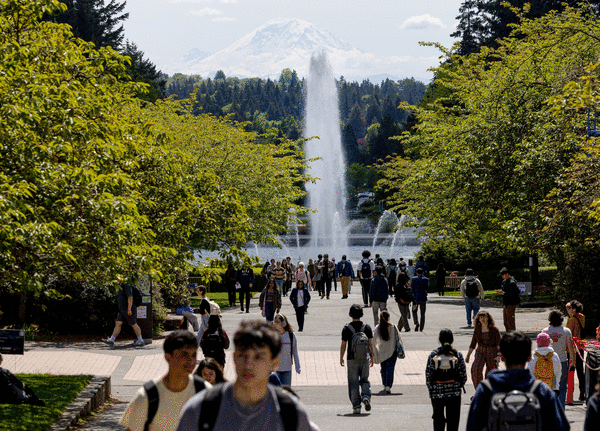
It’s not often one hears students clamoring for tougher coursework and tighter deadlines. But a group of college kids who recently graduated from Washington high schools have given state education leaders an earful.
“I did not feel prepared from my high school classes,” said one.
“Please invest in higher rigor courses,” urged another.
“In high school, I didn’t have much experience doing research or engaged in oral or written arguments,” said a third. “There was a steep learning curve.”
These freshmen and sophomores, speaking in late 2024, were among many groups providing feedback to the state Board of Education as it prepares to revamp requirements for earning a high school diploma in Washington.
And high time. It’s been more than a decade since the Legislature made major updates, even as basic career skills are changing rapidly.
Meanwhile, though high school graduation rates have climbed, academic performance, particularly in math, is sagging. Only 31% of high school sophomores demonstrate a grasp of geometry and algebra on track for college-level work, yet nearly 83% are graduating, according to the Washington State Report Card.
That gap, though not new, has widened alarmingly.
Over the last six years in Seattle, the gulf between math scores and graduation rates grew from 31 to 41 points. In Olympia, it increased by nearly 20 points. In Everett, the difference is now more than 58 points; and in Tacoma, the chasm between a sunny-looking 91% graduation rate and the 18% of sophomores on track to do college math is a shocking 73 points.
The state Board of Education believes outdated academic requirements are part of the problem. To revise them, board members have been gathering recommendations from educators, students, tribes and business leaders for more than a year.
They’re pondering coursework in topics like financial education, media literacy, emerging technologies and cultural competence.
But the Washington Roundtable, which represents industry, is more focused on bulking up baseline standards like Algebra 2 for all high school juniors.
State education chief Chris Reykdal thinks some kind of quantitative credit — such as statistics or analytics — should be part of senior year for anyone heading to a university.
Not everyone needs to go to college, of course. But for work in growth industries like health care, or even the trades, strong skills in computation, logic and problem-solving will be essential.
The Board of Education plans to unveil its official FutureReady recommendations during the 2027 Legislative session, and that will surely kick off yet another round of heated discussion.
But on one point, virtually all parties appear to agree with Roundtable Vice President Neil Strege, who spends a lot of time thinking about Washington’s high school diploma and what it actually means.
“It signifies that students have achieved 24 credits,” he said. “But I don’t think you can say with certainty that they are either career- or college-ready.”
_____
©2026 The Seattle Times. Visit seattletimes.com. Distributed by Tribune Content Agency, LLC.





















































Comments