Adriana E. Ramírez: Who's a real true American?
Published in Op Eds
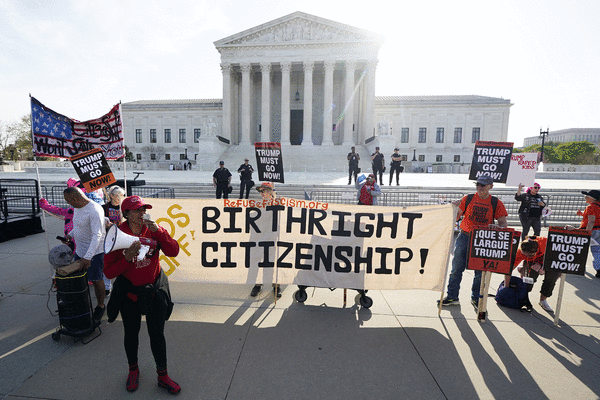
At last Friday’s Los Angeles Times Book Prizes, California author Amy Tan was honored with the 2025 Robert Kirsch Award, which recognizes a writer with deep connections to the American West. As Kirsch’s son introduced her, he noted that she was a “birthright citizen.”
The author of “The Joy Luck Club” was born in Oakland, California, to Chinese immigrants whose student visas had expired and who did not want to return to newly Communist China. The Supreme Court is now arguing about whether she is a true citizen, she said. “No matter what the outcome is, it’s been a kick in the gut to know that those in the highest echelons of government and those who support them believe that we don’t belong.”
The administration argues that people have taken advantage of a misunderstanding of the Constitution, traveling here during pregnancy to give birth in the United States and grant their children the “golden ticket” that is being American.
President Donald Trump believes the children of undocumented migrants have never been U.S. citizens, “some very, very good lawyers” told him, he told Fox News’ Bill O’Reilly back in 2015. “You’re going to find they do not have American citizenship. We have to start a process where we take back our country. Our country is going to hell.”
Start again
As documented in Daisy Hernández’s superb new book “Citizenship: Notes on an American Myth,” this is not the first time birthright citizenship has been under attack.
Over 30 years ago, Rep. Brian P. Bilbray, a California Republican, introduced the Citizenship Reform Act of 1995, which “amends the Immigration and Nationality Act to deny automatic U.S. citizenship at birth to children born in the United States to parents who are not U.S. citizens or permanent resident aliens.”
(Incidentally, one of the bill’s 51 co-sponsors was none other than John P. Murth, a Democrat serving Pennsylvania’s 12th Congressional District, which includes parts of Allegheny and Westmoreland Counties.)
As Hernández notes, during hearings held that year, a Justice Department constitutional scholar testified that the bill was “unconstitutional on its face” and would likely result in “a permanent caste of aliens, generation after generation after generation born in America but never to be among its citizens.”
The bill never made it out of subcommittee, but Hernández writes that the concept took hold, as a means of deterring illegal crossings, and “the Republican Party included the idea of eliminating birthright citizenship in its platform for the 1996 election.”
Living here today
On March 30, Trump posted on Truth Social, claiming birthright citizenship is “about the BABIES OF SLAVES! … Look at the dates of this long ago legislation - THE EXACT END OF THE CIVIL WAR!”
But the Fourteenth Amendment, adopted 1868, is pretty clear on birthright citizenship, without mentioning anything about slavery: “All persons born or naturalized in the United States, and subject to the jurisdiction thereof, are citizens of the United States and of the State wherein they reside.”
At question, according to Republicans, is the phrase “subject to the jurisdiction thereof.” Advocates of revoking birthright argue that because the children of foreign ambassadors, invading armies and Native Americans have no inherent rights to American citizenship, these “exceptions” confirm that “subject” is not as clearly defined as previously thought.
But the “under the flag” test has been a long-held equivalent to “under the jurisdiction thereof.” It’s pretty clear why an embassy, an invading army, and sovereign Native Americans, all living under a different flag, might not have birthright citizenship, as pointed out by Samarth Desai in SCOTUSblog.
Immigrants fleeing their home countries are not here under a different flag in any sense relevant to interpreting the Constitution’s words. And they are not an invading army, no matter how many times talking heads use that kind of rhetoric. The current Speaker of the House Mike Johnson once said, “we have a literal invasion of lawless masses flooding over our border from more than 160 countries.”
A metaphor does not an actual army make. “The reasons to eliminate jus soli citizenship run on a loop in my mind,” Hernández writes. “You cannot have a right to this land because you are not subject to the laws of the United States, because your parents don’t have papers, because your parents are invading the country, because your parents were not slaves.”
Thank my lucky stars
When you ask most people what makes them U.S. citizens, they will answer with some variant of “I was born here.” But citizenship has always been more complicated than that.
Hernández’s book covers the many tiers of citizenship in our country, from political to social and back again, and as I read through, I could not help but consider how much birthright citizens have given back to the United States.
From hundreds of Olympians, to scientists and politicians and judges, to famous authors receiving lifetime recognition, some of the best people America has were a gift from people born elsewhere.
All these cases, and their advocates, have done is reveal the bigotry and hatred of their proponents. I agree with Amy Tan, it’s a “kick in the gut” that betrays us all.
_____
©2026 PG Publishing Co. Visit at post-gazette.com. Distributed by Tribune Content Agency, LLC.




















































Comments