Commentary: The enrollment cliff is here. Online education is higher ed's most viable antidote
Published in Op Eds
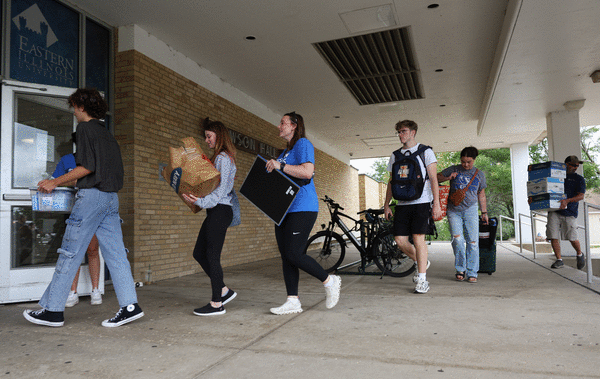
American higher education is approaching a structural demand shock. Whether one labels it the “demographic cliff” or the “enrollment cliff,” the underlying dynamic is straightforward: In many parts of the country, the pipeline of traditional-age students is softening, and institutional business models built around predictable cohorts of recent high school graduates will be forced to adapt.
The likely responses are not mysterious. Institutions can compete harder for a smaller pool of 18-year-olds. They can work to increase the share of high school graduates who pursue college. They can reduce offerings and capacity to match declining revenue. They can pursue consolidation through partnerships, mergers or closure. Or they can expand into the segment that is both substantial and underserved: adult learners seeking degree completion, career transitions and short-cycle credentials aligned with labor market opportunity.
That last path is where online education shifts from “innovation” to infrastructure.
A useful place to begin is with what the official federal data says about how students already participate. The Integrated Postsecondary Education Data System now shows that, across U.S. higher education, more students are enrolled in programs with an online component, either fully online or hybrid, than are enrolled exclusively face to face.
In the fall 2024 IPEDS profile, 26.5% of students were in programs conducted exclusively via distance education, and 28.2% were in programs that included some distance education. That’s 54.7% combined, compared with 45.2% in programs with no distance education. What we are seeing is not a temporary residue of the pandemic. It is the new equilibrium in student participation.
Why does that matter for the enrollment cliff? Because the cliff is not merely a recruitment challenge. It is a structural challenge that will require institutions to rethink how they serve and support students. Colleges and universities with high fixed costs and a limited geographic reach may find it increasingly difficult to rely solely on traditional campus-based recruitment as the pool of college-age students shrinks. The most scalable way to broaden reach without requiring adult learners to reorganize work and family around a campus timetable is online and hybrid delivery.
Crucially, this is not an argument that campuses are obsolete. But it is increasingly clear that campus-first models cannot continue to be the dominant growth engine for the sector as a whole. The growth engine is adult learners. And adults, by definition, require flexibility, predictable scheduling and services designed around complex lives.
This is also why the competitive landscape is about to intensify. As the traditional pipeline tightens, more institutions will enter or expand online markets, particularly in programs with clear economic value: degree completion, credit-bearing certificates and professional licensure pathways. Some will treat online as a revenue bridge. Others will treat it as a strategic redesign. Either way, the number of providers will increase, competition will heat up, and learners should benefit through more options, more entry points and more flexible pacing.
But online as an antidote only works if the sector stops confusing access with quality.
The central failure mode in online higher education is not modality; it is design. Too many programs have been built by translating legacy courses into a digital format while leaving the underlying instructional model intact. A lecture on a screen is still a lecture. A course that substitutes reading packets and perfunctory discussion boards for active learning is still passive education. When online is treated as a distribution channel rather than a learning system, persistence drops, and skepticism rises.
A few pragmatic lessons from San Diego State University Online, where I am a dean, are instructive here. Not as a victory lap, but as a set of design principles that matter for adult learners.
First, flexibility does not equal completion. Adult learners rarely disappear because they lack motivation. They stop because life interrupts and the program is fragile. Programs that perform better assume interruption is normal and engineer around it: predictable weekly rhythms, explicit time expectations, coherent course navigation, and early course “on-ramps” that set norms and pacing before students reach a breaking point.
Second, student support is not an add-on for online instruction; it is core infrastructure. In adult-serving programs, the difference between persistence and withdrawal is often response time, proactive advising and timely academic support. If students have to hunt for support, wait days for answers or navigate bureaucratic handoffs, the institution is effectively taxing them for having a life outside the classroom. When support is embedded and proactive, outcomes improve dramatically.
These lessons are not unique to one institution. They are replicable. They are also not free. Online education’s role as an antidote to the enrollment cliff depends on institutions committing significant resources to purpose-built design and support, not merely scaling enrollment.
Credential strategy must evolve as well. The enrollment cliff is colliding with labor-market volatility, and the predictable result is growing demand for shorter-cycle, career-relevant credentials. These are often credit-bearing certificates, licensure-aligned pathways, and stackable programs that ladder into degrees. This is not “anti-degree.” It is an adaptation to a world in which learning must occur repeatedly across a career rather than a single linear path. Online and hybrid formats are what make that cadence feasible at scale.
Finally, the future will be shaped by rigor in an era of artificial intelligence. Cheating is not an online problem; it is an assessment problem. If a course can be completed by outsourcing thinking, the course was not measuring the right thing. The answer is not to retreat from online. It is to raise standards: authentic assessments, performance tasks, supervised checkpoints where appropriate, meaningful feedback loops and clear demonstrations of mastery.
The enrollment cliff will force difficult choices. But the most viable response is not nostalgia or austerity; it is purposeful redesign. Online education has already proved it can scale access. The next decade will be defined by whether institutions can scale through access and quality.
____
Ian Gibson is dean of the Global Campus at San Diego State University.
___
©2026 Chicago Tribune. Visit at chicagotribune.com. Distributed by Tribune Content Agency, LLC.




















































Comments