Commentary: How AI is already improving lives
Published in Op Eds
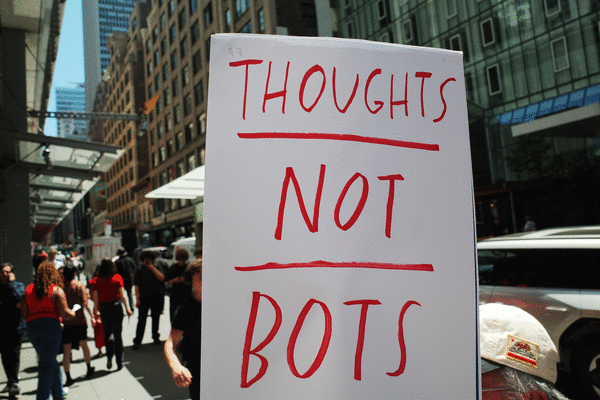
Leading AI models are doubling their capabilities every four months, and the implications for accelerating scientific research, improving education, and transforming much of the economy provoke both enthusiasm and angst.
While some CEOs of major AI companies speculate that AI will destroy millions of jobs in the U.S., just in the next five years, and anti-growth factions oppose critical AI infrastructure, like data centers, the positive case for AI has been criminally underrepresented in the public debate.
Healthcare is one example. In 2024, two Google DeepMind employees were awarded half of that year’s Nobel Prize in chemistry for their work in creating AlphaFold software. AlphaFold uses AI to predict the structures and likely interactions of proteins inside the body without synthesizing them in a lab. Before AlphaFold, researchers developing new medicines would create new proteins in a lab, but because their structures are so complex, scientists had little understanding of what the proteins could do, so they’d pursue a trial-and-error approach. They were reliant on experimentation to determine the positive and negative effects of a new molecule. AlphaFold considerably accelerates that process. Instead of taking months, now researchers can study the effects of different proteins much more quickly, substantially accelerating the drug development process. This means more medicines, at lower cost, and better health outcomes, including saved lives.
AI has also already been used to streamline certain bureaucratic complexities in the healthcare sector. Ten years ago, experts predicted that radiologists would be replaced. Instead, there are now more radiologists than before, and AI is helping them become more productive by automating tedious tasks like documentation, report formatting and electronic health record integration.
Not only is AI helping radiologists with administrative tasks, but it helps them detect anomalies sooner. Researchers at the Mayo Clinic developed a system using AI that can detect cancer up to three years before current systems can. Earlier detection means more treatment options and longer survival times.
For people with disabilities, AI is providing higher quality and faster transcription for the deaf, image descriptions for the blind, and speech generation for those unable to communicate verbally.
And these are merely a few applications that have already borne fruit. As adoption spreads, the technology improves and becomes more tailored, AI will continue to produce major advancements. 70 years after the invention of the integrated circuit, 50 years after the personal computer, and 30 years into the internet, humanity is awash in data and information. There is so much that we are no longer able to manage it ourselves, which is why search engines have already started integrating AI into the results, and the line between search and AI models is blurring.
But AI isn’t just about sorting information. A major beneficiary will be businesses that are too small to hire workers to perform administrative tasks, like building a website or designing a logo, to use AI agents to carry out these projects. AI agents are software programs that use AI to autonomously set goals, make decisions and take actions to complete various types of work. That ability moves toward leveling the playing field between businesses of different sizes, increases efficiency for all firms, and super charges competition to the benefit of consumers.
AI also has enormous potential to further reduce barriers to communication and increase access to education and healthcare worldwide. Language barriers may soon be greatly reduced, allowing for a historically impossible level of information sharing and growth. AI will bring the possibility of individual tutors to children worldwide, making education both more available and more effective.
While AI is new technology, the story of how technology drives change is nothing new. Electricity replaced whale oil; automobiles supplanted horses; calculators replaced slide rules; and then spreadsheets replaced calculators. Every change was disruptive, but every disruption represented progress. These new inventions made workers more productive and improved the lives of everyone.
So, too, will it be with AI. But the details are hard to predict. Precise effects of broad new technologies are notoriously difficult to anticipate. When the iPhone was released, few foresaw the app economy it would stimulate. With AI, detractors are using this ambiguity, as well as exaggerated and outright false claims, to turn policymakers against it.
But the history of new technologies and the enormous potential of AI to make us all healthier and wealthier advise against the naysayers. Lawmakers must resist the temptation to act out of fear to block the growth of AI and its still largely unknown benefits.
____
Jessica Melugin is Director of the Center for Technology and Innovation at the Competitive Enterprise Institute, where Jeremy Nighohossian is a senior fellow and economist.
___
©2026 Tribune Content Agency, LLC.



















































Comments