Commentary: Conservation depends on cooperating and transcending borders
Published in Op Eds
Political tides rise and fall. They always have.
Laws change. Priorities shift. Administrations come and go. Across generations, societies debate, correct course and eventually find new balance. Some long-standing norms endure because they serve the common good. Others, like the once-accepted evil of slavery, are rightly rejected as societies mature.
But nature does not operate on election cycles.
Rivers do not stop at checkpoints. Wildlife does not recognize borders. Air pollution does not pause at state lines. Drought, wildfire and habitat loss do not ask whether a community voted red or blue. And once a species, an old growth forest, a mountaintop or a river are destroyed, they’re gone forever.
Protecting life on Earth requires acting locally for global impact.
That is why many recent federal decisions affecting public lands, water, mining, science and environmental protections are so troubling. Too often, they move forward without meaningful community input, dismiss established science, weaken institutions built to serve the public and strain relationships with neighboring countries and Indigenous nations whose futures are tied to the same landscapes.
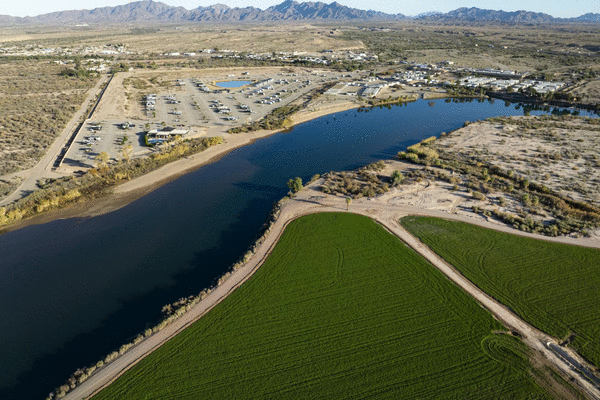
In the American Southwest, we know better than most that ecosystems are shared. The Colorado River connects seven states and Mexico. The Sonoran Desert spans two nations. Migratory species move across tribal lands, ranches, farms, cities and protected areas alike.
When decisions are made in distant capitals without listening to the people who live in these places, the result is usually conflict, delay and damage.
Consider the Sky Islands of southern Arizona and northern Mexico — mountain ranges rising from the desert that contain extraordinary biodiversity. These landscapes connect the Rocky Mountains and the Sierra Madre and support jaguars, birds, pollinators and hundreds of rare species.
Yet local residents increasingly fear that large-scale extraction decisions are being accelerated while their voices go unheard or unheeded. The same pattern appears elsewhere, from the Boundary Waters shared by the United States and Canada to groundwater basins throughout the West.
Americans broadly support clean air, clean water, parks, wildlife and open space. Across backgrounds and political beliefs, people want healthy lands and waters for their children. But our systems often reward short-term gain for a few over long-term security for many.
We can do better.
Real conservation must protect whole ecosystems, not just fragments inside political lines. And it must give agency to the people and communities who know those places best: tribal nations, ranchers, farmers, local governments, scientists, business owners and residents whose lives are directly tied to the land.
That means shifting from conflict-driven models — in which decisions end in lawsuits and resentment — to collaborative models built on shared stewardship, practical problem-solving and long-term accountability.
We have seen this approach work through building relationships, trust and capacity across borders, cultures and sectors so that conservation lasts.
In the Rio Grande-Rio Bravo river basin, one conservation team helped restore thousands of hectares of agave habitat across the United States and Mexico through dozens of partnerships, benefiting pollinators, local economies and ecosystems. Another helped restore thousands of acres of Tamaulipan thorn forest, essential for birds, ocelots and flood resilience.
These need not be isolated projects. They are building blocks of something larger: connected landscapes, stronger communities, shared governance and durable stewardship finance.
Consider the Baja-Sonora region, one of the most biologically rich landscapes in North America. More than 13 million people and dozens of Indigenous communities share this place. They also share growing threats: water scarcity, habitat fragmentation and under-investment in conservation.
The answer is not more top-down directives. It is empowering the people already working to steward their lands and waters.
The Southwest has always taught a simple truth: Survival depends on cooperation. Communities here learned long ago that water must be shared, neighbors must help one another, and the land must be respected.
That wisdom should guide our environmental future.
____
Ken Salazar is former U.S. secretary of the Interior and ambassador to Mexico. Leslie Harroun is the executive director of the Salazar Center for North American Conservation.
©2026 Los Angeles Times. Visit at latimes.com. Distributed by Tribune Content Agency, LLC.





















































Comments