Commentary: Parked cars become ovens, and dogs pay the price
Published in Op Eds
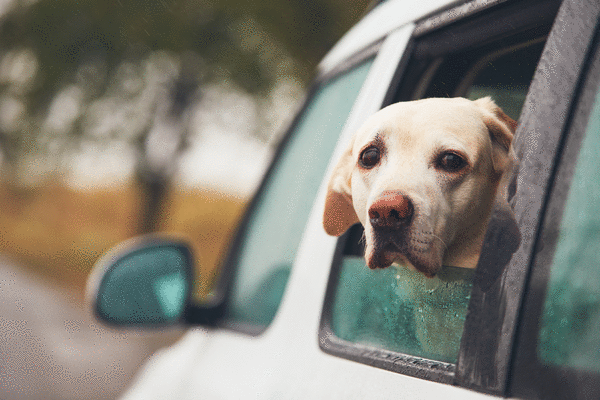
Every summer, it happens again: A dog is left behind in a parked car, panting desperately as temperatures climb, while someone insists they’ll “only be gone for a minute.” That minute can be the difference between life and death.
Leaving a dog in a hot car is not a harmless mistake—it is a predictable, preventable act of negligence that places an animal in grave danger.
On a mild 70-degree day, the temperature inside a parked car can soar to nearly 100 degrees in just 20 minutes. On a 90-degree day, it can reach 109 degrees in only 10 minutes—hot enough to cause brain damage or even kill a dog. Cracking the windows or parking in the shade makes no difference. Vehicles quickly become ovens, trapping heat and leaving animals with no escape.
Dogs are especially vulnerable to heatstroke because they can’t cool themselves by sweating. They rely primarily on panting, but in an enclosed, overheating car, panting becomes futile. As their body temperature rises, dogs can experience heavy drooling, vomiting, diarrhea, panic, lethargy, seizures, collapse and loss of consciousness. It doesn’t take long for their organs to start failing, and at a certain point, no amount of medical intervention will save them.
What makes these tragedies even more disturbing is that they’re entirely preventable. The belief that “it’s only been a few minutes” or that “the air conditioning was on” has cost dogs their lives. Dogs have accidentally turned off air conditioning, shifted vehicles out of park or been trapped when engines or cooling systems have failed without warning. No coffee run or “quick” stop is worth that risk.
From a legal standpoint, leaving a dog in a hot car is increasingly recognized for what it is: cruelty to animals. Many states now have laws that prohibit leaving animals in hot vehicles and protect good Samaritans who break into cars to save animals in distress. The law is finally catching up to common sense: Knowingly subjecting a dog to lethal heat is not an accident—it’s a violation of the basic duty of care.
Dogs are completely dependent on humans for their safety and well-being. Locking them in a car as temperatures rise reflects a troubling disregard for their capacity to suffer.
The danger doesn’t stop once a car door opens. Hot weather presents hazards at every turn. On a 90-degree day, asphalt can reach 135 degrees—hot enough to burn, blister and permanently damage dogs’ paws while reflecting heat back onto their bodies. In these conditions, heatstroke can develop quickly, even outside a vehicle.
Protecting dogs is pretty simple: In hot weather, dogs belong indoors in an air-conditioned space. If you’re running errands, leave them at home. Walk dogs early in the morning or late in the evening, provide water and watch vigilantly for signs of overheating. Flat-faced dogs, specifically, are at increased risk of heatstroke because they have difficulty regulating their body temperature. Their shortened airways and narrowed nostrils make panting—their primary cooling mechanism—highly inefficient. This restricted airflow, known as brachycephalic obstructive airway syndrome, prevents efficient heat dissipation, leading to rapid, life-threatening increases in core temperature during warm, humid weather.
If you see a dog trapped inside a hot car, don’t look away. Call the authorities, and have the vehicle’s owner paged at the nearest businesses. If help hasn’t arrived and the dog appears to be in distress, find a witness to back up your assessment and then safely remove the animal. Get the dog into air conditioning (or at least shade), cool them with tepid (not cold) water and give them water to drink while you wait for officials.
Dogs don’t die in hot cars because people don’t know better—they die because people choose convenience over compassion. No excuse, errand or other justification makes trapping an animal in a sweltering vehicle acceptable. Leaving a dog in a hot car isn’t just careless—it’s cruel. Until everyone starts to see it that way, dogs will continue to pay with their lives.
_____
Blair Patrick Schuyler is a writer for the PETA Foundation, 501 Front St., Norfolk, VA 23510; PETA.org.
_____
©2026 Tribune Content Agency, LLC.




















































Comments