Commentary: Our NATO allies are unwilling to play Donald Trump's game this time around
Published in Op Eds
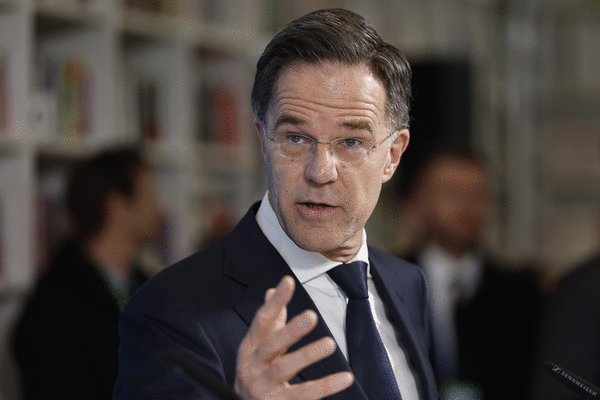
Mark Rutte may not be a household name in the Chicago area or the rest of America, but the man is perhaps the only thing standing in the way of a full-blown collision between President Donald Trump and the NATO alliance.
NATO’s secretary-general has emerged as Europe’s most capable Trump whisperer, someone who can fly to Washington at a moment’s notice to talk the mercurial president away from the ledge. Last July, Rutte made a trip to the White House to push for a NATO-financed scheme that would sustain weapons shipments to Kyiv for Ukraine’s war against Russia — following Trump’s infamous blowup with Ukrainian President Volodymyr Zelenskyy. Rutte pulled it off again in October, when it seemed like Trump would bypass Ukraine to negotiate an end to the war directly with Russian President Vladimir Putin.
What Rutte did back then appears relatively easy compared with the challenge he faces in Washington this week. The relationship between NATO and its most important member, the United States, is shaky. The nearly six-week-long war in Iran may be occurring thousands of miles away from NATO headquarters, but its impacts are reverberating throughout Europe in the form of ballooning fuel prices and the risk of energy shortages. Trump has been in an increasingly agitated state, lobbing barbs at the alliance for refusing to help clear the Strait of Hormuz, the Persian Gulf chokepoint where around 20% of the world’s oil flowed until Iran effectively shuttered it. It may be time, Trump recently said, to consider withdrawing from the organization.
Ordinarily, such words would set off panic throughout Europe. When Trump blasted NATO allies during the organization’s 2018 summit for penny-pinching on defense, European heads of state responded by pledging more defense spending. Last year, in the midst of Trump’s attacks on Zelenskyy and a growing perception in European capitals that Trump was ready to leave NATO behind, the alliance’s members mollified him by pledging to spend 5% of their gross domestic product on the military over the next decade.
This time, Trump’s pressure tactics are sparking resistance, not appeasement. He is huffing and puffing like he did before, but Europe isn’t responding in the way he’d like by sending their limited naval assets into the Strait of Hormuz. Instead, NATO is staying on the sidelines, and some members such as France, Spain and Italy are prohibiting U.S. military aircraft from using their bases for the war effort. As one can imagine, this is enraging some Republican talking heads. Ari Fleischer, George W. Bush’s former press secretary, accused NATO’s Western European heavyweights of compromising the unity of the alliance. Ditto U.S. Sen. Lindsey Graham: “The repercussions of providing little assistance to keep the Strait of Hormuz functioning are going to be wide and deep for Europe and America.”
The Europeans are shrugging off these comments, if not ignoring them entirely. None of them believe waging a war of choice against Iran is a particularly smart thing to do — and the reasons for that are clear. Nobody wants higher oil and gas prices. Their interests aren’t served when Iranian missiles and drones target Qatari natural gas facilities, Saudi refineries and Kuwaiti oil fields.
And with the war in Ukraine still very much churning along, the last thing European states want to do is deploy their warships, surveillance assets and combat aircraft to serve a war they weren’t consulted about. French President Emmanuel Macron spoke for many of his European colleagues when he implied that the U.S. is essentially asking for a bailout.
“I’m not here to comment on an operation that the Americans decided on with the Israelis, on their own,” Macron told journalists last week. “They can later complain that they aren’t being supported in this operation that they decided on alone.”
The average American may find all of this fairly abstract, but the Iran war actually provides a good lesson in what alliances are — and, just as importantly, what they’re not.
Alliances involve security relationships between two or more states against a common threat; ideally, the countries that enter into them all benefit. NATO is often referred to as a golden class because all of its members are entitled to the same protection: An attack on one is considered an attack on all. By pooling resources and committing to one another’s defense, deterrence is strengthened and a potential attacker likely will think twice before waging war.
Alliances, however, do not mean states have to engage in warfare just because an ally chooses to do so. For instance, if Poland were to attack Belarus, the U.S., France and Germany, among other NATO members, would not be required to enter into the conflict. States still have agency and the capacity to make decisions for themselves, and ultimately national interests override other considerations.
If a state concludes that entering a conflict is not in its own interest, then it has the sovereignty right to be a spectator.
Trump, of course, probably didn’t take an international relations course during his days at Penn’s Wharton School. If he did, he would understand that the United States having allies does not entitle it to automatic support of its decision-making. This is especially the case if the decision involves starting a war none of those allies wanted.
____
Daniel DePetris is a fellow at Defense Priorities and a foreign affairs columnist for the Chicago Tribune.
___
©2026 Chicago Tribune. Visit at chicagotribune.com. Distributed by Tribune Content Agency, LLC.




















































Comments