Editorial: During dark times on Earth, space provides a source of light
Published in Op Eds
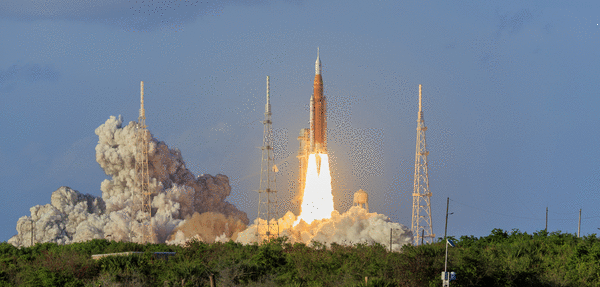
In ancient Greek mythology, Artemis was the twin sister of Apollo, both children of Zeus. She is joining her brother in the pantheon of American achievement and of scientific history.
This weekend, the Artemis II mission is en route to the Moon, carrying human beings on that journey for the first time in over half a century. During those years, the world has been profoundly shaped by massive technological advancements, particularly in communications technology and artificial intelligence. Yet space travel is a majestic, inspiring and courageous enterprise in a way no other technological improvement can match.
The physical frontier of space — the “final frontier,” to coin a phrase — remains the ultimate test of human ambition, ingenuity and endurance. It is a sign of great hope for the United States and for humanity that we are once again testing that frontier, with the realistic goal of establishing a permanent presence on the Moon within a decade.
Dark hour
This work offers such hope in part because it depends on cooperation and expertise, in stark contrast to the capricious and vicious state of American politics, and the Trump administration’s actions in this country and around the world. The beauty and grandeur of Artemis point to a better way of living and leading.
It’s hard to pick the worst example of the Trump administration’s malice in recent weeks, but its use and celebration of violence against civilian infrastructure in Iran, including energy and transportation, must be condemned. These are grotesque violations of international agreements, the basic norms of humaneness and the accepted law of war. The Iranian regime’s history and habits of depraved conduct do not justify doing that which America condemns when Iran does it.
Indeed, whatever moral authority and mutual trust the United States still enjoyed on the world stage have been extinguished. The negative consequences for peace and order among nations, for generations to come, will be momentous.
In a homily for Holy Thursday Mass this week, Pope Leo XIV referred to “this dark hour of history” in exhorting the faithful to work for peace in the world. It’s a particularly startling turn of phrase from the pontiff, who is not given to overstatement, and who holds an office with two millennia of history of its own.
But the phrase is apt. These weeks, as the United States and Israel wage a war of choice in Iran that is throwing global politics and the world economy into chaos, have been among the most discouraging and dangerous in decades.
Yet it is remarkable how the heights of human folly and of human genius can be on such display at the same time.
Epic ambition
The scale of the Artemis II mission is epic — and yet it’s just the very beginning of what should be a new age of human space exploration.
As of this writing, blessedly, the flight is going according to plan (with the exception of a malfunctioning toilet that, thankfully for the astronauts, has been fixed).
NASA is using Earth’s gravity as a sling shot to send the four astronauts on a trajectory toward the Moon, about 240,000 miles away. But the Moon, of course, is not just sitting there: It’s soaring through space at a speed of about 2,300 miles per hour, or about 1,000 meters per second, relative to the Earth.
The Orion spacecraft must approach the Moon at just the right time and angle, about 4,000 miles from its surface, to use the satellite’s gravity to swing it back toward home. The extent of the precision required is preposterous, not to mention the stakes of missing the mark. As anyone who watched “Apollo 13” will know, tiny errors can result in crashing into the lunar surface or, even more horrifyingly, hurtling off into space.
The plan and its successful execution are the product of generations of expertise and many years of work directed at a singular goal — not to mention international cooperation. It must be a model for solving problems closer to home.
Our blue dot
This past week, the four astronauts of Artemis — Reid Wiseman, Victor Glover and Christina Koch from NASA and Jeremy Hansen from the Canadian Space Agency — beamed home the first human-made images of a full “crescent Earth” in over 50 years.
For some, the image shows our planet’s smallness, for others, humanity’s cosmic meaninglessness. But in the picture of this blue dot of life, a symbol of our pushing back the final frontier, we should see humanity’s duties of stewardship to our home planet and of care for each other. The cooperation, discipline and ambition required to move beyond our atmosphere are the same habits we need to build better political communities on Earth.
If you are tempted to despair over the state of affairs here on Earth, in Washington or Tehran or elsewhere, take a moment to think about Artemis. While so many aspects of life on Earth as we knew it, including the entire post-Second World War global system, may be ending for good, Artemis represents a new beginning: the early stages of a new quest to expand the borders of humanity’s home beyond Earth’s atmosphere.
And when this dark hour comes to an end, as they always do, it will be the best of humanity represented by Artemis that builds and sustains a future — on this planet — that fulfills our potential.
_____
©2026 PG Publishing Co. Visit at post-gazette.com. Distributed by Tribune Content Agency, LLC.





















































Comments